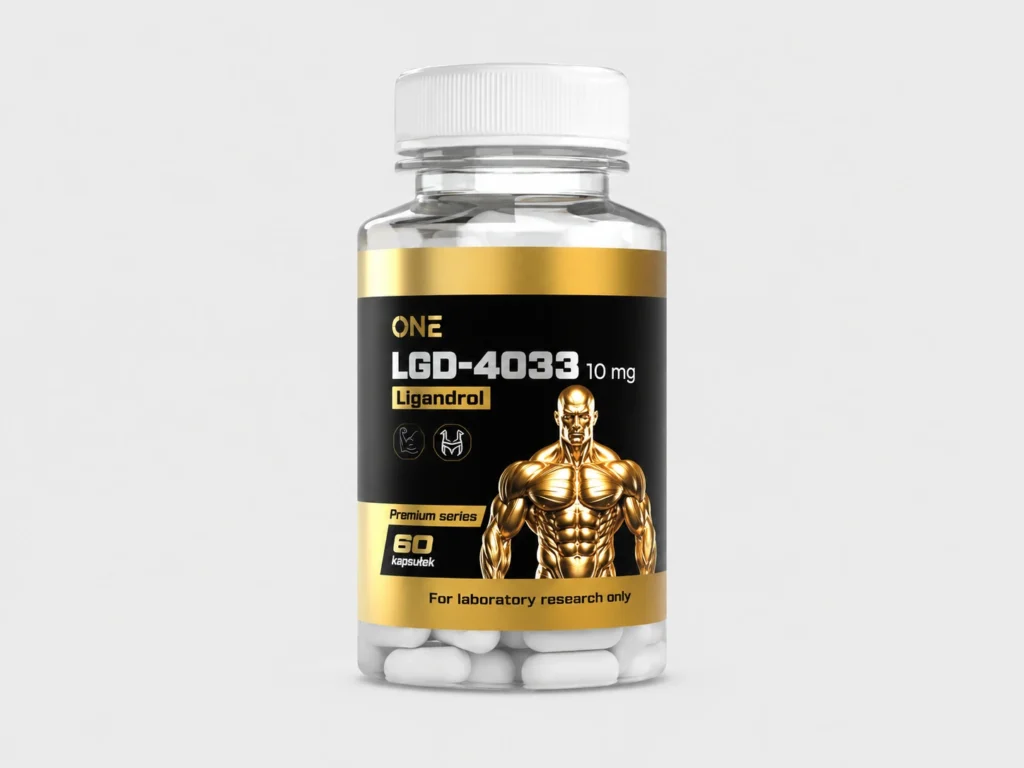
LGD-4033 (Ligandrol) — research reagent in capsules (Research Use Only)
LGD-4033 (Ligandrol) in this category is a chemical reagent intended exclusively for laboratory research — a non-steroidal selective androgen receptor modulator packaged in capsules. It is not a dietary supplement, a medicinal product or a foodstuff, and it is not intended for consumption.
Research Use Only. The products in this category are chemical substances for laboratory and scientific applications. They are not dietary supplements, medicinal products or foodstuffs. They are not intended for consumption or administration to humans or animals, and they do not serve to support training, physique, strength or physical form. The descriptions refer to pharmacology and results reported in the scientific literature — they do not constitute advice or instructions for use.
What is LGD-4033 (Ligandrol) — characterization of the compound
LGD-4033, also known as Ligandrol and by the development code VK5211, is a non-steroidal selective androgen receptor modulator (SARM). The compound was developed in the laboratories of Ligand Pharmaceuticals, and further clinical development was carried out by Viking Therapeutics.
In the literature, LGD-4033 is regarded as the best-characterized SARM after ostarine. It is distinguished by a circumstance rare in this class: it has data from phase I studies in healthy volunteers, covering the pharmacokinetic profile and tolerability. Most compounds in this family never went beyond rodent models and cell systems.
The mechanism is based on binding of the androgen receptor (AR) — the same protein that testosterone activates. Upon binding, LGD-4033 induces a different conformational change of the receptor, which in preclinical models leads to the recruitment of a different set of cofactors and a reported tissue selectivity toward muscle and bone tissue. The value describing this selectivity, i.e. the anabolic-to-androgenic ratio, is a parameter dependent on the model and the measurement method, not a physical constant of the compound. Critical reviews of the class point out that translating observations from models into predictable effects remains a subject of research.
LGD-4033 in capsules — a form, not a regulatory class
In this category you will find LGD-4033 packaged in capsules, together with the analytical documentation of the batch. A capsule is a way of portioning research material into repeatable units — a technical solution that facilitates record-keeping and analytical work, not a suggestion of intended use.
The regulatory class follows the substance, not the packaging. The same substance in a capsule and in a vial has the same Research Use Only framework. Only the packaging form changes.
The capsule form does not change the status of the reagent. LGD-4033 in capsules remains a chemical reagent exclusively for laboratory research (Research Use Only) and is not intended for consumption by humans or animals. Encapsulation does not turn a reagent into a dietary supplement or a consumer product.
What is studied in the context of LGD-4033
The directions below describe what is the subject of research — not effects promised to the buyer of the reagent.
- Muscle-loss models — sarcopenia and wasting conditions: endpoints concerning lean body mass and physical function.
- Bone tissue — mineral density and strength parameters in animal models.
- Tissue selectivity — characterization of androgen receptor binding and cofactor recruitment in in vitro systems.
- Pharmacokinetics and oral bioavailability — profiling the compound in early-phase studies.
LGD-4033 safety — what has been reported in studies
An honest picture of the reagent also includes the warning signals.
- Suppression of endogenous testosterone — in a phase I study, a reduction in total and free testosterone levels was reported in healthy volunteers, described as reversible within the observation horizon.
- Decrease in the HDL fraction — a change in the lipid profile described as an effect characteristic of the entire SARM class.
- Drug-induced liver injury (DILI) — a case report of liver injury associated with LGD-4033 has been published in the literature. We present this openly: a hepatotoxicity signal belongs to the profile of this compound.
- No phase III trials and no long-term data — the available human studies covered short observation periods, and the multi-year risk profile remains unknown.
LGD-4033 has not obtained registration as a medicinal product — neither with the EMA nor the FDA.
Reagent quality — HPLC purity and batch documentation
- HPLC purity ≥98% — confirmed by liquid chromatography.
- Identity confirmation — mass spectrometry (MS).
- COA per batch — a certificate of analysis for each batch, with a declaration of the substance content in the capsule.
- Batch traceability — linking the product to its analytical documentation.
- Storage — in the original packaging, in a dry and cool place, away from light and moisture.
Analytical documentation is not a decorative addition here. Independent chemical analyses of products sold online as “SARMs” have shown that a significant portion of them did not contain the declared substance or contained compounds other than those indicated on the label. Research material without a confirmed identity and purity is analytically worthless — a result obtained on an unknown substance describes nothing. That is why a COA per batch and traceability are a condition of the reagent’s credibility.
Regulatory status and WADA S1
LGD-4033 in this category has Research Use Only status. It is not a dietary supplement, a medicinal product or a foodstuff; it is not intended for use in humans or for any use outside a controlled research environment. The compound has no registration as a medicinal product with the EMA or the FDA.
Anti-doping status. The World Anti-Doping Agency places LGD-4033 in category S1 (anabolic agents) — the ban applies at all times, both in and out of competition. Sensitive methods have been developed to detect the compound and its metabolites using LC-MS/MS techniques. Persons subject to anti-doping control should verify the current WADA list.
Where to find more information about LGD-4033
Frequently asked questions
Is LGD-4033 a dietary supplement or a medicine?
No. It is a chemical reagent with Research Use Only status. It is neither a dietary supplement nor a medicinal product — it has not obtained registration with the EMA or the FDA and is not intended for consumption.
Does the capsule form mean a consumer product?
No. A capsule is merely a form of packaging the reagent. The regulatory class follows the substance, not the packaging — the same substance in a capsule and in a vial remains a research reagent.
What is known about LGD-4033 from human studies?
The compound has data from phase I studies in healthy volunteers, which is a rarity in the SARM class. They reported a pharmacokinetic profile and reversible suppression of endogenous testosterone. Phase III studies have not been conducted, and long-term data are lacking.
Is LGD-4033 detectable in anti-doping testing?
Yes. The compound is on the WADA prohibited list in category S1 (anabolic agents), with the ban applying at all times. Accredited laboratories have LC-MS/MS methods that detect the compound and its metabolites.
How should the reagent be stored in capsule form?
In the original packaging, in a dry and cool place, away from light and moisture. The capsule form does not require a cold chain.
 DE
DE  EN
EN  ES
ES