 DE
DE  EN
EN  ES
ES 

A research-focused comparison of Melanotan II and PT-141, covering melanocortin receptor selectivity, evidence, safety signals and regulatory status.
A patient with advanced lung cancer may lose a substantial amount of muscle mass over several months. Not because they are not eating — they eat as much as they can. They lose muscle because the tumor reprograms metabolism into a catabolic mode: it breaks down muscle protein faster than the body can rebuild it. This is cachexia — wasting that affects more than half of oncology patients and accounts for a significant share of cancer-related deaths. For decades there was no molecule that could halt that process without generating serious side effects. Ostarine — the first SARM to reach phase III research — became one of the most frequently analyzed compounds in this context.
⚠️ Chemical reagent intended exclusively for laboratory research (Research Use Only). Ostarine in the One-Peptides catalog is not a medicinal product, dietary supplement or food product. It is not intended for administration to humans or animals outside a controlled experimental environment. This article is educational and reviews the published scientific literature — all effects described are outcomes reported in studies (animal models, in vitro work or clinical trials where stated), not promises regarding human use.
In brief. Ostarine (MK-2866, enobosarm) is a selective androgen receptor modulator with the broadest human-study base among SARMs. In one phase 2 study, participants were randomised to placebo or ostarine for 12 weeks, while the longest published clinical study lasted 16 weeks; this defines the present boundary of long-term safety knowledge. Despite being the best documented compound in its class, ostarine has not been approved as a medicine and is included on the WADA Prohibited List (category S1). Research reagent (RUO).
Ostarine (clinical name: enobosarm; research codes: MK-2866, GTx-024) is a non-steroidal selective androgen receptor modulator (SARM) developed by the US company GTx Inc. (now Oncternal Therapeutics), headquartered in Memphis, Tennessee.
The project began in the late 1990s, when the team of Prof. James T. Dalton was looking for a compound with the anabolic properties of testosterone — but without its androgenic effects on the prostate, skin, and liver. After screening hundreds of candidates, GTx-024 (Ostarine) emerged as the molecule with the most favorable anabolic/androgenic ratio in preclinical models.
What distinguishes Ostarine from other SARMs is not so much its mechanism — shared across the class — as the quantity and quality of the clinical data. Ostarine is the only SARM that has reached phase III clinical trials in humans. No other SARM has accumulated a comparable evidence base.
More on the SARM class context is available in the overview article: What SARMs are: mechanism, generations, and the state of the research.
Ostarine acts on the androgen receptor (AR) — the same protein activated by testosterone. The difference lies in what happens after binding.
When testosterone binds AR, the receptor changes shape and recruits a set of coactivators (helper proteins) that “switch on” anabolic genes in muscle and bone — but also androgenic genes in the prostate, sebaceous glands, and hair follicles. Effect: muscle grows, but the prostate swells, skin oils up, and the hairline recedes.
Ostarine, after binding AR, triggers a different conformational change of the receptor. That different conformation recruits a different set of coactivators — those mainly present in skeletal muscle and bone tissue, and absent or inactive in the prostate and skin.
Analogy: imagine a lock with two modes of opening. Testosterone turns the key a full 360° — opening every compartment at once. Ostarine turns the same key 180° — opening only selected compartments. Same lock, same key, but different way of using it.
In preclinical models (rats) Ostarine showed an anabolic/androgenic ratio of about 10:1 — meaning its muscle activity was ten times stronger than its prostate activity. For comparison: testosterone has a 1:1 ratio.
Clinical studies assessed enobosarm in different populations and endpoints, and the longest published trial lasted 16 weeks.
The first human studies were conducted in healthy volunteers. This phase reported good tolerability of the compound, linear pharmacokinetics, oral bioavailability and a half-life on the order of one day.
A randomized, double-blind, placebo-controlled study published in the Journal of Cachexia, Sarcopenia and Muscle. A group of healthy older adults (men and postmenopausal women) was randomized to placebo and active Ostarine arms for 12 weeks.
Results:
This study delivered early controlled clinical data suggesting that Ostarine was associated with increased muscle mass without meaningful androgenic effects under trial conditions.
Two identical phase III studies — POWER 1 and POWER 2 — were conducted in patients with non-small-cell lung cancer (NSCLC) experiencing cancer cachexia. In total, more than 600 patients were randomized to active and placebo arms.
FDA granted Ostarine fast-track status — an expedited regulatory pathway — recognizing cancer cachexia as a serious unmet medical need.
POWER results:
A pivotal moment in SARM history: in a phase III trial, Ostarine was reported to increase muscle mass in cancer patients — but the regulator required more than mass gain alone. They wanted evidence that the mass gain translated into measurable functional improvement.
GTx/Oncternal continues to develop Ostarine in new indications, including AR-positive breast cancer.
Interested in research on selective androgen receptor modulators? Check Ostarine in the One-Peptides research reagent catalog — with an HPLC certificate for every batch.
An earlier phase II study in oncology patients with cachexia reported improvements in lean body mass and quality of life as measured by patient questionnaires. Those data formed the foundation for launching the POWER program.
Beyond muscle, Ostarine shows affinity for bone tissue — consistent with the SARM concept as a potential osteoporosis therapy.
Studies in ovariectomized rats (a postmenopausal osteoporosis model) showed that Ostarine:
Studies on Ostarine’s effects on bone tissue were conducted in animal models (ovariectomized rats). The findings have not been fully confirmed in dedicated human osteoporosis trials.
Short-term studies reported, among other findings, reversible hormonal and lipid changes, while the long-term risk profile remains unknown.
Phase II and III data allow a preliminary assessment of Ostarine’s safety profile in humans:
Important caveat: the longest Ostarine clinical trials ran for 16 weeks. No long-term safety data exist. The multi-year risk profile remains unknown.
Ostarine has a broader human-study base than other SARMs, but it remains a member of the same androgen-receptor-modulator class.
|
Feature |
Ostarine (MK-2866) |
LGD-4033 (Ligandrol) |
RAD-140 (Testolone) |
| Research phase | Phase III (POWER) | Phase II | Mostly preclinical / phase I |
| Main study population | Cachexia, sarcopenia | Sarcopenia, hip fracture | AR+ breast cancer |
| Anabolic/androgenic ratio | ~10:1 | ~10:1 | ~90:1 (rat model) |
| Testosterone suppression | Mild (reversible) | Moderate | Moderate to strong |
| Oral bioavailability | High | High | High |
| Status | Research reagent, WADA S1 | Research reagent, WADA S1 | Research reagent, WADA S1 |
For an overview of the class, see what are SARMs.
Ostarine is not the “strongest” SARM in terms of relative anabolic potency in comparative models. Its scientific value lies elsewhere: it has the best clinical database. For researchers this is the foundation — not potency but reproducibility and evidence quality define the value of a research compound.
Comparing reagents for androgen receptor research? At One-Peptides you will find Ostarine and other SARMs with full analytical documentation — HPLC certificate, transparent labeling.
Ostarine as a research reagent is available in the One Peptides Ostarine catalog — an MK-2866 research reagent with HPLC ≥98% certification, batch COA and full RUO documentation.
More articles from this cluster: all SARM articles.

A research-focused comparison of Melanotan II and PT-141, covering melanocortin receptor selectivity, evidence, safety signals and regulatory status.
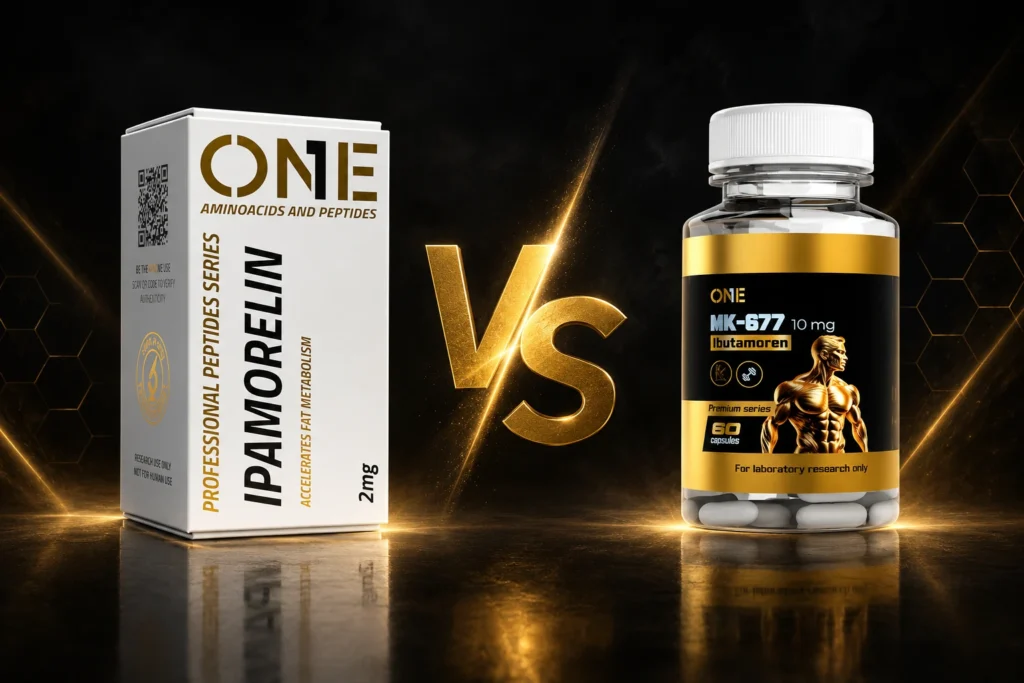
A research comparison of MK-677 and ipamorelin, focusing on GHS-R1a signaling, selectivity, administration route, human evidence and WADA status.
