DE
DE  EN
EN  ES
ES 
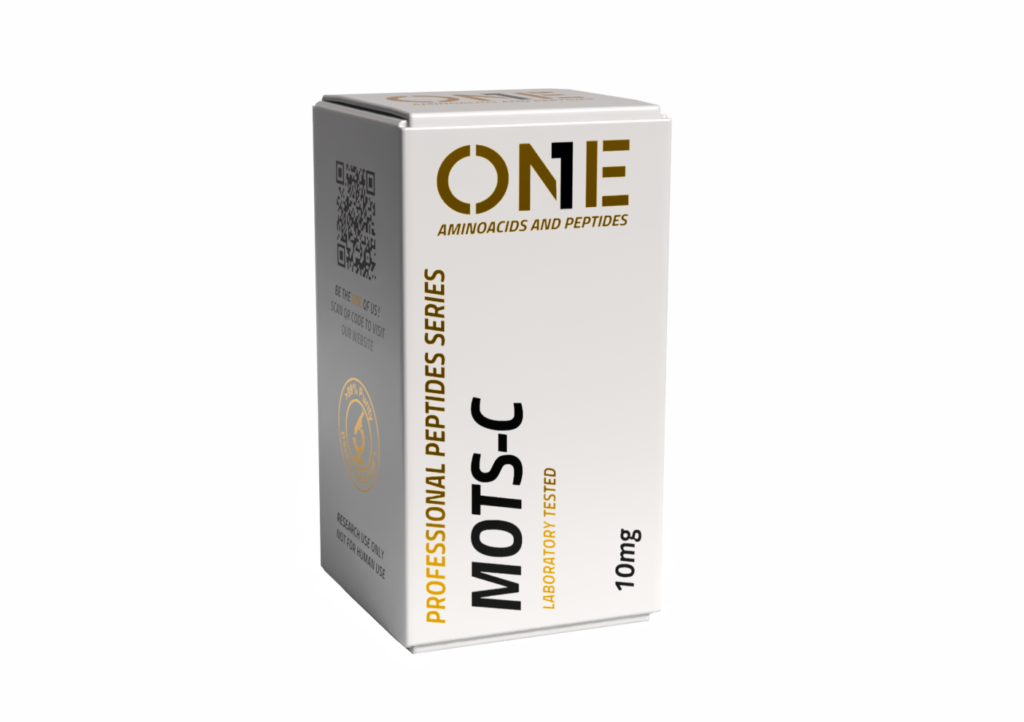
Category includes MOTS-c — mitochondrial-derived peptide (MDP) with a sequence of 16 amino acids, described in 2015 by Lee and colleagues (Cell Metabolism) as the first known representative of the MDPs class. Mechanistically, MOTS-c functions as AMPK activator + retrograde mitochondrial signal + exercise-mimetic in preclinical models. In the One Peptides catalog it is present as MOTS-c 10 mg in a lyophilized vial – Research Use Only standard reagent HPLC ≥98%, with mass spectrometry (MS) identity confirmation, full batch certificate of analysis and maintained 2-8°C cold chain. Browse available vials below and check the specifications in the COA before purchasing.
RUO status. MOTS-c is a chemical reagent for in vitro and ex vivo laboratory tests. It is not a medicinal product, dietary supplement or food. Not applicable to humans or companion animals. CohBar Inc., the company developing MOTS-c analogues, was in early stage clinical development (Phase I) – no regulatory authority has registered MOTS-c as a therapeutic product.
MOTS-c (Mitochondrial Open reading frame of the Twelve S rRNA-c) is mitochondrial peptide with a sequence of 16 amino acids: MRWQEMGYIFYPRKLR, encoded within the 12S rRNA gene of mitochondrial DNA. It was described in 2015 by the team of Changhan Lee and Pinchas Cohen in Cell Metabolism as the first known representative of the class mitochondrial-derived peptides (MDPs) — short peptides whose open reading frames are located in mitochondrial DNA, not in nuclear DNA.
The class of MDPs is a relatively new subject of research in molecular biology. In addition to MOTS-c, this class includes humanin (discovered earlier, in 2001, encoded in 16S rRNA) and the SHLP1–SHLP6 peptide series. A common feature of the class: these peptides are encoded in mitochondrial DNA and extend the mitochondrial gene model with a signaling function beyond the classical respiratory chain proteins.
Endogenous MOTS-c is present in peripheral blood, skeletal muscle, heart, and other mammalian tissues. Cross-sectional studies have reported that circulating MOTS-c concentrations decline with age — this observation is the basis for interest in the peptide in the context of aging research (context longevity research, NOT longevity supplement).
| Characteristic | MOTS-c |
|---|---|
| Relationship class | Mitochondrial-derived peptide (MDP) |
| Amino acid sequence | MRWQEMGYIFYPRKLR (16 aa) |
| Molecular mass | ~2174 Da |
| Gene location | Mitochondrial DNA, open reading frame inside 12S rRNA |
| Origin of the sequence | Mitochondrial (NOT nuclear) genome |
| Discovery | 2015 – Lee et al., Cell Metabolism |
| Mechanistic class | AMPK activator + retrograde mitochondrial signal + exercise-mimetic (in preclinical models) |
| Form in the catalogue | Lyophilized vial |
| Contents | 10 mg/vial |
| HPLC purity | ≥98% |
| Identity confirmation | Mass spectrometry (MS) |
| Documentation | COA per batch, batch traceability, cold chain 2–8°C |
| Regulatory status | Research Use Only – no registration as a drug or supplement |
In the preclinical literature, MOTS-c is described at three complementary mechanistic levels: AMPK activation, retrograde signaling to the cell nucleus, and partial replication of the effects of exercise in mouse models.
AMPK activation. AMP-activated protein kinase is a central sensor of the cell’s energy state – it is activated when the AMP/ATP ratio increases, signaling a “low energy state” and switching the cell from anabolic to catabolic processes. In in vitro and murine models, MOTS-c has been reported to activate AMPK in skeletal muscle and liver, modulating glucose uptake and fatty acid oxidation. The AMPK mechanism is common to the metformin-activated pathway – with an important localization difference described below.
Retrograde mitochondrial signaling. The classic model of information flow in the cell assumes the direction of nucleus → mitochondria – nuclear genes encode mitochondrial proteins, regulating their biogenesis. MOTS-c represents reverse flow (retrograde): a peptide encoded in mitochondrial DNA, synthesized in the mitochondrion, can leave the organelle, move to the cell nucleus and modify the expression of antioxidant response genes (modulation within the NRF2 pathway). This retrograde nuclear signaling distinguishes MOTS-c from metformin, whose action remains in the cytoplasmic compartment (AMPK activation without a nuclear signal from mitochondria).
Exercise-mimetic in mouse models. Studies in mice have reported that exogenous administration of MOTS-c improves exercise capacity, modifies muscle fiber composition, and replicates some of the metabolic adaptations observed after long-term endurance training. Hence the descriptive term “exercise-mimetic” — a compound that partially mimics the metabolic response to training in preclinical models. The term operates only at the level of rodent models — is not identical to the proven effect in humans.
Levels decline with age. Endogenous serum MOTS-c concentrations decrease with age in cross-sectional studies. The observation generates a hypothesis about the role of MOTS-c in the biology of metabolic aging—research hypothesis, unproven intervention in humans.
The association of MOTS-c with exercise physiology is one of the most frequently cited threads in the peptide literature. The observation of endogenous modulation must be separated from the interventional replication of the training effect.
Endogenous observation. Hyatt and colleagues (2022, including data from animal models and human cross-country studies) reported increase in MOTS-c expression in skeletal muscle after long-term physical activity. The observation suggests that exercise modulates the endogenous MDPs system – the peptide behaves as part of the skeletal muscle response to metabolic load.
Interpretive boundary. Observation of the increase in endogenous MOTS-c after training does not confirm a causal relationship between exogenous administration of the peptide on the improvement of human performance. These are two different research questions: (1) how the body modulates its own MOTS-c in response to training; (2) what happens after external administration of the peptide. The first question has observational data. The second question – regarding the clinical effect in humans – remains open.
Preclinical data in mice show partial replication of exercise adaptations following exogenous administration of the peptide. However, there are no completed controlled trials (RCTs) in humans that would test the interventional administration of MOTS-c on performance parameters or body composition. Any formulation such as “exercise pill” or “workout in a vial” is outside the current record and outside the regulatory framework in which the peptide operates (RUO reagent).
It is available in the catalog MOTS-c 10 mg in a lyophilized vial — peptide in dry form, ready to be dissolved in laboratory conditions in accordance with the research center’s protocol. The lyophilized form ensures maximum stability of the peptide during cold chain storage.
Quality standards of batches available in the category:
A batch that does not meet any of these five rules does not leave the warehouse. A full description of quality control procedures can be found in the section quality tests and certificates. Peptide calculator helps to calculate the concentration of the solution after dissolving the lyophilisate in the test buffer.
Categorical classification: RUO chemical reagent intended only for in vitro and ex vivo laboratory tests. No indications for use in humans. No health claims. No suggestions regarding physical performance, longevity, body composition or other health benefits on the buyer’s part.
No registration as a medicinal product. MOTS-c is not registered by the EMA, FDA, MHRA or other regulatory body. It is not approved for any clinical indication – it is not on the market as a treatment for metabolic disorders, sarcopenia, weight loss or any other indication.
No dietary supplement status. EFSA has not assessed MOTS-c as a food ingredient or dietary supplement. The class of mitochondrial-derived peptides functions in the literature as a class of endogenous signal peptides — not as a food ingredient. The formulation of MOTS-c as a dietary supplement in the European Union is inconsistent with Regulation 1924/2006 on nutrition and health claims.
Early stage of clinical development. CohBar Inc. — a biotech company founded by Pinchas Cohen (co-author of the discovery of MOTS-c in 2015) — conducted a program for the development of MOTS-c analogues as therapeutic candidates for metabolic diseases. The most advanced CohBar programs were located on Phase I clinical trials. Early stage development means no completed Phase II/III studies and no evidence of clinical effectiveness in humans.
Classification in the One Peptides catalog: Research Use Only (RUO). MOTS-c operates in international trade as peptide reagent for laboratory tests.
WADA status. MOTS-c is named on the WADA Prohibited List for 2026 — section S4.4.1 (metabolic modulators, AMPK activators); it is prohibited at all times, in and out of competition. A researcher working with MOTS-c and subject to doping control should verify the current WADA Prohibited List and national agency guidelines before use.
How is MOTS-c different from metformin?
Both compounds activate AMP-activated protein kinase (AMPK) – the central sensor of the cell’s energy state. The difference lies in signal localization and mechanism of formation. Metformin is a small organic molecule of synthetic origin that activates AMPK mainly by modulating the respiratory chain (complex I) in a manner limited to the cytoplasmic compartment. MOTS-c is a 16-amino-acid peptide encoded in mitochondrial DNA – endogenous in mammals, synthesized inside the mitochondrion and can leave the organelle in retrograde signaling. In preclinical models, it has been reported that MOTS-c can enter the cell nucleus and modify the expression of antioxidant response genes (NRF2 pathway) – this is a qualitative difference compared to metformin, which acts cytoplasmically.
Does MOTS-c act as an “exercise pill” in humans?
In mouse models, partial replication of the effects of endurance training following exogenous administration of MOTS-c has been reported. This preclinical data. The observation in humans that endogenous MOTS-c increases in skeletal muscle after long-term physical activity demonstrates endogenous modulation of the peptide by exercise—it is not evidence of an effect of exogenous administration on performance. The phrase “exercise pill” or “workout in a vial” is beyond current evidence – there are no completed randomized controlled trials (RCTs) in humans.
What are mitochondrial-derived peptides (MDPs)?
Mitochondrial-derived peptides are a class of short peptides whose open reading frames are located in the mitochondrial DNA rather than the nuclear genome. The first MDP I met was humanine (description 2001, encoded in 16S rRNA). MOTS-c (2015, encoded in 12S rRNA) is the second widely described member of the class. A series of peptides were later identified SHLP1–SHLP6 (Small Humanin-Like Peptides). MDPs participate in retrograde mitochondrial signaling – information communication from the mitochondrion to the cell nucleus.
Is MOTS-c registered as a medicine?
NO. MOTS-c has no registration as a medicinal product with the EMA, FDA or other regulatory authority. It is not on the market as a drug for any clinical indication. CohBar Inc. developed MOTS-c analogs on early clinical stage (Phase I). EFSA has not approved MOTS-c as a food ingredient or dietary supplement. In international trade, MOTS-c is available as RUO peptide reagent.
Is MOTS-c on the WADA list?
Yes. MOTS-c is named on the WADA Prohibited List for 2026 — section S4.4.1 (metabolic modulators, AMPK activators). It is prohibited at all times, in and out of competition. A doping-controlled researcher should verify the current WADA Prohibited List and national agency guidelines before use.
All items in this category are chemical reagents intended only for laboratory tests (Research Use Only). MOTS-c is not a medicinal product, dietary supplement or food. No EMA or FDA registration. No EFSA assessment. CohBar Inc. — a company developing MOTS-c analogues — conducted research at an early clinical stage (Phase I), without completed Phase II/III studies and without registration as a drug. No indications for use in humans or companion animals. No claims about longevity, physical performance, body composition or other health benefits to the buyer. MOTS-c does not appear in the catalog as a “longevity supplement” or “anti-aging supplement” – it is a peptide reagent for laboratory tests. WADA Status – A doping-controlled investigator verifies the current Prohibited List prior to use.
We offer a wide selection of peptides tailored to a range of laboratory analytical needs.
Every batch is tested for identity and purity (HPLC, MS) and comes with a certificate of analysis.
We invest in analytical testing and full batch documentation for every product.
Unsere zahlreichen positiven Bewertungen spiegeln die Zufriedenheit unserer Kunden wider, die immer wieder zurückkommen.
Melden Sie sich für den Newsletter an!
Erhalten Sie 10 % Rabatt auf Ihren ersten Kauf
One-Peptides.com
Informationen

© 2026 ONE-PEPTIDES.COM