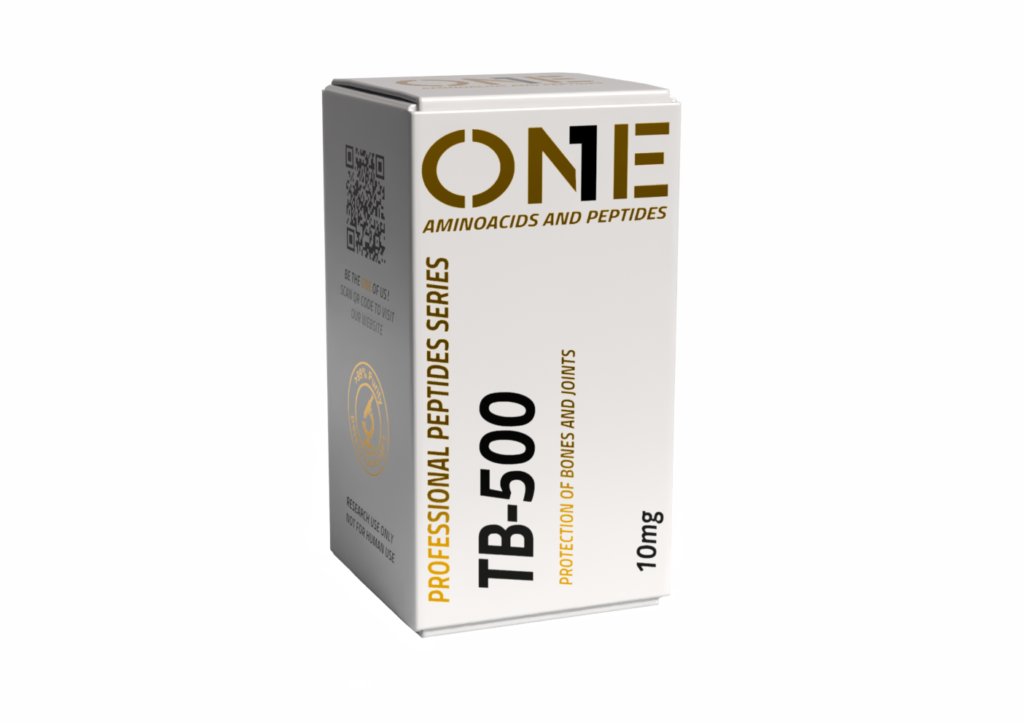
TB-500 – a peptide supporting research on cell migration and angiogenesis
TB-500 is a synthetic fragment of thymosin beta-4, consisting of 43 amino acids. It is one of the most intensively studied peptides in the context of cell migration, actin binding and the creation of new blood vessels in tissue models. Studies in vitro and in animal models indicate its involvement in cytoskeleton reorganization processes, which makes it a valuable tool in cell biology. TB-500 is not a medicinal product – it is intended for research use only. Browse the available TB-500 variants in the One Peptides offer and choose the form suitable for your research project.
What is TB-500?
TB-500 is a synthetic equivalent of the active fragment of thymosin beta-4 (Tβ4), a protein found naturally in many types of mammalian cells. Thymosin beta-4 was first isolated from calf thymus in the 1960s, and its structure and functions have been the subject of research for over five decades.
The main mechanism of action of TB-500 is based on the binding of G-actin monomers, which affects the dynamics of actin polymerization and the reorganization of the cytoskeleton. In cellular models, this peptide has been observed to promote cell migration, differentiation and the formation of new vascular structures (angiogenesis). Studies on animal models have also shown its presence in areas of active tissue remodeling.
TB-500 differs from the full thymosin beta-4 molecule in the length of its amino acid chain – it is its functional fragment, retaining the key actin-binding region (LKKTET sequence). It is this region that is responsible for most of the observed biological effects under experimental conditions.
TB-500 variants available
| Variant |
Form |
Research use |
| TB-500 5 mg |
Lyophilisate |
Pilot studies, in vitro experiments |
| TB-500 10 mg |
Lyophilisate |
Extended research protocols, animal models |
Each variant comes with a Certificate of Analysis (CoA) confirming the purity and identity of the compound. Detailed specifications, including HPLC and MS results, are available on individual product pages.
Which TB-500 variant should you choose?
The choice of the TB-500 variant depends primarily on the scale of the planned research. The 5 mg variant is suitable for preliminary in vitro experiments – e.g. cell migration tests in Boyden chambers or actin binding tests – it allows for carrying out series of measurements at different concentrations.
The 10 mg variant is intended for studies on animal models or longer experimental protocols that require a larger amount of substance. It also works well in laboratories conducting parallel projects requiring the same peptide.
Regardless of the selected variant, each product has identical purity confirmed by the CoA certificate.
How does TB-500 differ from similar compounds?
TB-500 vs BPC-157
Both peptides are intensively studied in the context of regenerative processes in tissue models, but they act through different mechanisms. TB-500 affects primarily the reorganization of the actin cytoskeleton and cell migration, while BPC-157 (Body Protection Compound) mainly affects the signaling pathways related to nitric oxide (NO) and growth factors. In studies on animal models, it was observed that BPC-157 modulates the expression of growth factor receptors, while TB-500 promotes angiogenesis through actin-dependent mechanisms. Both peptides can be found in the One Peptides offer – check the category BPC-157.
TB-500 vs GHK-Cu
GHK-Cu is a tripeptide conjugated with a copper ion, studied mainly in the context of extracellular matrix remodeling and regulation of gene expression. Unlike TB-500, which acts intracellularly at the level of the cytoskeleton, GHK-Cu acts at the level of the extracellular matrix and modulates the activity of metalloproteinases. These two compounds therefore represent different levels of biological organization. You can find more about GHK-Cu in the category GHK-Cu.
FAQ – Frequently asked questions
1. What exactly is TB-500 and what is its relationship to thymosin beta-4?
TB-500 is a synthetic fragment of thymosin beta-4, spanning 43 amino acids and containing the LKKTET region responsible for actin binding. It is not a full Tβ4 molecule, but its functional analogue used in laboratory tests.
2. What are the main areas of research using TB-500?
TB-500 is used in research on cell migration, angiogenesis, actin cytoskeleton dynamics and cell differentiation processes. Research is conducted both in vitro on cell lines and in vivo on animal models.
3. Is TB-500 a medicinal product?
NO. TB-500 offered by One Peptides is a compound intended solely for research purposes (Research Use Only). It is not a medicinal product, dietary supplement or agent for use on humans.
4. In what form is the TB-500 delivered?
TB-500 is supplied in the form of a freeze-dried powder, which ensures the stability of the compound during storage and transport. Requires reconstitution in an appropriate solvent before use in an experiment.
5. How to store TB-500?
Freeze-dried TB-500 should be stored at -20°C, away from light and moisture. After reconstitution, the solution should be stored at 2-8°C and used within a few days, in accordance with the guidelines included in the product data sheet.
Quality and standards at One Peptides
Each batch of TB-500 at One Peptides undergoes HPLC analysis (purity) and mass spectrometry (MS, molecular weight confirmation). Each order is accompanied by a certificate of analysis (CoA) and a safety data sheet (SDS). Our quality control procedures ensure the repeatability of parameters between batches, which is important for the reproducibility of test results.
 DE
DE  EN
EN  ES
ES