DE
DE  EN
EN  ES
ES 
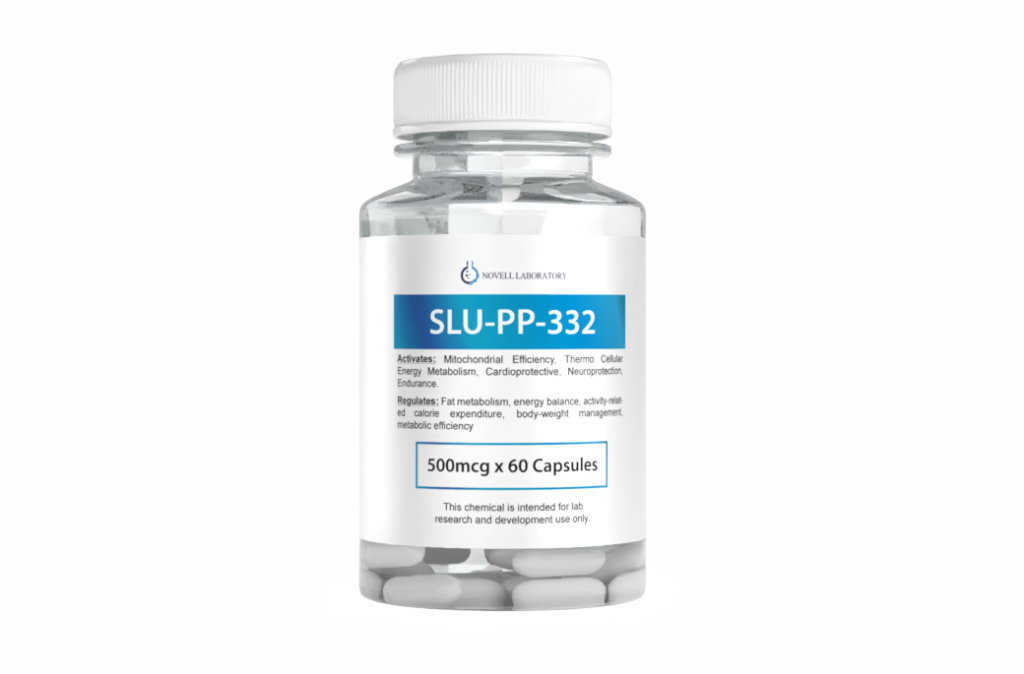
Category includes SLU-PP-332 — a small organic molecule (~395 Da), a pan-agonist of ERRα/β/γ receptors, developed in the Burris laboratory at Saint Louis University. It functions as a model in the literature “exercise mimetic” — in the publication by Billon et al. (2024), administration of SLU-PP-332 to mice was associated with an approximately 70% increase in running endurance and reduction of adipose tissue. Data are limited to mouse models — headlines like “exercise in a nutshell” are not supported by human clinical trials. In the One Peptides catalog SLU-PP-332 is available as Research Use Only reagent (500 mcg × 60 capsules), with HPLC documentation ≥98%, MS confirmation, full COA and cold chain transportation. The class “exercise mimetics” also includes historically GW501516 (cardarine) — which also describes guide to metabolic pharmacology.
RUO. SLU-PP-332 is chemical reagent intended only for laboratory tests (Research Use Only). It is not a medicinal product, dietary supplement or food. No indications for use in humans.
SLU-PP-332 (Saint Louis University Pharmaceutical Probe 332) is a small organic molecule of ~395 Da, a synthetic compound developed as a pharmacological tool for studying nuclear ERRs. It is not a peptide or steroid — belongs to the class of small-molecule nuclear receptor agonists, developed using medicinal chemistry methods.
The molecule was created in the laboratory Professor Thomas Burris (Saint Louis University, USA, now University of Florida) as a chemical probe for mapping the functions of ERR isoforms in vivo. Hence the name – “Saint Louis University Pharmaceutical Probe”, serial number 332.
| Characteristic | Value |
|---|---|
| Full name | Saint Louis University Pharmaceutical Probe 332 |
| Class | Small organic molecule |
| Mechanism | ERR pan-agonist (ERRα + ERRβ + ERRγ) |
| Molecular mass | ~395 Da |
| Relationship type | Synthetic nuclear receptor ligand |
| Origin | Burris Laboratory, Saint Louis University |
| Pharmaceutical status | No registration as a medicine; no EFSA approval |
| WADA status | Monitoring of the exercise mimetics class |
| Classification in circulation | Research Use Only reagent |
ERR (Estrogen-Related Receptors) is a family of three nuclear receptors – ERRα, ERRβ, ERRγ — discovered in 1988 based on sequence homology with the estrogen receptor. They act as transcription factors that regulate the expression of genes responsible for mitochondrial biogenesis, oxidative phosphorylation, fatty acid oxidation and energy metabolism in tissues with high energy demand (skeletal muscles, heart muscle, brown adipose tissue, kidneys).
The name “estrogen-related” is misleading — despite structural homology with the estrogen receptor, ERRs do not bind estrogen as a physiological ligand. They function as constitutively active receptors, modulated mainly by transcriptional coactivators (including PGC-1α, PGC-1β) and by synthetic ligands, such as SLU-PP-332.
In the context of physical exercise, ERRs (especially ERRγ in skeletal muscles) are one of the main “switches” of the endurance adaptation program – their activity increases in response to aerobic training.
SLU-PP-332 binds to the ligand domain of all three ERR isoforms simultaneously (pan-agonist) and activates the transcription program characteristic of muscles subjected to endurance training:
Precautionary framework:
The work was published in 2024 Billon et al. describing the effects of SLU-PP-332 in a mouse model. Main observations:
The publication caused a wave of headlines in the popular media – from “exercise in a pill” to “a training pill” to “a drug that will replace the gym.” Contrary to the hype, the data is there limited to mouse models only. There is a lack of human pharmacokinetic studies, phase I safety studies, phase II/III efficacy studies, and long-term data.
The extrapolation “70% increase in endurance in mice → 70% increase in performance in humans” is methodologically unfounded. Throughout the history of medicine, many molecules that showed promise in mouse models failed to make it to clinical trials. A classic historical example – Cardarine (GW501516, PPARδ agonist) — remained in the preclinical stage following oncological signals in long-term rodent studies.
In the One Peptides catalog SLU-PP-332 is available as chemical reagent for research applications:
Standards: HPLC ≥98%, MS confirmation, COA per batch, cold chain 2–8°C, batch traceability. Full description of the quality control procedure in section quality tests and certificates.
There are no indications for use in humans. The molecule is sold only as a reagent for laboratory tests. The product card does not contain application protocols, suggested amounts of active substances or claims about the effect on the human body – sales under the RUO exclude such information.
Pharmaceutical status. SLU-PP-332 is not a registered medicine in any country – neither in the USA (FDA), nor in the EU (EMA), nor in Poland (URPL). The molecule is located on stage of preclinical research (laboratory animals) and has not entered any phase of clinical trials in humans.
Dietary supplement status. European Food Safety Authority (EFSA) did not approve SLU-PP-332 as a food ingredient or dietary supplement. The molecule does not have Generally Recognized As Safe (GRAS) status in the USA. Sale as a dietary supplement in the EU is not permitted. The full context of the legal status of the reagents is described article about EU law.
Trading status. SLU-PP-332 is marketed only as chemical reagent Research Use Only.
WADA – exercise mimetics class monitoring. The World Anti-Doping Agency (WADA) is monitoring the developing class exercise mimetics/metabolic modulators — nuclear receptor agonists that can reproduce the training phenotype without physical exercise. The class historically includes, among others: PPARδ agonists (e.g. GW501516), indirect AMPK activators and currently SLU-PP-332. After publication in 2024, it is possible that SLU-PP-332 will be added to the list of prohibited substances within class S4 (hormonal and metabolic modulators) or as a separate item. Athletes subject to anti-doping control should verify the current version of the WADA list and consult a sports doctor before any contact with the molecule.
The term “exercise mimetic” means a pharmacological compound that activates at the molecular level adaptive programs characteristic of physical exercise – mainly mitochondrial biogenesis, oxidative phosphorylation and fatty acid oxidation. The molecule “mimics” the training signal in the cell, without replacing movement itself, the cardiovascular system or the mechanical load on tissues. SLU-PP-332 belongs to this class alongside historical items such as GW501516 (PPARδ) and AICAR (AMPK).
NO. All published data apply mouse models — mainly work by Billon et al. 2024. No clinical trials in humans, no pharmacokinetic data, no Phase I safety data. Media headlines such as “exercise in a nutshell” are an overinterpretation of preclinical results. Regardless of possible future data, exercise training affects the cardiovascular, skeletal, muscular and neurological systems in ways that a single molecule cannot reproduce.
NO. SLU-PP-332 it is not registered as a medicine in the USA (FDA), the EU (EMA) or in Poland (URPL). It is not approved as a dietary supplement by EFSA. It only functions as chemical reagent Research Use Only, intended for laboratory tests. It should not be used on humans.
“SLU-PP-332” develops as Saint Louis University Pharmaceutical Probe 332. The first element comes from the university – Saint Louis University in Missouri (USA), where the molecule was developed in the laboratory of Professor Thomas Burris. The second part — Pharmaceutical Probe — denotes the class of the research tool (chemical probe for mapping receptor functions in laboratory conditions). The number 332 is the ordinal identifier in the series of compounds tested in this laboratory.
At the time of editing this description SLU-PP-332 it is not mentioned directly in the current list of prohibited substances of the World Anti-Doping Agency. However, WADA monitors the developing class exercise mimetics/metabolic modulators — after publication in 2024, it is possible to introduce SLU-PP-332 to the prohibited list as part of class S4 (hormonal and metabolic modulators) or as a separate item. Athletes subject to doping control should verify the current version of the WADA list before any contact with the molecule.
All items in this category are chemical reagents intended only for laboratory tests (Research Use Only). They are not medicinal products, dietary supplements or foodstuffs. SLU-PP-332 is not FDA, EMA, EFSA or URPL approved. Published data only concern murine models (Billon et al. 2024) – no clinical trials in humans, no pharmacokinetic and phase I safety data. We make no promises regarding the molecule’s impact on performance, body composition or human health. Athletes subject to anti-doping control should verify the current version of the WADA list – the exercise mimetics class is subject to monitoring.
We offer a wide selection of peptides tailored to a range of laboratory analytical needs.
Every batch is tested for identity and purity (HPLC, MS) and comes with a certificate of analysis.
We invest in analytical testing and full batch documentation for every product.
Unsere zahlreichen positiven Bewertungen spiegeln die Zufriedenheit unserer Kunden wider, die immer wieder zurückkommen.
Melden Sie sich für den Newsletter an!
Erhalten Sie 10 % Rabatt auf Ihren ersten Kauf
One-Peptides.com
Informationen

© 2026 ONE-PEPTIDES.COM