DE
DE  EN
EN  ES
ES 
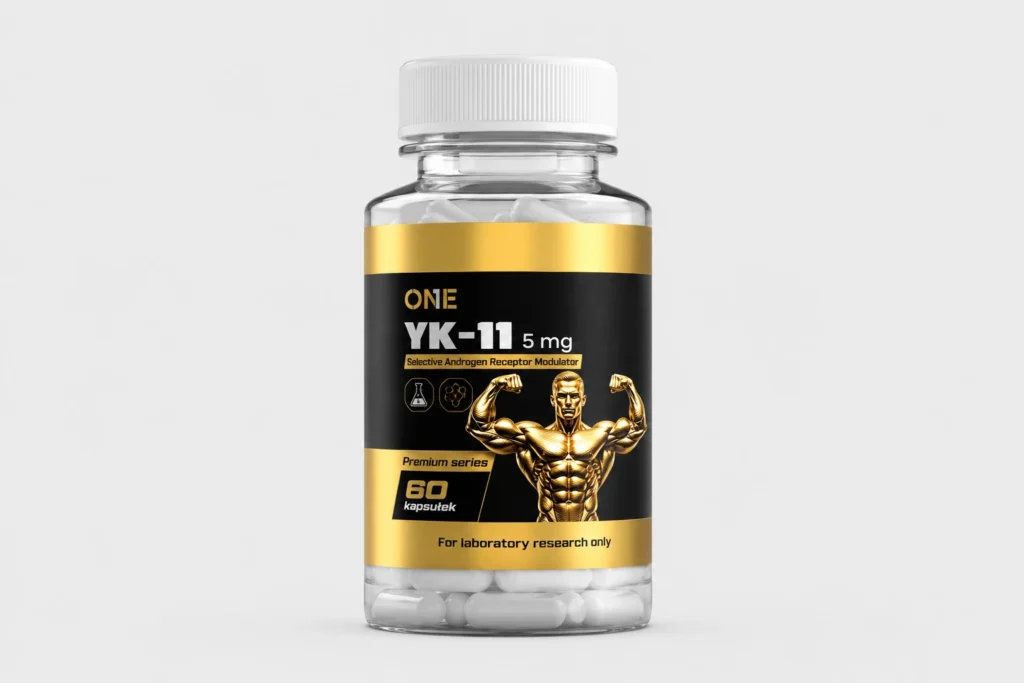
YK-11 is a chemical reagent intended exclusively for laboratory research (Research Use Only), offered in capsule form. It is not a dietary supplement, a medicinal product or a foodstuff, and it is not intended for consumption. The entire evidence base comes from cell cultures — no studies in humans or in animal models have been published.
Research Use Only. The products in this category are chemical substances for laboratory and scientific applications. They are not dietary supplements, medicinal products or foodstuffs. They are not intended for consumption or administration to humans or animals, and they do not serve to support training, physique or physical form. The descriptions refer to results reported in the scientific literature — they do not constitute advice or instructions for use.
YK-11 is a synthetically obtained compound whose chemical skeleton derives from 19-norpregnadiene. In terms of structure it therefore belongs to the family of steroids — unlike the other compounds usually grouped alongside it. LGD-4033, RAD-140 and Andarine are non-steroidal, built around different chemical cores. YK-11 remains here a structural exception and is therefore sometimes referred to in the literature as a “steroidal SARM”.
In the literature it is characterized as a partial agonist of the androgen receptor. Partial agonism means that the molecule binds to the receptor but activates it more weakly and differently than a full agonist: the receptor adopts a different conformation and recruits a different set of cofactors, giving a different profile of transcriptional response. We state the steroidal scaffold openly as a chemical fact — the structure of the molecule determines how cautiously the data should be interpreted.
A capsule is a way of packaging research material. Portioning into repeatable units facilitates batch record-keeping and analytical work, but it does not change the status of the reagent. The regulatory class follows the substance, not the packaging — the same substance in a capsule and in a vial falls within the same Research Use Only framework.
The capsule form does not change the status of the reagent. Encapsulation is a technical solution, not a suggestion of intended use. YK-11 remains a chemical substance exclusively for laboratory research (Research Use Only) and is not intended for consumption by humans or animals.
The directions below describe what is the subject of research — not effects promised to the buyer. All of them concern in vitro systems.
Myostatin is a protein that inhibits the growth of muscle tissue — a physiological limiter of its increase. Follistatin binds myostatin and antagonizes it, lifting part of this inhibition. This is biology described in the literature and the starting point for the market narrative around YK-11.
In C2C12 myoblasts, an increase in follistatin expression was reported after exposure to YK-11. This is where the term “anti-myostatin pathway”, repeated in commercial descriptions, comes from. It is, however, an observation from a culture dish, on an isolated cell line — not an effect demonstrated in any living organism. No study has been published showing an analogous change in an animal or a human. Here the market narrative runs ahead of the evidence.
For YK-11, no clinical trials of any phase have been published — neither I, nor II, nor III. Nor are there animal-model studies describing the compound’s action in an organism. Pharmacokinetic data in humans are lacking: absorption, distribution, metabolism and excretion. No safety profile has been described. The very absence of safety data is a signal for caution, not a neutral gap in the literature — unknown risk does not mean zero risk.
Why do culture results not transfer automatically to an organism? A culture dish is a maximally simplified system: a single cell line in a medium, exposed to a known concentration of the substance. It does not reproduce absorption, hepatic metabolism, tissue distribution, excretion or the feedback loops of the hormonal axes. A compound that changes the expression of a protein in a dish may, in an organism, undergo metabolic transformation, fail to reach the target tissue, or trigger a systemic response absent in the culture. The steroidal scaffold introduces additional uncertainty here — analogies to non-steroidal compounds from the same shelf are even less justified than usual.
Analytical documentation carries greater weight here than usual. Independent analyses of products sold online as “SARMs” have shown that a significant portion of them did not contain the declared substance or contained a different compound. With a substance so poorly characterized, identity errors cannot be caught other than analytically — the batch certificate and the mass spectrum remain the only reliable confirmation of the package’s contents.
YK-11 has the status of a Research Use Only chemical reagent. It is not a dietary supplement, a medicinal product or a foodstuff; it is not intended for use in humans or outside a controlled research environment. The compound has not obtained registration as a medicinal product — neither with the EMA nor the FDA.
Anti-doping status — YK-11 is on the World Anti-Doping Agency’s List of Prohibited Substances and Methods in category S1 (anabolic agents). The ban applies at all times: in competition and out of competition. Methods have been developed to detect YK-11 and its metabolites using liquid chromatography coupled with mass spectrometry (LC-MS/MS). Athletes subject to control should verify the current WADA guidelines.
Is YK-11 a SARM or a steroidal compound?
Structurally it is a steroidal compound — a derivative of 19-norpregnadiene. Mechanistically it is a partial agonist of the androgen receptor, acting through the same receptor as SARMs. Hence the literature term “steroidal SARM”.
Have studies of YK-11 been carried out in humans?
No. No clinical trials of any phase or animal-model studies have been published. All available knowledge comes from cell cultures; pharmacokinetic data and a safety profile in humans are not known.
What is the “myostatin pathway” of YK-11 and what does it prove?
Myostatin inhibits the growth of muscle tissue, and follistatin antagonizes it. In C2C12 myoblasts, increased follistatin expression was reported after exposure to YK-11. This proves only what was observed in the culture — it does not constitute a demonstration of an effect in an organism.
Does the capsule form mean that YK-11 is a supplement?
No. A capsule is merely a form of packaging. The regulatory class follows the substance, not the packaging — YK-11 in a capsule remains a research reagent and is not intended for consumption.
Is YK-11 detectable in anti-doping testing?
Yes. It is on the WADA list in category S1, and its detection together with its metabolites has been described using LC-MS/MS methods.
We offer a wide selection of peptides tailored to a range of laboratory analytical needs.
Every batch is tested for identity and purity (HPLC, MS) and comes with a certificate of analysis.
We invest in analytical testing and full batch documentation for every product.
Unsere zahlreichen positiven Bewertungen spiegeln die Zufriedenheit unserer Kunden wider, die immer wieder zurückkommen.
Melden Sie sich für den Newsletter an!
Erhalten Sie 10 % Rabatt auf Ihren ersten Kauf
One-Peptides.com
Informationen

© 2026 ONE-PEPTIDES.COM