 DE
DE  EN
EN  ES
ES 

A research-focused comparison of Melanotan II and PT-141, covering melanocortin receptor selectivity, evidence, safety signals and regulatory status.
Chemical reagent intended exclusively for laboratory research (Research Use Only). It is not a medicinal product, a dietary supplement, or a foodstuff. It is not intended for administration to humans or animals outside a controlled experimental environment.
Educational note. This comparison contrasts two research reagents solely in terms of the level and nature of the scientific evidence. It contains no doses or usage guidance and is not an encouragement to ingest. We describe both compounds as materials for laboratory work.
The “YK-11 vs ostarine” comparison is one of the more common questions when reviewing androgen receptor modulators. The answer, however, is less about physique and more methodological: these two compounds represent opposite ends of the evidence spectrum within the same family. Ostarine (MK-2866) is the best-studied AR modulator, with phase III clinical trials in humans. YK-11 remains a compound whose body of research ends at cell cultures. Below we compare them scientifically — without the language of doses and without promises regarding physique.
| Criterion | YK-11 | Ostarine (MK-2866) |
|---|---|---|
| Level of evidence | In vitro only (cell cultures) | Clinical trials, up to phase III |
| Organism / model | Cell lines (C2C12, MC3T3-E1, MDA-MB-453) | Humans / patients in clinical trials |
| Subject of research | Molecular AR mechanism, follistatin expression | Clinical assessment in study participants |
| Mechanism | Partial AR agonism + follistatin/myostatin pathway (in vitro) | Classical selective androgen receptor modulation |
| Structure | Steroidal (19-norpregnadiene derivative) | Non-steroidal |
| Reported safety signals | No human data whatsoever | Signals described in human studies |
| WADA status | Prohibited, S1 (anabolic agents) | Prohibited, S1 (anabolic agents) |
| Form | Research reagent (RUO) | Research reagent (RUO) |
The main difference does not concern the “potency” of the compound, but how much is known about it. Ostarine has gone through a pathway of human studies that includes phase III — clinical data collected from participants exist. YK-11 does not have a single study in humans or in animal models behind it; its entire body of work consists of cellular studies (Kanno et al., 2013; Yatsu et al., 2018; Kanno et al., 2022). A critical review of the entire class (Bond et al., 2025) places YK-11 among the most poorly characterized compounds. In practice, this means that ostarine can be discussed in terms of observations from an organism, whereas YK-11 only in terms of phenomena observed in a culture dish.
This difference has consequences for the very way the available information is read. With ostarine, references in the literature lead to studies in which the compound was administered to participants and effects were measured at the level of the whole organism. With YK-11, every primary source ends at the cell-culture stage — that is, at an observation isolated from metabolism, circulation, and hormonal regulation. Comparing these two compounds is therefore less a comparison of “which is stronger” and more an illustration of how varied the levels of scientific certainty can be within a single family of reagents.
Ostarine is a non-steroidal compound. YK-11, by contrast, has a steroidal scaffold, being a 19-norpregnadiene derivative, and in the literature it is sometimes called outright a “synthetic steroid” (Kanno et al., 2022). This chemical difference translates into the way it interacts with the receptor: YK-11 has been described as a partial AR agonist (Kanno et al., 2011), which means a different pattern of receptor activation than in the case of classical, non-steroidal modulators. Structural classification alone, however, says nothing about the action in an organism — for YK-11 such data simply do not exist.
The market narrative most often points to the “anti-myostatin pathway” as a distinguishing feature of YK-11. The basis is a study in C2C12 myoblasts in which YK-11 increased the expression of follistatin — a protein that antagonizes myostatin (Kanno et al., 2013). This is a cellular observation and can only be treated as such, because it has not been confirmed in any organism. The mechanism of ostarine, on the other hand, has been described as classical selective androgen receptor modulation, studied also at the clinical level. In other words: for YK-11 we have an interesting molecular hypothesis from cell culture, and for ostarine — observations from human studies.
Here the difference is sharpest. For YK-11 there are no human safety data whatsoever — no adverse effects, pharmacokinetics, or toxicity threshold have been described, because there were no human studies. This absence is in itself a signal of caution for those conducting research. For the SARM class as a whole, adverse events have been described, including those concerning the liver and hormonal balance (Leciejewska et al., 2024), but these are observations relating to the group, not to YK-11 itself. Ostarine, as a clinically studied compound, has safety signals described in the literature that come from human studies — which paradoxically makes it better characterized in terms of risk as well.
In regulatory terms, both compounds are treated the same. Both YK-11 and ostarine are offered exclusively as laboratory research reagents (RUO), without registration as medicinal products. Both are on the WADA list in category S1 (anabolic agents) and both are detectable in anti-doping testing. The difference between them therefore lies not in legal status, but in how deeply each of them has been scientifically characterized.
YK-11 or ostarine — which is better studied?
Ostarine. It has clinical trials up to phase III in humans, whereas YK-11 has been described only in cell cultures.
How does the mechanism of YK-11 differ from ostarine?
YK-11 is a partial AR agonist with a steroidal structure, with a follistatin/myostatin pathway described in vitro (Kanno et al., 2013). Ostarine is a non-steroidal modulator with a classical receptor-action profile.
Are both prohibited in sport?
Yes. Both YK-11 and ostarine belong to WADA category S1 and are detectable in anti-doping testing.
Where can I find more about each of these compounds?
The YK-11 profile is described in the article on YK-11 research, and ostarine in the guide to ostarine (MK-2866). Reagent cards: YK-11, ostarine and cardarine.

A research-focused comparison of Melanotan II and PT-141, covering melanocortin receptor selectivity, evidence, safety signals and regulatory status.
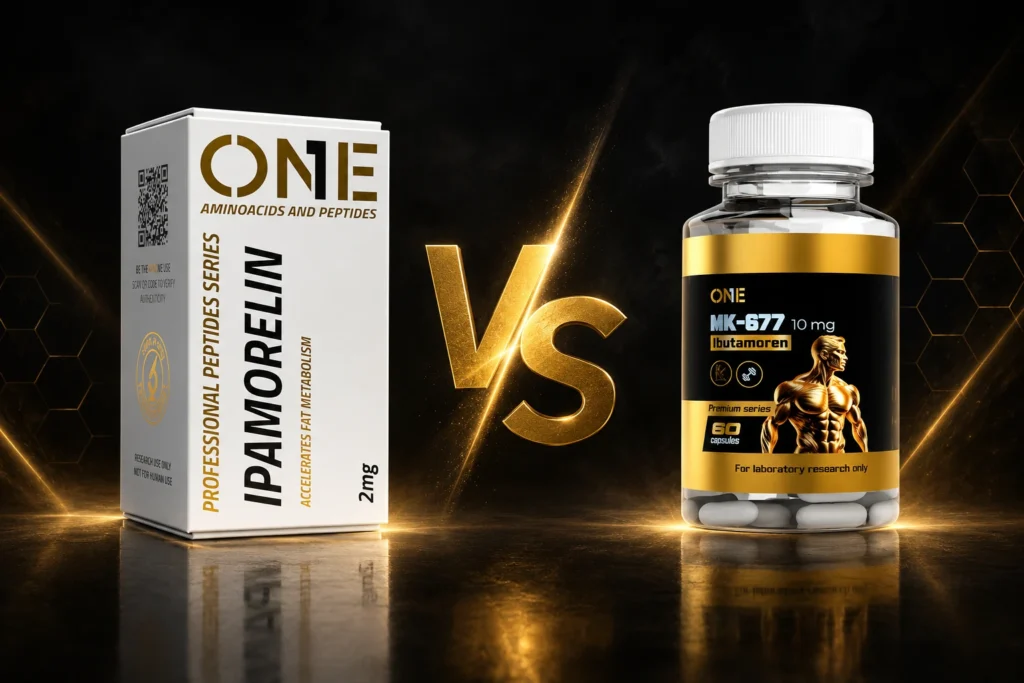
A research comparison of MK-677 and ipamorelin, focusing on GHS-R1a signaling, selectivity, administration route, human evidence and WADA status.
