DE
DE  EN
EN  ES
ES 
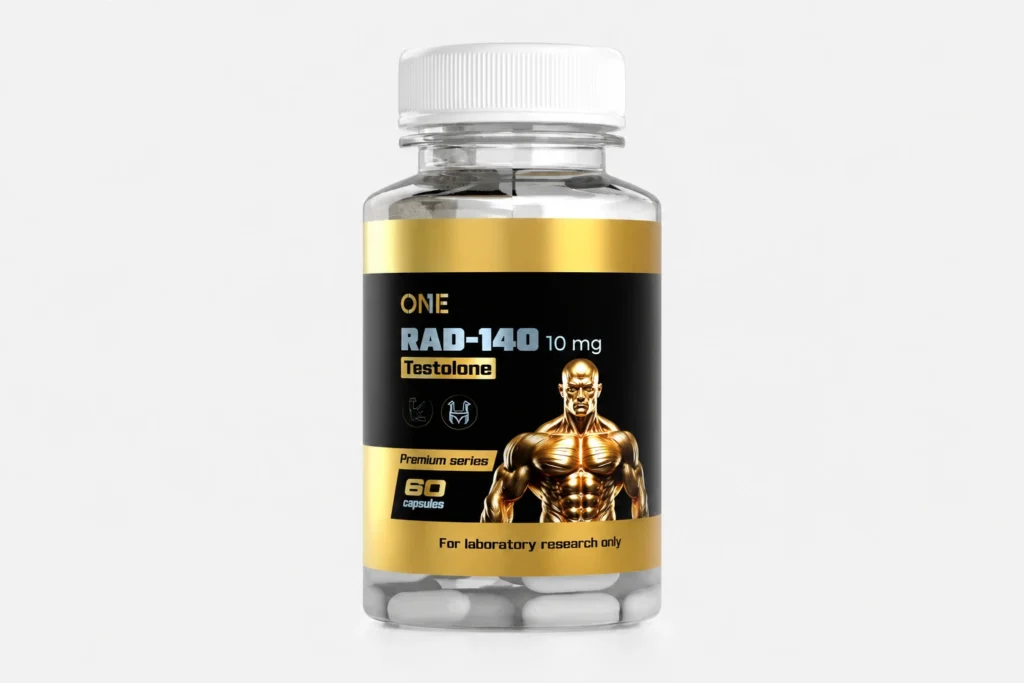
RAD-140, also known as Testolone, is a non-steroidal selective androgen receptor modulator supplied in capsule form — as a chemical reagent exclusively for laboratory research. It is not a dietary supplement, a medicinal product or a foodstuff, and it is not intended for consumption by humans or animals.
Research Use Only. The products in this category are chemical substances for laboratory and scientific applications. They are not dietary supplements, medicinal products or foodstuffs. They are not intended for consumption or administration to humans or animals, and they do not serve to support training, strength, performance, recovery or muscle-mass development in humans. The descriptions refer to pharmacology and results reported in the scientific literature — they do not constitute advice or instructions for use.
RAD-140 is a non-steroidal compound developed by Radius Health as a candidate from the class of selective androgen receptor modulators (SARMs). It binds to the androgen receptor (AR) — the same protein on which testosterone acts — while inducing a different conformational change of the receptor. In preclinical models this leads to tissue selectivity: activity in muscle and bone tissue with relatively weaker action on androgenic tissues.
In preclinical studies a high anabolic-to-androgenic ratio was reported for RAD-140. This value is a parameter dependent on the model and the measurement method, not a physical constant of the compound — comparisons retain meaning only within the same research system.
The market narrative describing RAD-140 as “the strongest SARM” remains a marketing simplification, not a clinical finding. The compound has not undergone phase III trials, and the available literature covers preclinical models and early development phases.
A capsule is a way of packaging research material. Portioning the reagent into repeatable units facilitates batch record-keeping and analytical work — it is not a suggestion of intended use.
The regulatory class follows the substance, not the packaging. The same substance in a capsule and in a vial has the same Research Use Only framework.
The capsule form does not change the status of the reagent. RAD-140 in capsules remains a chemical reagent exclusively for laboratory research and is not intended for consumption by humans or animals. A capsule does not turn a reagent into a dietary supplement or a consumer product.
The directions below describe what is the subject of research — not effects promised to the buyer of the reagent.
The common thread of these directions is the androgen receptor in various tissues — muscle, nerve and glandular. It is one mechanism viewed from several sides, not several independent promises.
The literature has described two independent cases of drug-induced liver injury (DILI) associated with products containing RAD-140. We present this openly — it is the best-documented safety signal of this compound.
One of the described cases had a cholestatic pattern — that is, a disturbance of bile outflow. In laboratory tests such a pattern manifests as a dominant increase in alkaline phosphatase and bilirubin, in contrast to the hepatocellular pattern, in which aminotransferases come to the fore. That case required treatment with corticosteroids, which indicates a course going beyond mere discontinuation of the preparation and observation.
The conclusion is two-sided. On the one hand, the hepatotoxicity signal of RAD-140 is a documented point of attention, not a hypothesis — the events were described in peer-reviewed literature and linked to a specific compound. On the other hand, these are case reports, not controlled studies: such material does not allow the frequency of events to be estimated or the risk of the substance itself to be separated from the quality of the tested preparation.
Analytical documentation is not a decorative addition. Independent chemical analyses of products sold online as “SARMs” have shown that a significant portion of them did not contain the declared substance or contained compounds other than those indicated on the label.
The same uncertainty burdens the interpretation of reports of adverse events: when the material comes from an uncontrolled circulation, it is harder to attribute an effect to a specific molecule.
RAD-140 has the status of a Research Use Only reagent. It is not a dietary supplement, a medicinal product or a foodstuff; it is not intended for use in humans or for any use outside a controlled research environment. It has no EMA or FDA registration as a medicinal product.
Anti-doping status — the World Anti-Doping Agency places RAD-140 in category S1 (anabolic agents), with the ban applying at all times. Sensitive methods have been developed to detect the compound and its metabolites using liquid chromatography–mass spectrometry (LC-MS/MS) techniques. Athletes subject to anti-doping control should verify the current WADA guidelines.
The state of research is also developed by a profile article on RAD-140 and a RAD-140 vs ostarine comparison.
Is RAD-140 a medicine or a dietary supplement?
No. RAD-140 is a chemical reagent with Research Use Only status. It has not obtained registration with the EMA or the FDA and is not intended for consumption.
What is known about RAD-140’s effect on the liver?
The literature has described two independent cases of drug-induced liver injury associated with products containing RAD-140. One of them had a cholestatic pattern (a disturbance of bile outflow) and required treatment with corticosteroids. This is a documented safety signal, although case reports do not allow the frequency of events to be estimated.
Is the term “the strongest SARM” a scientific fact?
No. It is a market narrative. A high anabolic-to-androgenic ratio was reported in preclinical models, and this value depends on the model and the measurement method. The compound has no phase III trials.
Does the capsule form mean the product is a supplement?
No. A capsule is a form of packaging the reagent. The regulatory class follows the substance, not the packaging — RAD-140 in a capsule remains research material not intended for consumption.
Is RAD-140 detected in anti-doping testing?
Yes. The compound is on the WADA list in category S1, with the ban applying at all times. Sensitive methods have been developed to detect RAD-140 and its metabolites (LC-MS/MS).
We offer a wide selection of peptides tailored to a range of laboratory analytical needs.
Every batch is tested for identity and purity (HPLC, MS) and comes with a certificate of analysis.
We invest in analytical testing and full batch documentation for every product.
Unsere zahlreichen positiven Bewertungen spiegeln die Zufriedenheit unserer Kunden wider, die immer wieder zurückkommen.
Melden Sie sich für den Newsletter an!
Erhalten Sie 10 % Rabatt auf Ihren ersten Kauf
One-Peptides.com
Informationen

© 2026 ONE-PEPTIDES.COM