 DE
DE  EN
EN  ES
ES 

A research-focused comparison of Melanotan II and PT-141, covering melanocortin receptor selectivity, evidence, safety signals and regulatory status.
The first vial of bacteriostatic water was developed in the 1940s by the American pharmaceutical company E.R. Squibb & Sons in response to a concrete hospital problem: physicians administering injectable drugs needed a solvent that would not be contaminated after the first puncture and would allow repeated withdrawals from the same vial over a period of up to 28 days. Sterile water for injection used at the time was sterile only at factory filling — once the septum was pierced, any microflora in the air could colonize the solution.
The solution was to add a small amount of benzyl alcohol to the sterile water — a compound that at 0.9% inhibits the growth of most bacteria and fungi but does not kill them (hence “bacteriostatic,” not “bactericidal”). The resulting formula became the standard in hospital pharmacy and, decades later, reached research laboratories as the preferred solvent for lyophilized peptides.
For a team working with research peptides, bacteriostatic water has one basic advantage: it permits repeated withdrawals from the same vial over a typical experimental cycle (28 days), without growing microbial contamination risk over time. That meaningfully changes laboratory logistics — full context, from RUO standards to working-solution storage, is covered in the laboratory practice with research peptides handbook.
📖 This article is educational and describes the use of bacteriostatic water as a solvent for research peptides (Research Use Only). It is not medical advice or a human-use protocol.
In brief. Bacteriostatic water is water for injection containing 0.9% benzyl alcohol (9 mg/mL) as a preservative; a standard 10 mL vial therefore contains 90 mg of benzyl alcohol. The preservative supports repeated withdrawals from one vial for up to 28 days after the first puncture, unlike preservative-free water for injection or saline. A typical research-peptide reconstitution uses 1-2 mL. This material describes laboratory practice with RUO reagents.
Bacteriostatic water contains sterile water for injection and 0.9% benzyl alcohol, equivalent to 9 mg of preservative per millilitre.
Bacteriostatic water has a simple composition:
A standard 10 mL vial contains 90 mg of benzyl alcohol. In the One Peptides catalog, bacteriostatic water 10 mL is available as an auxiliary reagent for reconstituting research peptides. Why the figure is fixed at exactly 0.9% — and the preservative’s full safety record — is covered in our article on benzyl alcohol in bacteriostatic water.
Benzyl alcohol is not ethyl alcohol (ethanol). The structural differences carry functional consequences:
|
Feature |
Benzyl alcohol |
Ethanol |
| Formula | C₆H₅CH₂OH | CH₃CH₂OH |
| Preservative action | Yes (bacteriostatic) | Weak at low concentrations |
| Effect on peptides | Minimal at 0.9% | Can denature at higher concentrations |
Benzyl alcohol at 0.9% inhibits the growth of bacteria and fungi, but it is not sufficient to inactivate viruses (which require higher concentrations or different preservatives). For typical research-peptide laboratory work this protection is adequate.
Bacteriostatic water contains a preservative that ordinary water for injection lacks, while saline additionally contains sodium chloride.
The choice of solvent for a peptide depends on the experimental context. The table below contrasts the four most commonly used options; for a focused comparison of the two waters, see bacteriostatic water vs sterile water for peptides.
|
Solvent |
Composition |
Sterility after puncture |
Peptide stability |
Main applications |
| Bacteriostatic water | WFI + 0.9% benzyl alcohol | 28 days | Very good for most peptides | Standard peptide reconstitution, experiments requiring repeated withdrawals |
| Sterile WFI | WFI without preservatives | 24 hours | Very good | Cell culture, peptides sensitive to preservatives (GHK-Cu), single-use protocols |
| Physiological saline 0.9% | WFI + 0.9% NaCl | 24 hours (if preservative-free) | Good | General preparations when isotonicity is needed |
| PBS pH 7.4 | Phosphate salts + NaCl | 24 hours | Very good for pH-sensitive peptides | Cell culture, in vitro experiments |
The procedure includes disinfecting the septum, withdrawing the required volume once with a sterile syringe and slowly introducing the liquid down the reagent-vial wall.
Remove the bacteriostatic-water vial from the fridge 15–20 minutes before use. Cold water slows peptide dissolution and may cause local aggregates.
Inspect the vial before opening:
Any visual anomaly is a signal not to use the vial.
Disinfect the rubber septum with 70% isopropanol on a sterile swab. Allow the alcohol to evaporate for 30 seconds. A wet septum increases the risk of contamination at the moment of puncture.
Before drawing water, insert an empty syringe into the vial through the septum and push air into the vial. This makes water withdrawal easier (no negative pressure resisting the draw).
Draw the required volume of water into an insulin syringe. For typical peptide reconstitution — 1 to 2 mL. Remember that smaller volume = higher final peptide concentration.
Direct the water stream onto the inner wall of the peptide vial at about a 45° angle. Do not direct the jet onto the lyophilizate — this can cause mechanical microdegradation of peptide molecules. The full gentle technique and concentration math are covered in mixing peptides with bacteriostatic water: reconstitution basics.
After the first withdrawal, write the puncture date on the label. Store the vial at controlled room temperature (~20–25°C) per the label; many labs refrigerate it at 2–8°C as a precaution. Standard usable period from first puncture: 28 days. After that, the vial should be discarded regardless of how much water remains. The full storage picture is in do you refrigerate bacteriostatic water? shelf life explained.
After the first puncture, a correctly stored vial is intended for use for no longer than 28 days.
An unopened bacteriostatic-water vial keeps:
Always check the expiry date on the label. After the expiry date, preservatives may lose effectiveness and the water itself may lose its sterility.
After the first withdrawal:
After 28 days the solution should be discarded. Despite the preservative content, over time the risk of resistant-strain contamination and benzyl-alcohol degradation grows.
Discard the vial immediately if you notice:
Benzyl alcohol at 0.9% (9 mg/mL) has been widely used in pharmacy for decades. The toxicology profile is well characterized:
Used bacteriostatic-water vials should be disposed of per local laboratory-waste regulations. In most cases:
For teams working in formal research-laboratory settings, local chemical-waste management rules apply.
For typical laboratory applications the following peptide-concentration calculations after reconstitution with bacteriostatic water are useful.
Peptide concentration (mg/mL) = peptide mass in vial (mg) / water volume added (mL)
|
Peptide mass in vial |
BAC water added |
Final concentration |
Syringe volume for 100 µg |
| 2 mg | 1 mL | 2 mg/mL | 0.05 mL (50 µL) |
| 5 mg | 1 mL | 5 mg/mL | 0.02 mL (20 µL) |
| 5 mg | 2 mL | 2.5 mg/mL | 0.04 mL (40 µL) |
| 5 mg | 5 mL | 1 mg/mL | 0.1 mL (100 µL) |
| 10 mg | 1 mL | 10 mg/mL | 0.01 mL (10 µL) |
| 10 mg | 2 mL | 5 mg/mL | 0.02 mL (20 µL) |
| 10 mg | 5 mL | 2 mg/mL | 0.05 mL (50 µL) |
For more complex concentration and volume calculations, a peptide calculator is available.
The most common errors are failing to disinfect the septum, reusing a syringe, confusing solvents and exceeding 28 days after the first puncture.
|
Error |
Consequence |
How to avoid |
| Using a vial after 28 days from puncture | Contamination risk | Mark the puncture date, discard after 28 days |
| No septum disinfection before puncture | Microflora introduction into the vial | 70% IPA, 30 seconds to evaporate |
| Reusing a syringe | Cross-contamination | Single-use syringes only |
| Confusing BAC with WFI | Wrong choice for sensitive peptides | Check the label before use |
| Storing BAC at room temperature after puncture | Shortened usable period | Refrigerate at 2–8°C as a precaution; respect the 28-day window |
| Using BAC for GHK-Cu | Possible interaction with copper | Sterile WFI for copper peptides |
| Skipping the visual check | Missed contamination | Always check clarity |
You can buy bacteriostatic water 10 mL in the One Peptides catalog as an auxiliary reagent for reconstituting research peptides; the product is also listed in the water for peptides category. Whatever the source, check three things: the composition (water for injection with 0.9% benzyl alcohol), the integrity of the septum seal and the expiry date on the label.
No. The bacteriostatic water in the One Peptides catalog is an auxiliary reagent for laboratory reconstitution and is not intended for administration to humans or animals. In work with RUO research peptides, it serves exclusively as a solvent.
The standard period is 28 days from first puncture, stored at controlled room temperature (~20–25°C) per the label, often refrigerated at 2–8°C as a precaution. After that the vial should be discarded.
Preservative-containing saline is 0.9% NaCl + benzyl alcohol. Bacteriostatic water is pure water + benzyl alcohol, with no NaCl. For most research peptides, bacteriostatic water is preferred — the lack of additional ions positively affects peptide stability and does not disturb solution ionic strength.
Yes — at the moment of factory filling. After the first puncture it becomes “bacteriostatic” — benzyl alcohol inhibits the growth of microorganisms introduced during puncture, but it is not an absolutely sterile environment. Hence the 28-day limit after first use.
There is no need — the product is stable at room temperature and in the fridge. Freezing and thawing preservative-containing water can affect the distribution of benzyl alcohol in solution. For peptide reconstitution, standard fridge storage is sufficient.
Dispose of the vial safely (mind the glass shards) and open a new one. Breakage compromises product sterility — even if everything looks visually fine.
At 0.9% benzyl alcohol has minimal impact on most standard research peptides. The exception is GHK-Cu (a copper peptide) — for that specific peptide preservative-free sterile WFI is recommended. For other peptides in the One-Peptides catalog, bacteriostatic water is the standard, well-tolerated solvent.
A better choice is preservative-free sterile WFI or PBS. Benzyl alcohol at 0.9% can affect the viability of some cell lines. Bacteriostatic water is, however, fully appropriate for reconstituting peptides subsequently used in in vivo models.
Sterile bacteriostatic water in the One-Peptides catalog: Bacteriostatic water 10 mL — a pharmacopeial formulation with 0.9% benzyl alcohol, ready for research-peptide reconstitution.

A research-focused comparison of Melanotan II and PT-141, covering melanocortin receptor selectivity, evidence, safety signals and regulatory status.
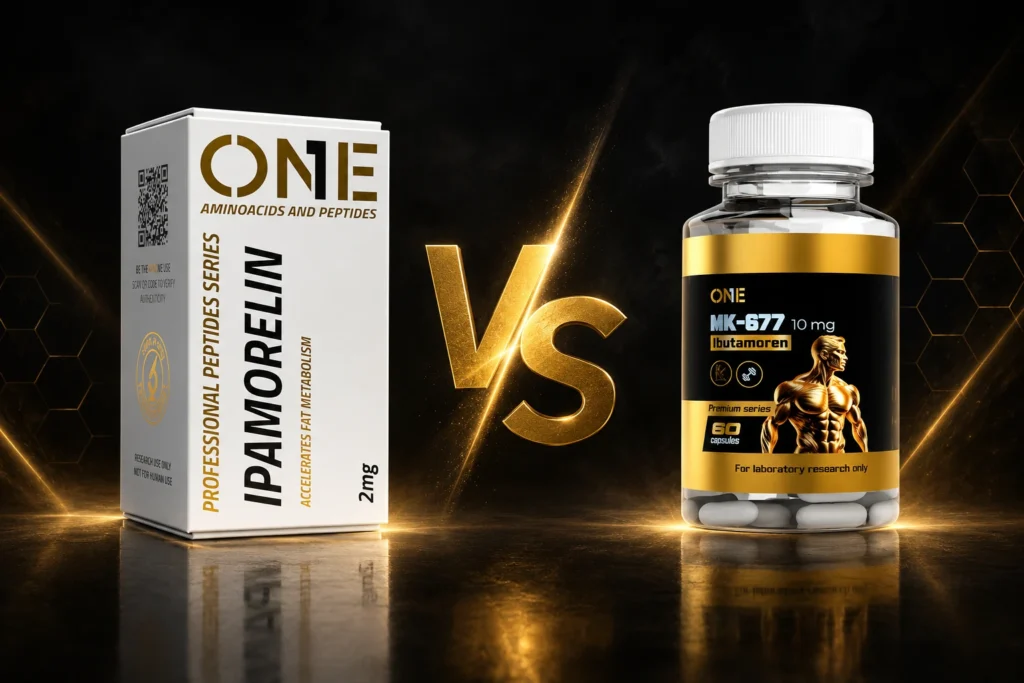
A research comparison of MK-677 and ipamorelin, focusing on GHS-R1a signaling, selectivity, administration route, human evidence and WADA status.
