 DE
DE  EN
EN  ES
ES 


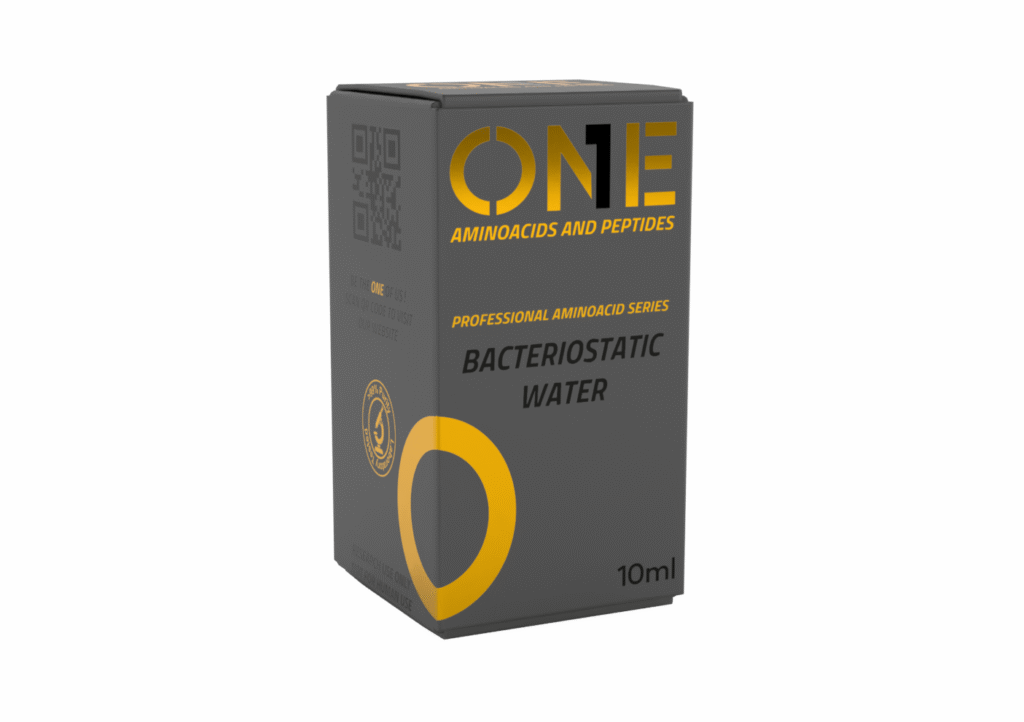
Bacteriostatic water – Research Use Only (RUO). Chemical reagent intended only for laboratory tests. It is not intended for human consumption or diagnostic purposes.
Related categories and reagents: In the context of this area of research, it is also worth comparing research peptides.
Bacteriostatic water vs other solvents. The difference concerns not the water itself, but the added preservative. Water for injection (WFI) and preservative-free saline variants do not contain a bacteriostatic agent and are intended for single use after the first puncture. One Peptides Bacteriostatic Water contains 0,9% benzyl alcohol (9 mg/mL) as an antimicrobial preservative, which makes it suitable for repeated withdrawals for a limited period; in a 10 mL vial, this equals 90 mg of preservative. The category name alone does not determine the composition: official labels from other manufacturers also list 1.1% variants. This is an auxiliary reagent; its role is to prepare a research solution, not to exert an effect of its own. Read more: what bacteriostatic water is and how to use it.
One Peptides Bacteriostatic water for dissolving peptides 10 ml is not a biologically active compound in the same sense as a peptide, SARM or receptor agonist. It is an auxiliary reagent whose role is to prepare the test solution, maintain the sterility of the material for a limited time after opening, and provide a predictable environment for the dissolved substance. From the laboratory’s perspective, it is an element of the formulation, not an “important technical addition”.
The most significant methodological thing is simple: the name bacteriostatic water describes the category of the reagent and the composition matters. This product is formulated at 0,9% benzyl alcohol (9 mg/mL) — the USP standard concentration for bacteriostatic water for injection. As good RUO practice, the exact value remains confirmable on the batch label, SDS or Certificate of Analysis.

In the reference nomenclature, it is sterile, non-pyrogenic water containing a bacteriostatic preservative, most often benzyl alcohol. This system is intended for preparing solutions from research materials requiring reconstitution or dilution under aseptic conditions. The reagent itself does not function as an “active substance”, but the readability of the further experiment depends on its quality and compatibility with the dissolved material.
This means several practical benefits for laboratories working with peptides. First, a test solution can be prepared from a lyophilized or other solid form without introducing random ions or buffers if the product does not contain them. Secondly, the presence of benzyl alcohol reduces the risk of microorganisms multiplying after the first removal of material from the container. Third, this type of formulation is sometimes used as a reference point when comparing different solvents for peptides with different stability.
At the same time, you need to mark the limitation. Bacteriostatic water is not a universal solvent for every peptide and every biological formulation. It has been reported in the formulation literature that antimicrobial preservatives, including benzyl alcohol, may interact with proteins and peptides, sometimes affecting their aggregation or stability. Therefore, compatibility with the dissolved material should not be assumed automatically.
| Component | Role in formulation | Research Notes |
|---|---|---|
| Purified water/water for injection purposes | basic dissolving medium | provides an environment with a low content of ionic and microbiological pollutants |
| Benzyl alcohol | bacteriostatic preservative | 0,9% (9 mg/mL) — antimicrobial preservative; in a 10 mL vial this equals 90 mg |
| Product parameter | Value |
|---|---|
| Mark | One Peptides |
| Volume | 10 ml |
| Benzyl alcohol | 0,9% (9 mg/mL) |
| Product type | auxiliary reagent for preparing research solutions |
| Status | Research Use Only (RUO) |
There is one more thing worth paying attention to. The term itself for dissolving peptides does not mean that each peptide will behave identically in this environment. For some molecules, pH compatibility will be important, for others, the presence of a preservative, and for still others, the speed of preparation and storage temperature after reconstitution.
Bacteriostatic water is a simple formula only at first glance. In laboratory practice, its behavior depends on the purity of the water, the type of packaging, the concentration of the preservative and the method of repeatedly taking material from the container.
The basic medium is pharmaceutical quality water or equivalent. Its task is not to activate a specific receptor, but to create a predictable system for the reconstituted material. For peptides this is important for several reasons:
Benzyl alcohol acts as an antimicrobial preservative at 0,9% (9 mg/mL). In official labels for bacteriostatic diluents it is described as antimicrobial preservative. This term is important because it clearly shows the place of this ingredient in the formulation. The point is not to affect the dissolved peptide, but to limit the multiplication of microorganisms in the repeated collection material.
Official labels for bacteriostatic diluents indicate a pH range typically around 4.5-7.0 (target near 5.7 in the USP monograph). This range illustrates a practical feature of the category: it is a relatively neutral to slightly acidic environment, usually sufficient for many test solutions, although not necessarily optimal for each molecule.
This product has no receptor mechanism. Its “action” is purely formulation-related and microbiological.
Benzyl alcohol acts as a bacteriostatic preservative, i.e. an ingredient that limits the growth of microorganisms in the aquatic environment. Research and reviews on antimicrobial preservatives indicate that benzyl alcohol remains one of the most common preservatives in multi-dose formulations, especially where a simple formulation needs to be combined with reasonable material compatibility.
In laboratory practice, this means that after the first collection, the material does not automatically become “resistant to contamination”. The preservative limits the growth of microorganisms, but does not replace aseptic technique. Still important:
The second level of action is the solvent function. Bacteriostatic water is intended to enable the transition of a peptide or other research substance to the liquid phase with as few interfering variables as possible. This is especially important for lyophilisates, where the reconstitution step itself may affect:
The gentle technique and the concentration math behind a clean reconstitution are described step by step in mixing peptides with bacteriostatic water: reconstitution basics.
This is a point that should not be omitted. Formulation reviews and experimental studies show that antimicrobial preservatives can interact with peptides and proteins. For some materials, benzyl alcohol does not cause a significant disturbance in stability, for others it may increase the tendency to aggregation or affect the conformational state of the molecule. For this reason, bacteriostatic water is a good laboratory solvent only if its compatibility with the material to be dissolved has been verified or results from the documentation of this substance.
Official labels for bacteriostatic diluents indicate storage at controlled room temperature (~20–25°C), usually with protection from extreme conditions and with a requirement to use only the clear solution with the seal intact; many laboratories refrigerate the vial at 2–8°C as a precaution after the first puncture. However, what is most important for the One Peptides product is what the batch label says.
In laboratory practice, it is worth adopting several rules:
If the material is to be used to reconstitute a peptide with sensitive stability, it is also worth documenting the temperature of the solution preparation process itself.
This is the most obvious area of use. The product acts as a medium for the transition of the peptide from the solid state to the test solution, while limiting the risk of microbial contamination after the first collection.
Bacteriostatic water can serve as the first step in material preparation before further dilution into cell medium or working buffer, as long as the molecule being dissolved is compatible with it. To convert a vial mass and target concentration into a diluent volume, use the peptide reconstitution calculator.
Laboratories can use this product to compare different reconstitution options, for example: bacteriostatic water vs. sterile water without preservative, or bacteriostatic water vs. pH-specific buffer.
The presence of benzyl alcohol makes the product a good reference point for tests including solution stability, clarity, tendency to aggregation and repeatability of material collection from one container.
This application has great practical value. Instead of assuming that each peptide “likes” bacteriostatic water, the laboratory can directly measure whether, after reconstitution, the solution remains stable, whether aggregation does not occur, and whether the analytical reading remains clean.
One Peptides Bacteriostatic water for dissolving peptides 10 ml is a RUO chemical reagent used to prepare research solutions from peptide materials and related substances requiring reconstitution. The value of this product lies not in its biological activity, but in the quality of the environment it creates for the dissolved molecule: sterility, presence of a 0,9% benzyl alcohol preservative and formulation predictability.
The most important practical conclusion is simple. This product should not only be judged by volume 10 ml, but primarily by batch compatibility, the 0,9% benzyl alcohol concentration, solution clarity, storage conditions and compatibility with a specific peptide. Only then does it function as a reliable laboratory tool.
NO. Bacteriostatic water contains a preservative, most often benzyl alcohol, which limits the growth of microorganisms after opening the container. Sterile water without a preservative does not have this property. The full side-by-side is in bacteriostatic water vs sterile water for peptides.
One Peptides Bacteriostatic Water contains 0,9% benzyl alcohol (9 mg/mL), in line with the pharmacopeial standard for this category. Official labels from other manufacturers also list 1.1% variants, so the category name alone does not determine the composition.
This should not be assumed automatically. Some peptides are well compatible with benzyl alcohol, but for others the preservative may affect stability or aggregation. Verification of compatibility with a specific material is needed.
It is worth checking the volume, clarity, the 0,9% preservative concentration, integrity of the closure, batch number and storage conditions.
Follow the manufacturer’s label and laboratory procedures, keep records of the first collection, and withdraw material from work if turbidity, sediment, or closure failure occurs.
 DHL Express





Bewertungen
Es gibt noch keine Bewertungen.