 DE
DE  EN
EN  ES
ES 

A research-focused comparison of Melanotan II and PT-141, covering melanocortin receptor selectivity, evidence, safety signals and regulatory status.
The most common misunderstanding when working with research peptides isn’t about reconstitution or dosing – it’s about storage. In the laboratory, you can find vials of BPC-157 left on the counter over the weekend, ampoules of TB-500 repeatedly frozen and thawed during the experiment, and semaglutide stored for a year in the refrigerator door next to the milk. Each of these cases is an error that will not reveal itself immediately – the peptide still looks like a peptide, the solution is clear, the label is intact. The consequences emerge weeks later when the HPLC chromatogram shows many more peaks than in the certificate of analysis from the day of production.
Peptide as a chemical molecule has one main enemy: time multiplied by suboptimal environmental conditions. Temperature, moisture, light, oxygen and pH all act together on the amino acid chain, hydrolyzing peptide bonds, oxidizing cysteine and methionine residues, deamidating asparagine and glutamine. Well-stored lyophilized peptide can maintain biological activity for 24 months. If stored incorrectly, it degrades significantly within just a few weeks.
This article collects research peptide storage standards in one place – from the lyophilisate, through the working solution, to the cold chain during transport. This is one of the foundations of laboratory practice with research peptides — consistent with the principles of working with Research Use Only reagents.
📖 The following article is educational and describes the rules for storing research peptides (Research Use Only) in laboratory conditions. The procedures are provided in a research context and do not constitute medical advice or a protocol for human use.
In brief. Research-peptide stability depends primarily on physical form: a lyophilisate at -20 degrees Celsius may remain active for 18-24 months, whereas a solution in bacteriostatic water at 2-8 degrees Celsius generally remains usable for 14-28 days, depending on the peptide. This requires low residual-water content in the lyophilisate, typically ≤5% by Karl Fischer analysis. The most important single degradation factor is repeated freeze-thaw cycling, so material is aliquoted before freezing. These principles concern laboratory work with RUO reagents.
A lyophilisate is more stable than a solution because the absence of bulk water limits hydrolysis and other molecular-degradation processes.
The peptide exists in two completely different states from a stability perspective: as a lyophilisate (powder after sublimation of water) and as a solution after reconstitution. From the perspective of peptide chemistry, these are two different situations.
The lyophilisate is a porous structure in which the peptide molecules are surrounded by minimal residual water content (typically ≤5%, determined by the Karl Fischer method). No liquid solvent means:
The standard stability period of the lyophilized research peptide at -20°C is 18–24 months. Some particularly stable peptides (BPC-157) may remain active longer.
When water is added, the peptide becomes much less stable:
The standard period of stability of the peptide solution in bacteriostatic water in a refrigerator at 2–8°C is 14–28 days depending on the peptide. Details of reconstitution are described in the guide how to dissolve peptides step by step.
Lyophilisates are generally stored at -20 degrees Celsius and working solutions at 2-8 degrees Celsius, subject to the documentation for the specific batch.
Temperature -80°C (ULT medical freezer – Ultra-Low Temperature) is the standard for long-term storage for:
At -80°C, enzymatic activity and chemical processes practically cease. The stability of the lyophilisate may be 5+ years.
The temperature of -20°C is the most common standard for storing lyophilized research peptides. Sufficient for most research protocols.
Standard home freezers (frost-free) are not suitable for long-term storage of peptides. Defrost cycles raise the temperature to 0°C or higher every 6–8 hours, which, when repeated over months, degrades the peptide.
Temperature 2-8°C is the standard range for:
After first opening the lyophilisate vial, it is recommended to store it at 2-8°C to avoid freeze/thaw cycles during use. After the end of the period of use (approx. 30 days), the vial can be transferred back to -20°C, but each temperature transfer reduces the stability of the peptide. The characteristics of the solvent are described in the article bacteriostatic water – what is it and how to use it.
Short-term exposure of peptides to room temperature is acceptable during laboratory procedures:
Long-term storage of the peptide (both lyophilisate and solution) at room temperature is not allowed. The stability of the peptide at 25°C is 1–2 orders of magnitude lower than at -20°C.
Freeze-thaw cycles accelerate degradation through ice-crystal formation, local shifts in concentration and pH, and mechanical stress.
Freeze-thaw cycles are one of the main causes of peptide degradation. Each cycle causes:
| Number of cycles | Estimated loss of activity | Comment |
|---|---|---|
| 1 cycle | <5% | A single cycle is tolerated |
| 3 cycles | 5–15% | Warning threshold |
| 5+ cycles | 15–40% | Significant degradation |
| 10+ cycles | 40–60% | The peptide is not suitable for precise research |
The best practice is aliquoting — dividing the peptide into smaller portions before freezing. Each portion is thawed only once, used whole and disposed of.
Aliquote procedure:
Aliquoting is particularly important for expensive and sensitive peptides – one cycle of thawing 1 mL of peptide instead of 10 cycles of thawing 100 µL significantly extends the shelf life.
Most standard peptides are not significantly photosensitive. Exceptions:
Rule of thumb: for peptides with cysteine, tryptophan, methionine or metal ions in complex – store in opaque packaging. For other standard peptides – amber glass vials are sufficient but not required.
Amino acid residues susceptible to oxidation:
The lyophilisate has minimal contact with dissolved oxygen. In the reconstituted solution, oxidation occurs faster, therefore the stability period is shorter (14–28 days) than in the lyophilized solution (18–24 months).
For advanced protocols (peptides particularly sensitive to oxidation), the vials are flushed with argon or nitrogen before closing – eliminating dissolved oxygen.
Moisture is the enemy of freeze-dried food. Mechanism:
A standard peptide manufacturer uses silica gel as a moisture absorber in the packaging. Once the vial is opened, this protection disappears – so the first opening should be carefully planned (rule of 20 minutes of temperature equilibration to avoid condensation).
Under suitable conditions, a lyophilisate generally remains active for 18-24 months and a working solution for 14-28 days.
The table below summarizes the estimated stability periods of the most common research peptides under optimal storage conditions.
| Peptide | Lyophilisate -20°C | Lyophilisate -80°C | Solution 2–8°C |
|---|---|---|---|
| BPC-157 | 24 months | 36+ months | 28–30 days |
| TB-500 / Thymosin Beta-4 | 18–24 months | 36+ months | 14–28 days |
| Semaglutide | 24 months | 36+ months | 28 days |
| Retatrutide | 24 months | 36+ months | 28 days |
| MK-677 (powder) | 36+ months | 60+ months | n/a (small molecule) |
| Ostarine (powder) | 36+ months | 60+ months | n/a (small molecule) |
| GHK-Cu | 18–24 months | 36+ months | 14–28 days (protected from light) |
| Epithalon | 24 months | 36+ months | 21–28 days |
| Semax | 24 months | 36+ months | 28 days |
| Selank | 24 months | 36+ months | 28 days |
| Oxytocin | 18 months | 24+ months | 14–21 days |
| Melanotan II | 24 months | 36+ months | 30 days |
Indicative values – specific batch stability depends on production conditions, peptide purity and quality of the freeze-drying process. For peptides from the One Peptides catalog, specific batch stability data is available in the Certificate of Analysis (COA).
Cold chain is a set of procedures that ensure the continuity of low temperatures in the transport of the peptide from the production site to the end user. Breaking the cold chain – even for several hours at room temperature – can reduce the stability of the peptide by 20-40%.
Professional research peptide supplier provides:
For particularly sensitive orders, the supplier may attach a thermal recorder (data logger) – a small device that monitors the temperature throughout transportation. After delivery, the device is connected to the computer (or read via NFC) and receives a full temperature profile over time. This is evidence of cold chain behavior.
For teams publishing results in scientific journals, cold chain documentation may be required in the methodology section.
Repeated freeze-thaw cycles, moisture condensation, light exposure and uncontrolled temperature most often shorten stability.
| Mistake | Consequence | How to avoid |
|---|---|---|
| Store in a frost-free home freezer | Thawing cycles degrade the peptide | Freezer only, no automatic defrost |
| Frequent freeze/thaw cycles | Gradual loss of activity | Aliquoting before freezing |
| Opening a cold vial without equalizing the temperature | Water condensation, hydrolysis | 20 minute rule |
| Storing the reconstituted peptide in the freezer | Degradation during frost/thaw cycles | Only 2-8°C refrigerator for solution |
| No documentation of reconstitution date | Loss of shelf life control | Label the vial immediately after reconstitution |
| Store at room temperature for more than 1 hour | Accelerated degradation | Return to refrigerator immediately after use |
| No light protection for GHK-Cu | Disintegration of the complex with copper | Aluminum foil or opaque packaging |
| Breaking the cold chain in transport | Decreased party stability | Professional supplier with refrigerated transport |
Yes, but for a shortened period. Most lyophilized peptides will retain significant activity for several weeks at room temperature. For full stability of 18-24 months, a temperature of -20°C or lower is necessary. Short-term exposure (transport, laboratory procedures) is tolerated.
NO. The door has the highest temperature fluctuations in the refrigerator (open/close cycles). Peptides should be stored at the back of the refrigerator, preferably in the middle shelves, where the temperature is most stable.
Short-term exposure (24–72 hours) to room temperature reduces stability but does not completely invalidate the activity of the peptide. For the lyophilized peptide, the loss is minimal. For a peptide in solution – higher, but usually the peptide still retains significant activity. For precise quantitative experiments, HPLC verification before use is recommended.
Absolutely not. The microwave generates local, very high temperatures that immediately degrade the peptide. Defrosting should be slow – in the refrigerator (2-8°C) for several hours or at room temperature for 30-60 minutes.
In the refrigerator 2-8°C – about 4-6 hours. At room temperature – 30-60 minutes. Once thawed, the peptide should be used within 14-28 days (depending on the peptide) and should not be re-frozen.
Only if the freezer is of the type without automatic defrost (manual defrost). Most modern home freezers are frost-free – with cyclic defrosting every 6-8 hours. These cycles generate temperature fluctuations that degrade the peptide. For professional storage, a dedicated laboratory or medical freezer is recommended.
Aliquote. After reconstitution, divide the peptide into smaller aliquots (e.g. 100 µL or 500 µL) and freeze each separately. Defrost only one aliquot at a time. For a complete guide to aliquoting, see the “Freeze and Thaw Cycles” section of this article.
Not necessarily – the expiration date on the label is a conservative estimate based on stability data under optimal conditions. If stored correctly, the peptide may remain active longer than the declared date. However, for precise quantitative experiments after the expiration date, HPLC verification or purchase of a new batch is recommended.
For research teams working with peptides for many months, periodic HPLC verification (e.g. every 6 months) on a sample from a stored batch is recommended. Stable peptide purity and unchanged chromatogram confirm the preservation of integrity over time.
Full catalog of research peptides with declared stability: research peptides. Each batch with a certificate of analysis containing peptide-specific stability data.
ℹ️ Global disclaimer
All One-Peptides products are reagents intended exclusively for laboratory and scientific research (Research Use Only). They are not medicines, dietary supplements or products intended for human consumption. The procedures described in this article apply to peptide storage in a research context; does not constitute medical or pharmaceutical advice or protocol for human use.

A research-focused comparison of Melanotan II and PT-141, covering melanocortin receptor selectivity, evidence, safety signals and regulatory status.
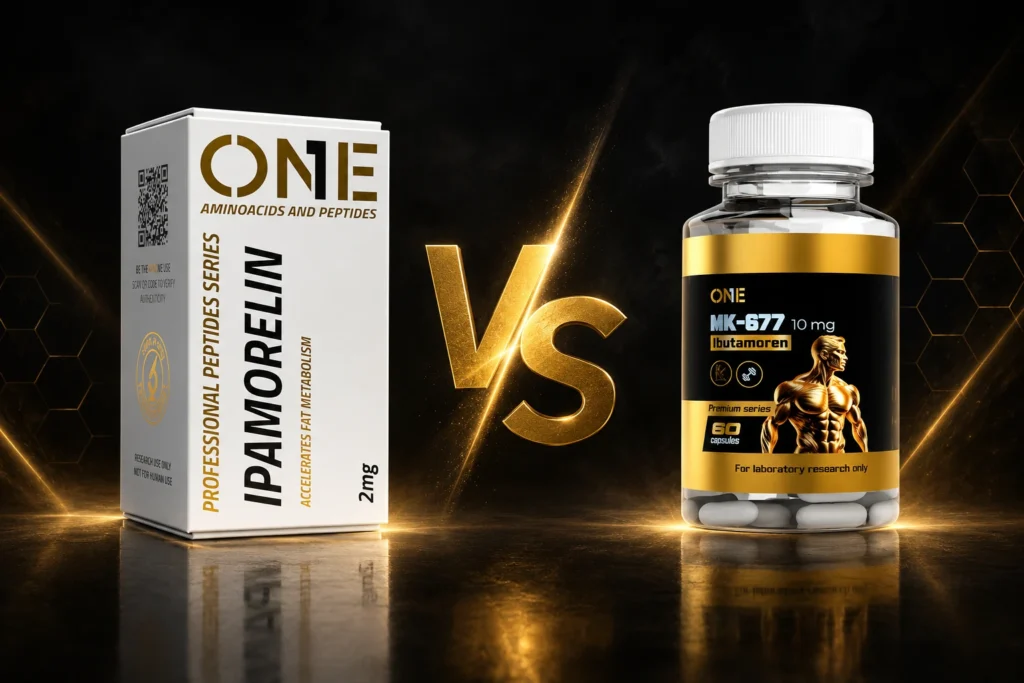
A research comparison of MK-677 and ipamorelin, focusing on GHS-R1a signaling, selectivity, administration route, human evidence and WADA status.
