 DE
DE  EN
EN  ES
ES 

A research-focused comparison of Melanotan II and PT-141, covering melanocortin receptor selectivity, evidence, safety signals and regulatory status.
Chemical reagent intended solely for laboratory research (Research Use Only). It is not a medicinal product, a dietary supplement, or a foodstuff. It is not intended for administration to humans or animals outside a controlled experimental environment.
This material is educational in nature and compares two SARM research compounds strictly on a scientific level. It does not contain health advice, physique comparisons, or administration instructions. We describe research data and regulatory status.
RAD-140 (Testolone) and ostarine (MK-2866) are the two most frequently paired compounds from the group of selective androgen receptor modulators (SARMs). In market discussions they are usually compared through the lens of “potency” and physique effects. Such a comparison is, however, misleading and inconsistent with the research-reagent framing. A sound comparison concerns how their evidence base differs — the research phase, the model organism, and the reported safety signals.
| Criterion | RAD-140 (Testolone) | Ostarine (MK-2866) |
|---|---|---|
| Research phase | mainly preclinical, early observations | clinical trials, including phase III |
| Model organism | neurons in vitro, rats, tumor models | preclinical models and studies involving humans |
| Subject of research | AR characterization, neuroprotection, AR+/ER+ breast cancer | including cachexia and muscle mass loss |
| Selectivity in models | high anabolic-androgenic activity (preclinically) | selective AR modulator studied clinically |
| Reported safety signals | documented case of DILI (hepatotoxicity) | safety signals described in the SARM-class literature |
| WADA status | S1 (anabolic agents) — prohibited | S1 (anabolic agents) — prohibited |
| Form | research reagent (RUO) | research reagent (RUO) |
The table deliberately omits dosages and physique effects in humans — such data do not fit within the research-reagent framing and are not the subject of this comparison.
The fundamental difference between the compounds lies in the maturity of the research. Ostarine (MK-2866) has been the subject of clinical trials, including phase III work conducted, among other contexts, in cachexia and muscle mass loss — it is the most clinically studied compound in the SARM group. RAD-140, by contrast, remains mainly at the preclinical stage: androgen receptor characterization (Miller et al. 2011), neuroprotection (Jayaraman et al. 2014), and experimental oncology (Yu et al. 2017).
The consequence is significant. More can be said about ostarine at the level of data involving humans, whereas knowledge of RAD-140 rests primarily on cellular and animal models. The critical review by Bond et al. (2025) emphasizes that for both compounds, and RAD-140 in particular, market enthusiasm outpaces the actual evidence base and a complete set of phase III clinical data is lacking.
Both compounds are described as selective androgen receptor modulators, that is, substances that stimulate AR in a tissue-differentiated manner. For RAD-140, a high anabolic-androgenic activity ratio was reported in preclinical characterization (Miller et al. 2011), in animal models and cellular systems. For ostarine, selectivity was also studied under clinical conditions, which provides a stronger basis for assessing the profile in humans.
The “anabolic-androgenic ratio” itself is worth explaining, because it is often misunderstood. It is a quantity describing how strongly a compound acts on muscle and bone tissue relative to its androgenic action (on glandular tissue, skin, and other androgen-sensitive tissues). The higher this ratio in a model, the more clearly the compound “separates” the two types of action. RAD-140 was reported in the preclinical literature as a substance with a distinctly anabolic direction of this ratio (Miller et al. 2011). It is important, however, that such values differ between studies and models, and direct numerical comparisons between RAD-140 and ostarine carry considerable uncertainty — they were studied in different systems, using different methods. A comparison of “which has the higher ratio” is therefore not a hard ranking.
For those conducting research, the practical meaning of this contrast is different from what the market narrative suggests. A high anabolic-androgenic ratio in a model is information about the research value of a compound — about how cleanly it separates AR signaling in experimental tissues — and not a prediction of a physique effect in humans. Ostarine, thanks to the presence of clinical data, allows this selectivity to be assessed on a stronger basis; RAD-140 remains at the level of preclinical data.
Finally, it is worth noting that “selectivity in a model” does not automatically mean safety in humans. It is a parameter describing the behavior of a compound in a specific experimental system, not a guarantee of predictable action in the body.
Here the comparison makes a real practical difference. For RAD-140 there is an explicitly documented hepatotoxicity signal: Barbara, Dhingra, and Mindikoglu (2020) described a case of drug-induced liver injury (DILI) associated with products containing RAD-140. We do not pass over this — the liver injury signal is a real point of attention, described in the medical literature, for those conducting research on this reagent. It is the most concrete, specifically named difference in the profile of the two compounds: for RAD-140 there is a published clinical report linking it to liver injury.
For ostarine, safety signals are discussed in the literature concerning the entire SARM class, with a greater share of clinical data. In studies involving humans, ostarine presented a generally milder, better-characterized profile than emerges from the isolated case reports for RAD-140 — which, however, largely reflects the difference in the quantity and quality of data, and does not prove that either compound is “safe.” The absence of a prominent signal is sometimes the result of a lack of research, rather than proof of harmlessness.
A signal common to the entire class must also be added. Compounds acting on the androgen receptor — including both discussed here — have been studied for their effect on the hypothalamic-pituitary-gonadal axis; the SARM literature has described the phenomenon of suppression of endogenous hormonal signaling (axis suppression). Bond et al. (2025) emphasize that, regardless of the compound, the uncontrolled trade in substances from this group as “supplements” carries risk, the safety data are incomplete, and the long-term consequences remain poorly understood. In other words: the DILI difference distinguishes RAD-140 negatively, but neither of these compounds is free from safety signals characteristic of the entire class.
From an anti-doping standpoint, both compounds are treated the same way: RAD-140 and ostarine are on the WADA Prohibited List of Substances and Methods in the category S1 (anabolic agents) and are prohibited in sport at all times. Neither of them holds registration as a medicinal product — on the market they function as laboratory research reagents (Research Use Only), not intended for consumption.
RAD-140 or ostarine — which compound is better studied?
Ostarine (MK-2866) has a more mature evidence base, including phase III clinical trials. RAD-140 remains mainly at the preclinical research stage (Bond et al. 2025).
Is RAD-140 “more potent” than ostarine?
Comparisons of “potency” are a market narrative. Within the research-reagent framing, we compare the research phase and safety signals, not physique effects in humans.
Which compound has a documented liver injury signal?
For RAD-140, a case of drug-induced liver injury was described (Barbara et al. 2020). This is a significant difference in the safety profile.
Are both prohibited in sport?
Yes. Both RAD-140 and ostarine belong to the WADA category S1 (anabolic agents).
Related materials: ostarine article, RAD-140 profile, SARM guide, and reagent cards — RAD-140, ostarine and cardarine.

A research-focused comparison of Melanotan II and PT-141, covering melanocortin receptor selectivity, evidence, safety signals and regulatory status.
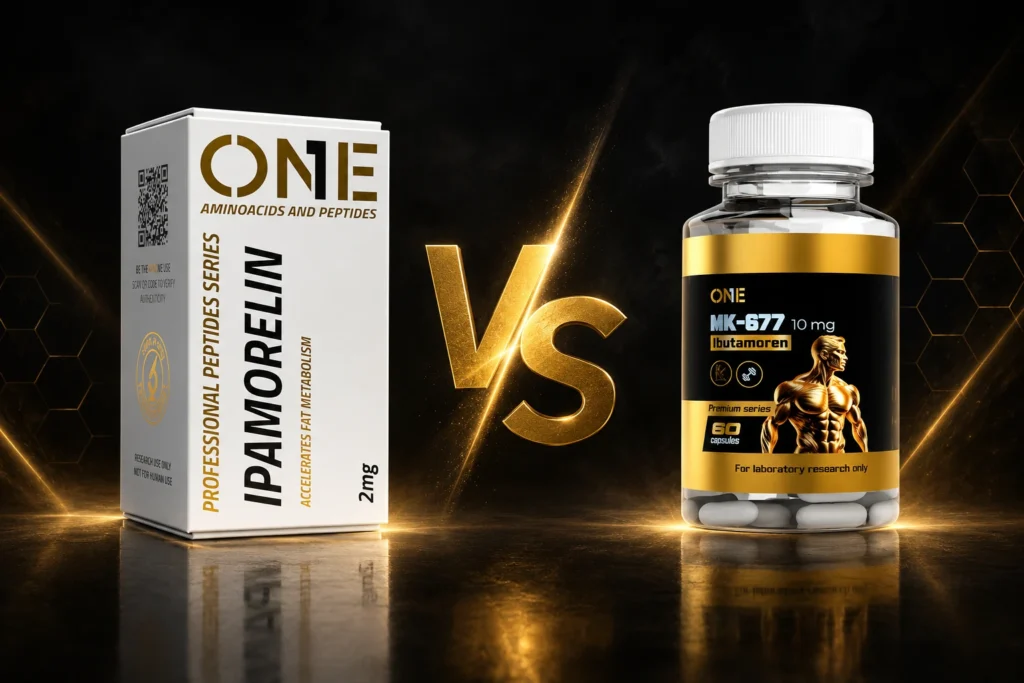
A research comparison of MK-677 and ipamorelin, focusing on GHS-R1a signaling, selectivity, administration route, human evidence and WADA status.
