 DE
DE  EN
EN  ES
ES 

A research-focused comparison of Melanotan II and PT-141, covering melanocortin receptor selectivity, evidence, safety signals and regulatory status.
Chemical reagent intended exclusively for laboratory research (Research Use Only). It is not a medicinal product, a dietary supplement, or a foodstuff. It is not intended for administration to humans or animals outside of a controlled experimental environment.
The following comparison is educational in nature and concerns compounds treated as research reagents. It is not health advice, usage instructions, or an encouragement to administer the substances to any organism. The comparison is conducted solely on scientific grounds — without administration protocols and without physique-related promises.
The comparison of LGD-4033 and ostarine (MK-2866) is among the most frequently searched pairings within the SARM class. Both compounds are well recognized in the literature, but they differ above all in the scope of their evidence base and the research stage they have reached. Below we compare them on scientific grounds — how what has actually been studied differs, rather than what marketing promises.
| Criterion | LGD-4033 (Ligandrol) | Ostarine (MK-2866) |
|---|---|---|
| Research phase reached | Phase I (healthy volunteers) | Phase III (including cachexia, sarcopenia) |
| Model organism of the main studies | Rodents (preclinical) + phase I in humans | Rodents (preclinical) + phase II/III clinical trials |
| Subject of the main studies | Safety and pharmacokinetics | Cancer cachexia, sarcopenia, muscle mass loss |
| Anabolic-androgenic selectivity | Reported tissue selectivity in preclinical models | Reported tissue selectivity in preclinical models |
| Reported safety signals | Reversible testosterone suppression (phase I); DILI case report (Labban 2024) | Signals described in class reviews; data limitations |
| WADA status | S1 (anabolic agents) — prohibited | S1 (anabolic agents) — prohibited |
| Form | Research reagent (RUO) | Research reagent (RUO) |
The most significant difference between the two compounds concerns how far they have advanced in clinical trials. Ostarine is historically the best-documented SARM — it was the subject of clinical trials reaching phase III in the context of cancer cachexia and muscle mass loss. LGD-4033, by contrast, has primarily phase I data concerning safety and pharmacokinetics in healthy volunteers (Basaria 2013).
In practice, this means that for ostarine a broader body of human research is available concerning endpoints related to muscle mass, whereas for Ligandrol the main pool of human data focuses on safety over a short observation horizon. Solomon (2019), in a review of the class, presents both compounds as leading SARM molecules, while at the same time noting differences in the advancement of the research programs.
An important caveat: even for ostarine, despite more advanced research, Bond (2025) points to substantial limitations in the evidence base of the entire SARM class. “More data” does not mean “complete data” — both molecules remain the subject of research, not approved medicinal products.
Both molecules are described as tissue-selective androgen receptor modulators. In preclinical models, an anabolic effect on muscle and bone tissue was reported for them, with weaker action on androgenic tissues such as the prostate. This theme — a favorable ratio of anabolic to androgenic action observed in animal models — constitutes the theoretical basis for interest in the entire SARM class (Solomon 2019).
Caution should nonetheless be exercised. The anabolic-androgenic ratios reported in the literature come from preclinical models and do not translate directly into predictable action in humans. Bond (2025) emphasizes that the data confirming selectivity derive mainly from laboratory conditions, and their clinical interpretation remains limited. Comparing the two compounds “by selectivity” therefore makes sense only as a model-based description.
For LGD-4033, a phase I study reported reversible suppression of endogenous testosterone (Basaria 2013), and in a separate report Labban (2024) described a case of drug-induced liver injury (DILI) associated with this compound. This case report documents a real signal of hepatotoxicity, although as a single report it does not allow conclusions to be drawn about the frequency of the phenomenon.
For ostarine, safety signals are described within reviews of the SARM class, with a similar limitation resulting from the scarcity of long-term data. Bond (2025) points out that for both compounds — and for the class as a whole — large, long-term studies are lacking, which leaves the safety profile uncharacterized over the horizon of chronic exposure. An honest comparison therefore does not point to a “safer” SARM, but rather to two compounds with an incompletely characterized profile.
In regulatory terms, both compounds are available in the European Union exclusively as research reagents (Research Use Only) — neither of them holds a European Medicines Agency registration as a medicinal product or authorization as a dietary supplement.
In the field of sport, both LGD-4033 and ostarine appear on the World Anti-Doping Agency List in category S1 (anabolic agents) — as substances prohibited in sport at all times. In this respect, both compounds are treated identically.
LGD-4033 or ostarine — which SARM is better studied?
Ostarine has advanced further in clinical trials (up to phase III in the context of cachexia and sarcopenia), whereas LGD-4033 has mainly phase I data concerning safety and pharmacokinetics.
Is either of them safer?
The honest answer is: for both, long-term data are lacking (Bond 2025). For LGD-4033, reversible testosterone suppression and a DILI case report (Labban 2024) have been reported. Neither of them can be described as “safe” in a clinical sense.
Are both prohibited in sport?
Yes. Both LGD-4033 and ostarine are on the WADA List in category S1 (anabolic agents).
Can they be bought as a supplement?
No. Both are laboratory research reagents (RUO), not supplements or medicines. They are not intended for consumption.
More information can be found in the profile LGD-4033 (Ligandrol) — research and mechanism, in the overview Ostarine (MK-2866), and on the reagent data sheets: LGD-4033, ostarine and cardarine.

A research-focused comparison of Melanotan II and PT-141, covering melanocortin receptor selectivity, evidence, safety signals and regulatory status.
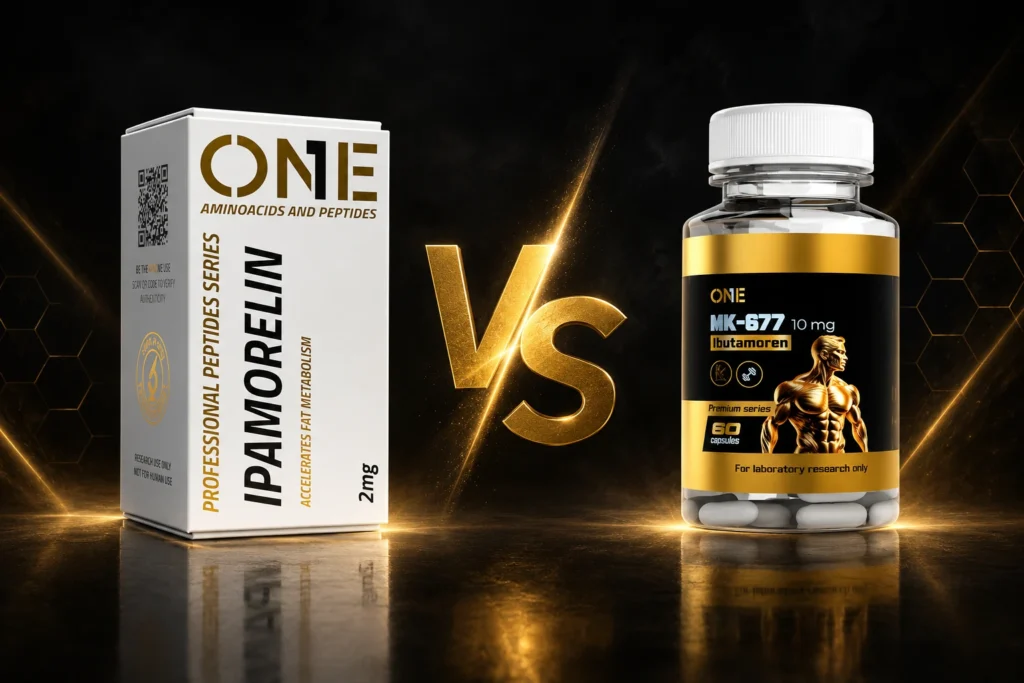
A research comparison of MK-677 and ipamorelin, focusing on GHS-R1a signaling, selectivity, administration route, human evidence and WADA status.
