 ES
 EN
 DE



Research reagent for laboratory use only. Not for human or veterinary use, diagnostic, or therapeutic purposes.
HPLC reports from an independent laboratory are published on the central HPLC methodology and lab reports page.
Related categories and reagents: In the context of this area of research, it is also worth comparing MK-2866 Ostarine and growth hormone secretagogues.
MK-677 vs ostarine and peptide secretagogues. These are three different classes despite appearing in adjacent catalogue sections. MK-677 (ibutamoren) is an orally active non-peptide agonist of the ghrelin receptor GHSR1a. MK-2866 (ostarine) does not act on the growth-hormone axis; it modulates the androgen receptor, which is a different receptor and pathway. Peptide secretagogues such as GHRP-2, GHRP-6 and ipamorelin act on the same receptor as MK-677, but they are peptides administered parenterally and have much shorter half-lives. In practical terms, MK-677 shares a receptor target with GHRPs but not with ostarine; its difference from GHRPs lies in molecular structure and route of administration rather than molecular target.
MK-677 vs ostarine (MK-2866). They are sometimes compared because of their similar catalog codes, but they belong to two different classes of compounds. MK-677 (528.7 g/mol, CAS 159634-47-6) is a nonpeptide agonist of the ghrelin receptor GHSR1a, described in the literature in the context of the growth hormone axis. Ostarine (389.33 g/mol, CAS 841205-47-8) is a selective androgen receptor modulator (SARM)—a different receptor, a different axis and a different body of literature. The difference concerns the molecular target, not potency.
MK-677 vs peptide GH secretagogues. Within the class of compounds described as stimulating growth hormone release, MK-677 differs structurally: it is a nonpeptide molecule with a mass of 528.7 g/mol, whereas GHRP-2 (817.97 g/mol), GHRP-6 (873.01 g/mol) and ipamorelin (711.85 g/mol) are peptides. The shared element is the GHS-R1a receptor; the chemical class differs.
One Peptides MK-677 Ibutamoren is a small-molecule research compound from the group of ghrelin receptor agonists — it is neither a peptide nor an androgen receptor modulator. The description covers chemical identity, batch quality, interaction with GHSR1a, effects on the GH-IGF axis and analytical parameters.
MK-677, also known as ibutamoren or MK-0677, has a well-documented research history. It was developed as a non-peptide growth hormone secretagogue and GHSR1a agonist. In the scientific literature, it occurs in both preclinical and historical clinical studies on sleep, the GH-IGF axis, body composition, and models of metabolic cachexia.
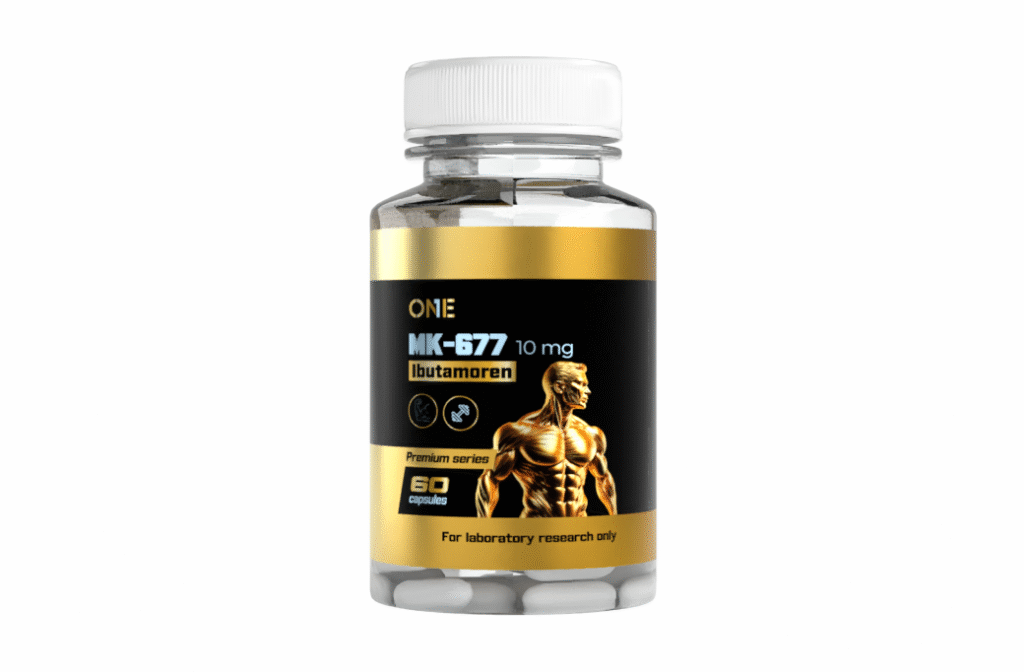
MK-677 is a non-peptide agonist of the GHSR1a ghrelin receptor. This receptor belongs to the family of G protein-coupled receptors and is involved in the regulation of growth hormone secretion, appetite, sleep architecture, energy management and selected neuroendocrine signals. The compound does not act as a classic GH-secreting peptide, but as a small molecule capable of activating the same molecular target.
| Active ingredient | Alternative names | Research characteristics |
|---|---|---|
| MK-677 | ibutamoren, MK-0677, L-163,191 | Non-peptide GHSR1a agonist used in research on the GH-IGF axis, sleep architecture, neuroendocrine expression and anti-doping analytics |
| Product parameter | Value |
|---|---|
| Brand | One Peptides |
| Packaging format | 60 capsule units |
| Status | Research Use Only (RUO) |
MK-677 is a small molecule ghrelin receptor agonist, described in PubChem as ibutamoren with the CID identifier 178024. In chemical documentation, it most often functions as the free base with a CAS 159634-47-6, although other forms are also found in the reference market, including salts. If the manufacturer does not explicitly state the type of salt, the laboratory should confirm this information by COA and MS spectrum.
| Parameter | Value |
|---|---|
| Code name | MK-677 |
| Other names | ibutamoren, MK-0677, L-163,191 |
| CAS | 159634-47-6 |
| PubChemCID | 178024 |
| Molecular formula | C27H36N4O5S |
| Molar mass | 528.7 g/mol |
| Chemical class | non-peptide GHSR1a agonist, GH secretagogue |
The structure of ibutamoren includes the spiro[indoline-piperidine system], a sulfonyl moiety, an amide, a benzyloxy fragment and a stereogenic center. This set of chemical functions gives the compound the character of a small-molecule ligand with moderate lipophilicity and pronounced receptor activity. From the laboratory’s point of view, this has two effects. First, the compound is well suited for LC-MS analysis. Secondly, it behaves differently than peptides, so it does not require the same working logic as peptide lyophilisates.
Publicly available chemical data indicate that MK-677 is a neutral molecule with a topological polar surface area of approximately 130 Ų and a logP in the range of approximately 1.3 for the free base according to the PubChem entry. These values are not sufficient to predict the behavior of each formulation, but they help to understand why the compound fits well into extraction and chromatographic models based on organic solvents.
With a product containing 60 solid units, not only the chemistry of MK-677 itself becomes important, but also the presence of a carrier. It can influence:
For this reason, good laboratory practice requires that the commercial material be treated as a matrix from which the main compound must first be reliably recovered before proceeding to receptor testing or quantitative analysis.
For a low-molecular-weight research material such as MK-677, cool, dry and light-protected conditions are most practical. After preparing the working solution, the stability depends on the solvent used, storage time and the number of heating and cooling cycles.
In laboratory work you should:
Nitrile gloves, safety glasses and a clean work surface remain standard. In cellular models, parallel control of the carrier and solvent is needed.
MK-677 acts as an agonist of the GHSR1a ghrelin receptor. This receptor has constitutive activity and participates in the regulation of the neuroendocrine growth axis. After ligand binding, Gq/11-dependent signaling is activated, leading to an increase in intracellular calcium and further cascades modulating GH secretion, the activity of hypothalamic neurons and selected metabolic parameters.
In 2021, structural data was published showing how ibutamoren interacts with the human ghrelin receptor. This study is important for the laboratory because it explains why a non-peptide agonist can activate the receptor similarly to ghrelin, even though its chemical structure is completely different. In practice, this means that MK-677 can serve as a tool for comparative studies between peptide and non-peptide GHSR1a agonists.
Historical clinical studies have shown that MK-677 increased parameters related to GH and IGF-1. The compound serves to study the neuroendocrine axis involving the hypothalamus, pituitary and liver. In experimental models, this allows us to analyze the dynamics of GH secretion, signal pulsatility and the relationship between GHSR1a activation and the secondary IGF response.
Published MK-677 studies have used polysomnography and endocrine-marker endpoints to examine how GHSR1a activation relates to central neuroendocrine rhythms. On an RUO product page, these observations should be read only as literature context for receptor research, not as product benefits or use guidance.
Longer-term literature also discusses broader metabolic safety markers. For laboratory work, those signals function as cautionary endpoints for protocol design and risk assessment, not as claims about expected effects in humans.
MK-677 is useful as a non-peptide agonist in projects comparing ghrelin receptor activation, intracellular signaling, and response profiles of different ligands.
In preclinical and translational studies, the compound is used to assess GH secretion, changes in IGF-1 and secondary responses in tissues dependent on this axis.
Historical receptor research makes ibutamoren relevant for projects on neuroendocrine rhythm markers and GHSR1a activation.
Because the literature describes broader metabolic safety markers, MK-677 may also be used in projects analyzing the wider physiological cost of GHSR1a activation.
Ibutamoren is included in the WADA documents in force from January 1, 2026 in the group of growth hormone secretagogues and their mimetics. This makes it an important analyte in LC-MS/MS methods for anti-doping laboratories.
You need to be careful with MK-677 for three reasons. First, a compound can come in a variety of chemical forms, and without a COA, there is no way to tell whether a batch corresponds to the free base. Secondly, material packaged in solid units requires validation of recovery and homogeneity. Thirdly, the literature indicates a broader metabolic profile than mere activation of the GH-IGF axis, so the results must be analyzed in a multidimensional manner.
In practice, a good product page should separate:
One Peptides MK-677 Ibutamoren is a RUO chemical reagent from the field of GHSR1a ghrelin receptor agonists, packaged in 60 solid units. From a scientific point of view, what is most important here is the combination of well-described small-molecule chemistry, recognized receptor mechanism and extensive literature covering the GH-IGF axis, sleep architecture and metabolic parameters.
NO. MK-677 is a non-peptide agonist of the GHSR1a ghrelin receptor.
Yes. Ibutamoren is the international name of a compound researched as MK-677 or MK-0677.
Because there are various forms of ibutamoren on the market. Without COA and LC-MS, it should not be assumed that each batch corresponds to the free base described in PubChem.
Most often, these are studies on GHSR1a, the GH-IGF axis, sleep architecture, neuroendocrine signals and anti-doping analytics.
The most practical conditions are cool, dry and protected from light, consistent with the extraction procedure used in the given laboratory.
Related research: MK-677 mechanism and research applications · MK-677 vs HGH Fragment 176-191 — two approaches to the GH axis · MK-677 research reagents
 DHL Express
Have a question about this product? Ask it below. We publish questions together with our answer after review.
No questions yet. Be the first to ask.




Valoraciones
No hay valoraciones aún.