 ES
 EN
 DE



Semaglutide – Research Use Only (RUO) – A chemical not intended for human consumption or diagnostic purposes.
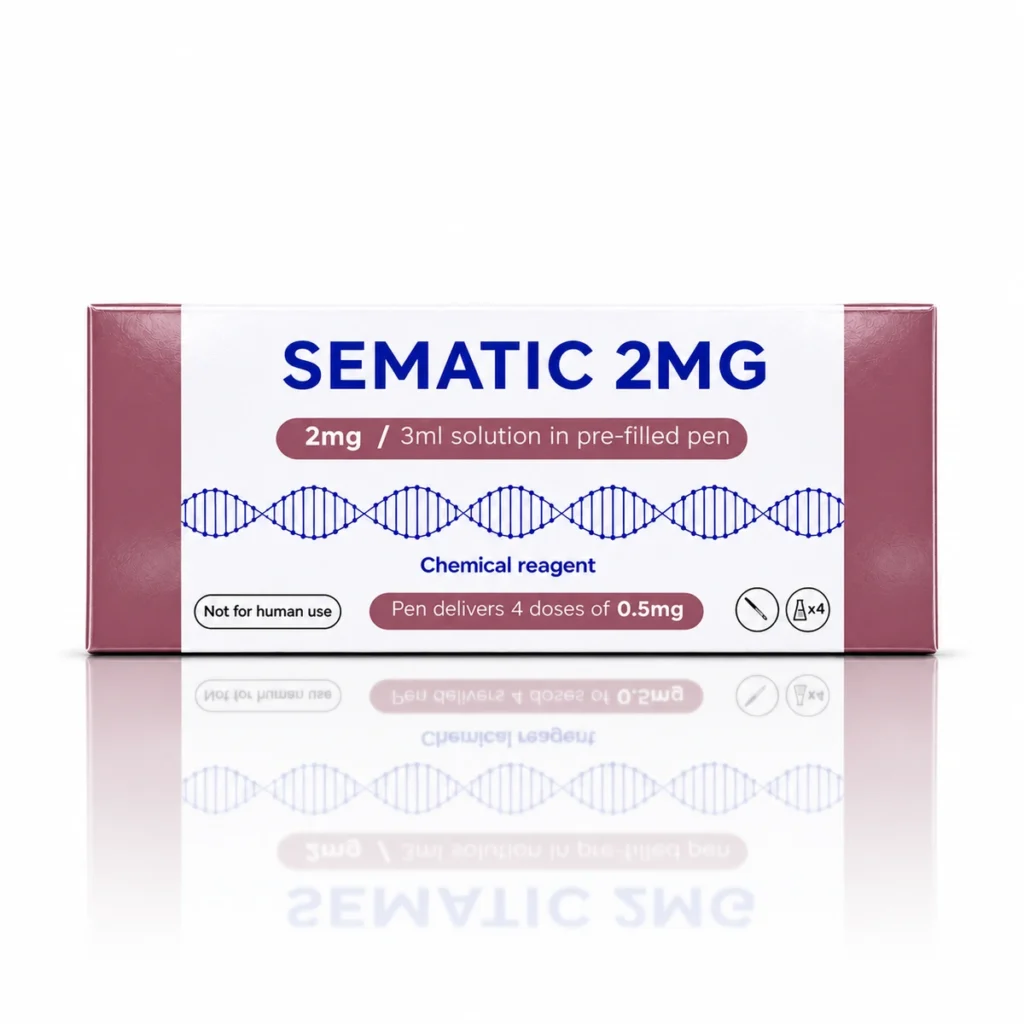
Semaglutide is a synthetic analogue of glucagon-like peptide-1 (GLP-1), classified as a chemical reagent intended for research uses only. The molecule is one of the most widely studied GLP-1R receptor agonists in the context of regulating metabolic homeostasis in cellular and animal models. The same peptide as a ready-made solution in a pen, with no lyophilisate reconstitution, is described on the SEMATIC 2 mg PEN page.
Structurally, semaglutide is based on native human GLP-1(7-37), in the sequence of which two amino acid modifications were introduced (Aib at position 8, Arg→Arg34) and acylation with a C18 fatty acid (octadecandioic acid) via a gamma-glutamate linker at position Lys26. These modifications endow the molecule with resistance to degradation by DPP-4 and the ability to reversibly bind to serum albumin, which in pharmacokinetic models translates into a significantly extended half-life compared to native GLP-1.
The first reports of semaglutia in the scientific literature appeared as part of the Novo Nordisk research program. Since then, the molecule has become a reference substance in research on the incretin pathway and its role in energy metabolism.
Semaglutide belongs to the class of long-acting GLP-1 receptor agonists – group synthetic peptides designed to activate the GLP-1R receptor (class B GPCR receptor) with a prolonged pharmacokinetic profile.
Receptor GLP-1R it is expressed in many types of tissues: beta cells of the islets of Langerhans of the pancreas, hypothalamic neurons (arcuate nucleus, nucleus of the solitary tract), cardiomyocytes, vascular endothelial cells and hepatocytes. This wide tissue distribution makes semaglutide a research tool with a wide range of applications – from the biology of pancreatic islets to the neurobiology of energy balance regulation.
In the preclinical literature, semaglutide is often used as a comparator in studies of newer multireceptor agonists such as tirzepatide (bi-receptor GIP/GLP-1) or retatrutide (triple GIP/GLP-1/glucagon).

Semaglutide is an acylated GLP-1 analogue with a sequence based on human GLP-1(7-37) with the following modifications:
|
Parameter |
Value |
| Type | synthetic acylated peptide |
| Class | GLP-1R receptor agonist |
| Sequence | 31 amino acids (modified) |
| Molar mass | ~4113.58 Da |
| Summary formula | C₁₈₇H₂₉₁N₄₅O₅₉ |
| Form in the preparation | lyophilisate, 2 mg |
| CAS (semaglutide) | 910463-68-2 |
Semaglutide adopts an alpha-helical conformation typical of glucagon family peptides. The C18 acyl chain protrudes from the surface of the helix and forms a hydrophobic albumin-binding domain. Crystallographic studies and molecular modeling indicate that the peptide fragment responsible for the interaction with GLP-1R covers positions 7–30, while the C-terminal part of the chain stabilizes the helix conformation.
The GLP-1R receptor belongs to the GPCR (secretin family) class B receptor family. After binding of semaglutide to the extracellular domain (ECD) and the transmembrane region of the receptor, a conformational change occurs, activation of the Gs protein and an increase in the intracellular cAMP concentration.
The signal cascade is as follows:
cAMP → PKA → CREB — activation of transcription of genes dependent on the CRE element (cAMP Response Element), including proinsulin genes in pancreatic beta cells.
cAMP → Epac2 → Rap1 — PKA-independent pathway leading to exocytosis of insulin granules. Studies on INS-1E cells showed that semaglutide at a concentration of 1–10 nM increases glucose-dependent insulin secretion with EC₅₀ comparable to native GLP-1.
PI3K/Akt – activation of the survival pathway in beta cells. In INS-1 cell cultures exposed to glucotoxic conditions (25 mM glucose), semaglutide reduced apoptosis as measured by caspase-3 activity by 40–60% compared to controls.
In studies in a mouse model (C57BL/6, ob/ob mice) after peripheral exposure to semaglutide, the following were observed:
The effect of these neuronal changes was a statistically significant reduction in food consumption by animals (p<0.001) and a change in food preferences towards a low-fat diet in the two-choice test.
In studies in Wistar rats, semaglutide prolonged gastric emptying time measured by the acetaminophen test (pharmacokinetics of acetaminophen absorption as a proxy for gastric emptying). The mechanism is related to the activation of afferent fibers of the vagus nerve and modulation of the vomiting center in the area postrema.
In mouse hepatocytes (AML12 line) exposed to semaglutide:
In a high-fat diet-induced hepatic steatosis model (C57BL/6 mice on an HFD diet for 12 weeks), semaglutide exposure led to a 35–50% reduction in hepatic triglycerides compared to the control group.
Semaglutide 2 mg as a research reagent is used in the following areas:
Study of glucose-dependent insulin secretion in isolated islets of Langerhans. Assessment of the effect on beta cell viability and proliferation under conditions of glucotoxicity and lipotoxicity. Potency comparison with other GLP-1R agonists (liraglutide, exendin-4).
Mapping of neuronal activation (c-Fos, pSTAT3) in the hypothalamus and brainstem after semaglutide exposure. Study of the interaction between the incretin pathway and leptin signaling. Analysis of changes in the expression of neuropeptides (POMC, CART, NPY, AgRP) using immunohistochemical and qPCR methods.
To evaluate the effects of semaglutide on steatosis, inflammation and fibrosis in mouse models induced by high-fat diet or methionine/choline deficiency (MCD). Histological (NAS score) and biochemical (ALT, AST, liver triglycerides) analysis.
Study of the effect of GLP-1R activation on cardiomyocytes in ischemia/reperfusion models. Assessment of the expression of oxidative stress markers (SOD2, catalase, GPx) and apoptosis markers (caspase-3, Bcl-2/Bax) in cardiac tissue.
Semaglutide, as a monoreceptor GLP-1R agonist, serves as a reference comparator in studies with tirzepatide (GIP/GLP-1) and retatrutide (GIP/GLP-1/glucagon) – enabling determination of the additive contribution of additional receptors.
Based on the available preclinical literature, semaglutide 2 mg is a versatile research tool due to:
What is the mechanism of the prolonged half-life of semaglutide?
Acylation with octadecandioic acid (C18) at the Lys26 position allows reversible binding to serum albumin (>99% binding). Albumin acts as a reservoir from which semaglutide is gradually released. Additionally, the Ala8→Aib substitution protects against cleavage by DPP-4, which degrades native GLP-1 within 2–3 minutes.
How does semaglutide differ from liraglutide in in vitro studies?
Both are acylated analogues of GLP-1, but differ in acyl chain length (C18 vs. C16) and linker type. Semaglutide has a higher affinity for albumin and a longer half-life. In studies on INS-1E cells, the cAMP activation profile is comparable, but the differences are visible in the kinetics – semaglutide maintains activation for a longer time.
What working concentrations are used in studies on cell lines?
In published in vitro studies, the range of 0.1–100 nM was most commonly used. The EC₅₀ for cAMP activation in HEK293 cells overexpressing GLP-1R is ~0.2 nM. In studies of insulin secretion in the islets of Langerhans, concentrations of 1–10 nM were used.
How should semaglutide be stored after reconstitution?
Store the reconstituted solution at 2–8°C, protected from light and repeated freezing/thawing. Use within 14 days. Before reconstitution, the lyophilisate is stable at -20°C for a minimum of 24 months.
What analytical methods are used to verify purity?
Recommended: RP-HPLC (C18, acetonitrile gradient) with UV detection at 220 nm to assess purity (>98%), LC-MS/MS to confirm molar mass and acyl chain integrity, LAL test to determine bacterial endotoxins (<0.25 EU/mg).
 DHL Express
Have a question about this product? Ask it below. We publish questions together with our answer after review.
No questions yet. Be the first to ask.




Valoraciones
No hay valoraciones aún.