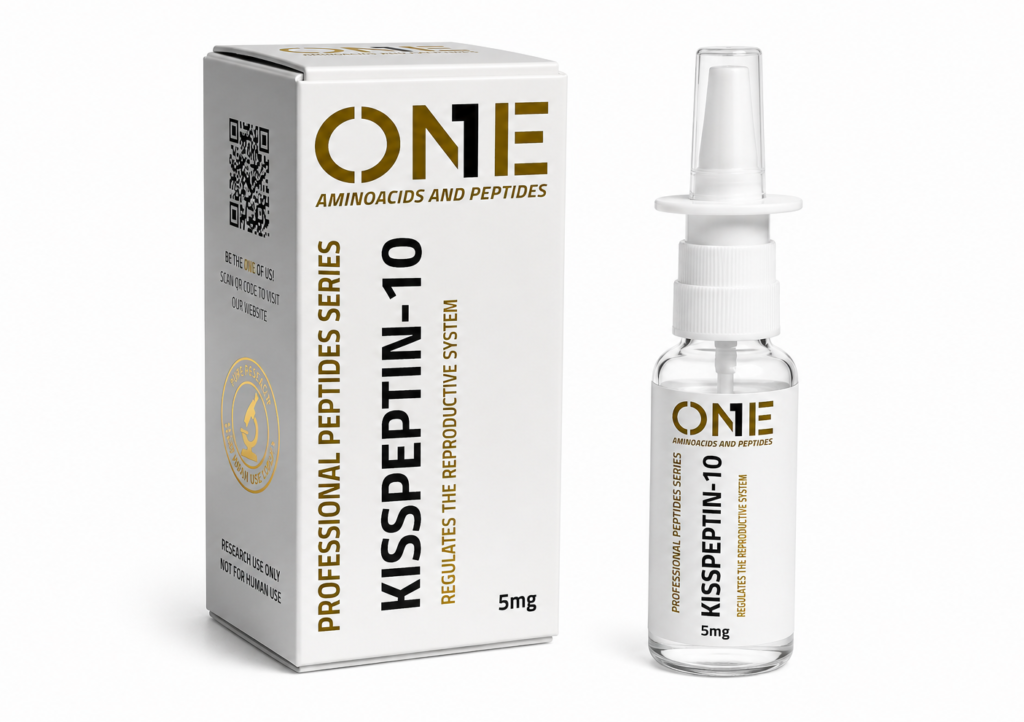
Kisspeptin – a neuropeptide for research on the reproductive axis and the GPR54 receptor
Kisspeptin is a neuropeptide encoded by the KISS1 gene. It occurs in nature in several forms, of which Kisspeptin-10 – the active C-terminal fragment – is most often used in experimental studies. It plays a central role in research on the regulation of GnRH release, activation of the GPR54 receptor (KISS1R) and the functioning of the reproductive axis in animal models. It is a tool for neuroendocrine research on reproduction. A substance intended exclusively for scientific research (Research Use Only) – it is not a medicinal product. Check out Kisspeptin-10 in the One Peptides offer.
See also the full section research peptides.
What is Kisspeptin?
Kisspeptin is a family of peptides produced by the proteolysis of a precursor protein encoded by the KISS1 gene (formerly known as the metastasis suppressor gene, discovered in 1996 in Hershey, Pennsylvania – hence the name referring to Hershey’s Kisses chocolates). The main form – Kisspeptin-54 (formerly called metastin) – consists of 54 amino acid residues. It produces shorter, biologically active fragments: Kisspeptin-14, Kisspeptin-13 and Kisspeptin-10.
All active forms of Kisspeptin act through the GPR54 receptor (KISS1R), a member of the G protein-coupled receptor (GPCR) family. The breakthrough discovery of the role of Kisspeptin occurred in 2003, when two independent research teams showed that mutations inactivating the GPR54 receptor lead to lack of sexual maturation in animal models. It turned out that kisspeptin neurons in the arcuate nucleus and paraventricular nucleus of the hypothalamus are the master regulator of gonadotropin-releasing hormone (GnRH) release.
The mechanism of action includes activation of GPR54 on GnRH neurons, stimulation of the Gq/11-PLC-IP3 pathway, increase in intracellular calcium concentration and, as a result, release of GnRH into the pituitary portal system.
Kisspeptin variants available
| Product |
Form |
Quantity |
| KISSPEPTIN-10 5 mg |
Lyophilisate |
5 mg |
The product is supplied with a Certificate of Analysis (CoA) covering HPLC and MS data. Full specifications and documentation are available on the product card.
Kisspeptin-10 5 mg – product characteristics
Kisspeptin-10 in the One Peptides offer is available in the form of a 5 mg lyophilisate. Kisspeptin-10 is a C-terminal decapeptide that is the shortest fragment that retains full activity towards the GPR54 receptor (KISS1R). Its advantages include easier synthesis, higher solubility and well-characterized biological activity in cellular and animal models. The 5 mg preparation is suitable both for in vitro experiments examining GPR54 activation and stimulation of the GnRH axis, as well as for in vivo studies on animal models. This amount allows for a series of experiments with multiple replicates to be carried out within one research project.
How does Kisspeptin differ from similar peptides?
Kisspeptin vs PT-141 (Bremelanotide)
Kisspeptin and PT-141 are studied in the context of the reproductive axis, but they work through completely different mechanisms. Kisspeptin activates the GPR54 receptor (KISS1R), stimulating the release of GnRH from hypothalamic neurons, which initiates the HPG (hypothalamic-pituitary-gonadal axis) cascade. PT-141, on the other hand, is an agonist of melanocortin receptors (mainly MC3R and MC4R) and acts at the level of the central nervous system through melanocortin pathways, independent of the GnRH axis. These two peptides therefore represent two different experimental approaches to the study of neuronal mechanisms of regulation of reproductive functions. See category PT-141
Kisspeptin vs GnRH analogues
Kisspeptin acts “above” GnRH in the reproductive axis hierarchy – it stimulates the endogenous release of GnRH from hypothalamic neurons. GnRH analogues (agonists and antagonists) act directly on the GnRH-R receptor in the pituitary. This difference has important experimental implications: Kisspeptin allows the study of regulation at the level of the hypothalamus while maintaining the physiological pulsatility of GnRH, while GnRH analogues bypass this level of regulation and act directly on pituitary gonadotropes. The choice between them depends on the level of the axis on which the study focuses.
FAQ – Frequently asked questions
1. Why is Kisspeptin called the “masterregulator” of the reproductive axis?
This term results from the position of kisspeptin neurons in the hierarchy of the HPG axis. In animal models, it has been shown that KISS1 neurons in the hypothalamus integrate metabolic, photoperiodic and steroid signals and then – through activation of GPR54 on GnRH neurons – initiate the entire reproductive cascade. Inactivation of the KISS1 or GPR54 gene leads to lack of sexual maturation.
2. What is the difference between Kisspeptin-10 and Kisspeptin-54?
Kisspeptin-10 is a C-terminal decapeptide constituting the minimal active fragment sufficient to fully activate the GPR54 receptor. Kisspeptin-54 (Metastin) is a complete endogenous form of the peptide containing 54 amino acid residues. Both bind GPR54, but may differ in pharmacokinetics, half-life and tissue distribution in animal models. One Peptides’ offer includes Kisspeptin-10, which is the most frequently used form in experimental research.
3. Is Kisspeptin a medicinal product?
NO. Kisspeptin in the One Peptides offer is a substance intended exclusively for scientific research (Research Use Only). It is not a medicinal product, dietary supplement or food for consumption.
4. How to store Kisspeptin?
Lyophilized Kisspeptin should be stored at -20 C, in a dry place protected from light. After reconstitution, the solution should be divided into aliquots and stored at -20 C, avoiding repeated freezing and thawing. Storage recommendations are included on the product SDS.
5. Does Kisspeptin affect other systems beyond the reproductive axis?
Yes, the GPR54 receptor is also expressed outside the hypothalamus, among others. in the pancreas, placenta and some cell lines. Research on the non-reproductive roles of Kisspeptin, including its originally discovered function in the context of metastasis suppression (KISS1 gene as a tumor suppressor gene), is an active area of research. However, most of the scientific literature focuses on the role of Kisspeptin in the HPG axis.
Quality and standards at One Peptides
Kisspeptin-10 offered by One Peptides is subject to quality control, including analysis of purity by HPLC and confirmation of identity by mass spectrometry (MS). Each batch has a certificate of analysis (CoA) and a safety data sheet (SDS). Quality documentation is available for download directly on the product page.
 ES
ES  EN
EN  DE
DE