
Mixing peptides with bacteriostatic water means reconstituting a freeze-dried (lyophilized) research peptide by adding a measured volume of bacteriostatic water to the vial, letting the diluent run gently down the inner wall, and allowing the powder to dissolve into a solution of known concentration for laboratory work. The technique is deliberately gentle, and the volume […]

You do not have to refrigerate unopened bacteriostatic water — sealed vials are stable at controlled room temperature. Once the closure is first punctured, the vial enters its in-use period: bacteriostatic water for injection is commonly labeled for use within about 28 days after first entry, and many labs refrigerate it during that window to […]
Benzyl alcohol is the antimicrobial preservative that defines bacteriostatic water for injection. Present at 0.9% (9 mg/mL), it inhibits bacterial growth between withdrawals, which is what allows a single vial to be entered multiple times during laboratory reconstitution of research peptides without the diluent itself becoming a contamination route. ℹ️ Research-use context: this article describes […]
Bacteriostatic water is sterile Water for Injection that contains 0.9% (9 mg/mL) benzyl alcohol as a bacteriostatic preservative, manufactured under pharmacopeial aseptic conditions in a multiple-dose container. In a laboratory setting it serves as a diluent for reconstituting research peptides, where the preservative lets a vial be punctured repeatedly while limiting microbial growth between withdrawals. […]
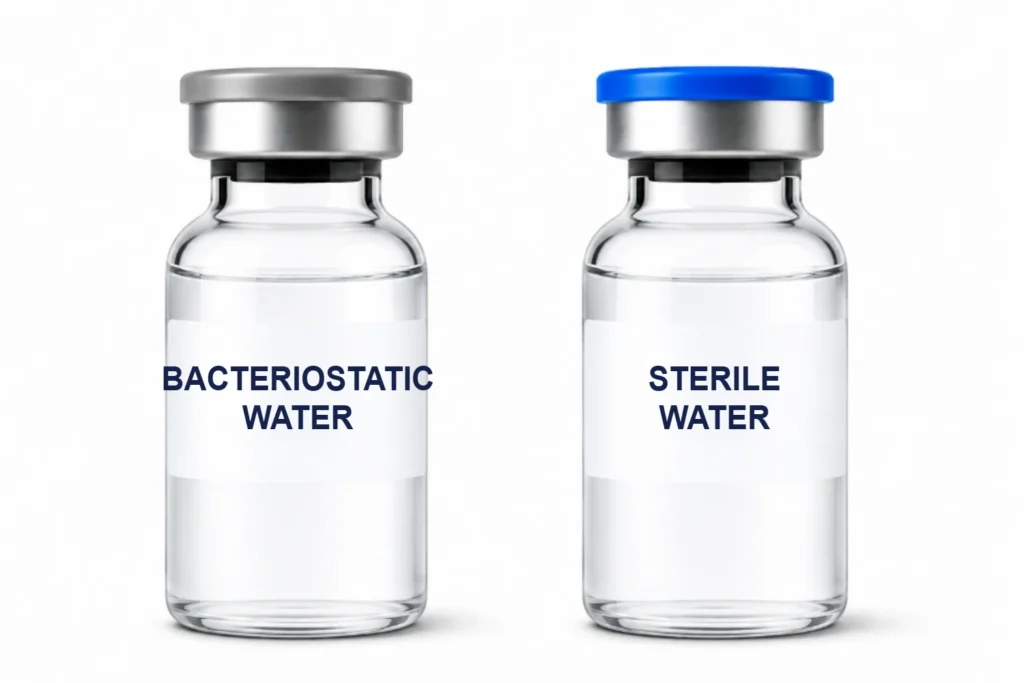
Bacteriostatic water is sterile water that contains a small amount of an antimicrobial preservative — usually 0.9% (9 mg/mL) benzyl alcohol — which suppresses bacterial growth and allows a multiple-dose vial to be entered repeatedly over time. Sterile water for injection (SWFI) contains no preservative and is intended for single use. In the lab, that […]
The peptide calculator helps you avoid mistakes when working with research peptides. The most common error is not a reconstitution error or a storage error. The most common error is an arithmetic error – confusion between milligrams and micrograms, between milliliters and “units” on an insulin syringe, between mass concentration and molar concentration. It rarely costs the health of the sample and often the precision of the experiment – which […]

The certificate of peptide analysis usually comes to you as a one-page PDF file or paper scan. At first glance – a few logos, a table with numbers, percentage of purity next to the HPLC heading, somewhere below the mass spectrum or its numerical representation. Most researchers only look at one number: purity. If they see “≥98%”, they consider it resolved and proceed to […]
The most common misunderstanding when working with research peptides isn’t about reconstitution or dosing – it’s about storage. In the laboratory, you can find vials of BPC-157 left on the counter over the weekend, ampoules of TB-500 repeatedly frozen and thawed during the experiment, and semaglutide stored for a year in the refrigerator door next to the milk. Each of these cases is an error that will not be revealed […]
The first vial of bacteriostatic water was developed in the 1940s by the American pharmaceutical company E.R. Squibb & Sons in response to a concrete hospital problem: physicians administering injectable drugs needed a solvent that would not be contaminated after the first puncture and would allow repeated withdrawals from the same vial over a period […]
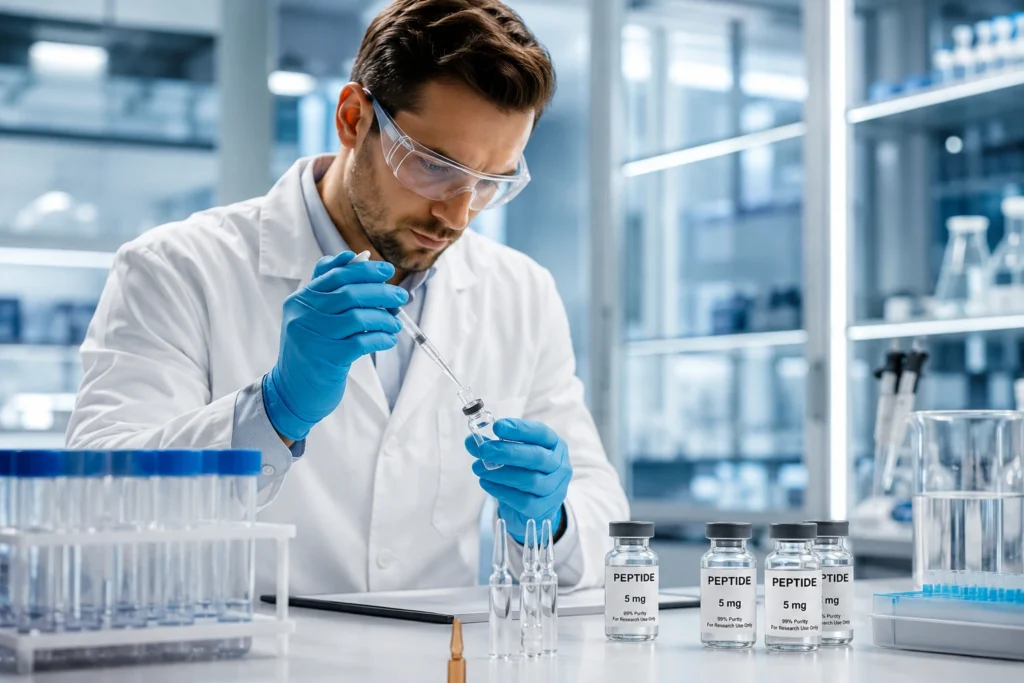
A lyophilizate looks surprisingly small. You open the vial and see a thin, almost invisible layer of white powder at the bottom of the glass — sometimes it is hard to believe this is ten milligrams of a peptide whose price equals several hours of a synthesist’s work. First reflex — tilt the vial, tap […]
 ES
 EN
 DE

