ES
ES  EN
EN  DE
DE 
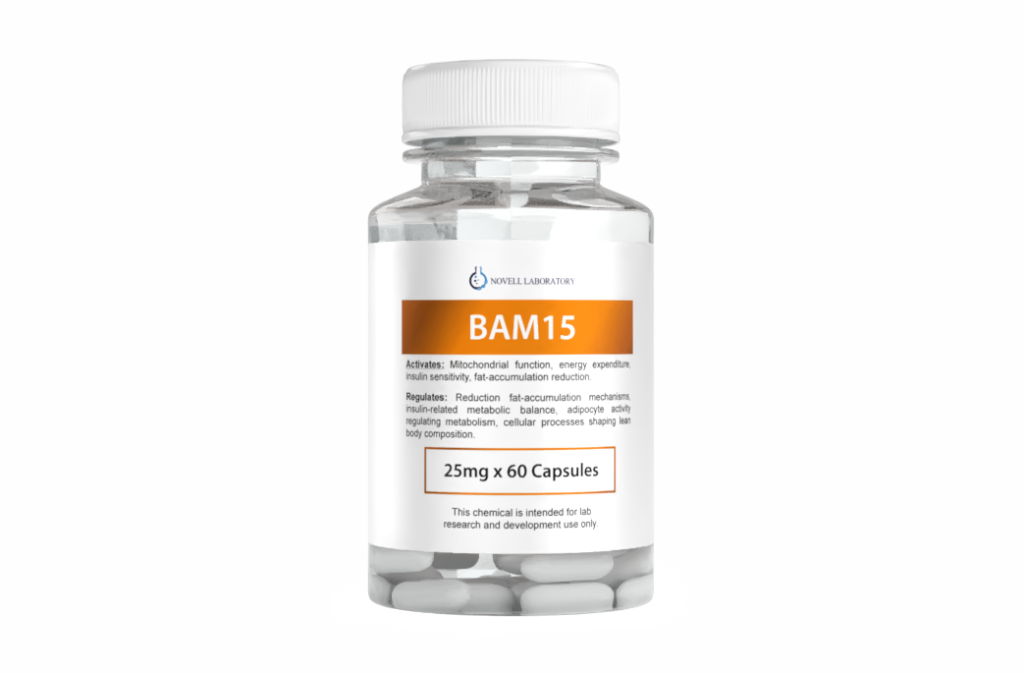
Category includes BAM-15 — a small organic molecule from the class of mitochondrial protonophore uncouplers, studied in academic laboratories since around 2014 as a candidate for models of obesity and non-alcoholic fatty liver disease (NAFLD/MASH). This NOT a peptide — is a synthetic small organic molecule with a mass of ~415 Da, designed with mitochondrial selectivity, unlike the historical, toxic DNP. Capsules are available in the catalog BAM-15 25 mg, 60 pieces in the HPLC standard ≥98%, with confirmation of identity by mass spectrometry (MS) and full batch documentation (COA). Category position in the One Peptides catalog: chemical reagent intended only for laboratory tests (RUO) — no indications for use in humans. Browse the available variants below and check the specifications in the COA before purchasing.
RUO status. BAM-15 is a chemical reagent for in vitro and ex vivo laboratory tests. It is not a medicinal product, dietary supplement or food. Not applicable to humans or companion animals.
BAM-15 is one of the entries in the full list of metabolic modulators in the catalogue (RUO).
BAM-15 (systematic name: 2-fluorophenyl-{6-[(2-fluorophenyl)amino]-(1,2,5-oxadiazolo[3,4-e]pyrazin-5-yl)}-amine) is a small organic molecule from the class mitochondrial protonophore uncouplers. The compound was described in 2014 by the team of Kenwood and colleagues as a candidate for models of pharmacological uncoupling of oxidative phosphorylation with improved mitochondrial selectivity towards older 2,4-dinitrophenol (DNP)-type uncouplers.
Unlike the research peptides dominating the One Peptides catalog, BAM-15 is not a peptide molecule – it is a synthetic organic compound weighing ~415 Da, insensitive to gastrointestinal proteases, formulated in encapsulated form as an RUO reagent.
| Characteristic | BAM-15 |
|---|---|
| Relationship class | Small organic molecule – mitochondrial protonophore uncoupler |
| Chemical type | Oxadiazole-pyrazine derivative (NOT peptide) |
| Molecular mass | ~415 Da |
| Mechanism | Proton transport across the inner mitochondrial membrane |
| Origin | Academic laboratories, original description circa 2014 (Kenwood lab) |
| Form in the catalogue | Cápsulas |
| Contents | 25 mg/capsule, 60 capsules per pack |
| HPLC purity | ≥98% |
| Identity confirmation | Mass spectrometry (MS) |
| Documentation | COA per batch, batch traceability, cold chain storage |
| Regulatory status | Research Use Only – no registration as a drug or supplement |
In a healthy cell, the inner mitochondrial membrane is virtually impermeable to protons. The respiratory chain pumps protons out of the mitochondrial matrix into the intermembrane space, building an electrochemical gradient. The return of protons to the matrix by ATP synthase (complex V) drives ATP production. This is Mitchell’s classic chemiosmotic hypothesis.
Mitochondrial uncoupler is a compound that creates an alternative path for proton return – bypassing ATP synthase. The proton gradient is constantly dissipated as heat, and energy from the oxidation of substrates (fatty acids, glucose, amino acids) is not stored in the ATP phosphate bonds. The respiratory chain works at an accelerated speed to maintain the gradient – which translates into an increase in energy expenditure measured as increased oxygen consumption and heat emission.
In mouse models, simultaneous activation of the AMPK pathway – a sensor of the low energy state of the cell – has been described. A decrease in the ATP/ADP ratio and an increase in AMP activate AMPK, which inhibits anabolic processes (synthesis of fatty acids, cholesterol) and activates catabolism (oxidation of fatty acids, mitochondrial biogenesis).
Mitochondrial selectivity of BAM-15 vs. DNP. Classic DNP uncouples not only mitochondria, but also other cell membranes (lysosomes, plasma membrane) – this is the reason for the narrow margin between the desired dose and lethal hyperthermia. The BAM-15 is designed as an uncoupler selective for the inner mitochondrial membrane — in in vitro models, no significant uncoupling of other membranes was observed at concentrations that effectively uncoupled mitochondria. In mouse models, the dramatic increase in body temperature typical of DNP poisoning was not reported, despite a marked increase in energy expenditure.
This mechanistic selectivity confirmed in in vitro and mouse models — this is not the same as proven safety in humans. We discuss this difference in the next section.
2,4-dinitrophenol (DNP) was briefly used in the 1930s as a weight loss drug. In 1938, the FDA withdrew DNP from the market after a series of deaths caused by hyperthermia, metabolic acidosis, and multi-organ failure. DNP remains a banned substance in consumer trade in the US, EU and most jurisdictions – occasional fatal poisonings mainly concern the illegal weight loss market.
BAM-15 was designed decades later with a mechanistic premise: mild uncoupler with a narrow window of action located mitochondrially. The architecture of the molecule limits uncoupling to the inner mitochondrial membrane, which theoretically increases the margin of safety.
| Record element | BAM-15 | DNP |
|---|---|---|
| In vitro models (isolated mitochondria, cells) | Yes – mechanism profile described | Yes – historical data |
| Animal models (mice, rats) | Yes – effects on body weight, glucose, NAFLD in rodent models | Yes – historical |
| Early Phase I studies in humans | Mentions of clinical programs at individual biotech companies | No modern attempts |
| Phase II/III in humans | None completed | Not applicable – substance withdrawn |
| Registration as a medicine (EMA, FDA, MHRA) | Lack | Withdrawn in 1938 (FDA) |
| Long-term safety in humans | No data available | Negative (deaths) |
Conclusion for the researcher: mechanistically, BAM-15 presents a significantly more favorable profile than DNP. However, at the level of clinical records there are no long-term human data — arguing for safety in humans remains a hypothesis drawn from rodent models. This is the meaning of the full label Research Use Only in the category description.
There is one variant available in the catalog – BAM-15 25 mg in capsules, 60 pieces per package. The encapsulated form facilitates precise measurement in ex vivo laboratory protocols and work with isolated tissues at milligram concentrations. This It is NOT a form intended for human consumption — a capsule is a standard storage packaging for a reagent, analogously to the packaging of SARMs in RUO capsules.
Quality standards of batches available in the category:
A batch that does not meet any of these five rules does not leave the warehouse. A full description of quality control procedures can be found in the section quality tests and certificates.
No registration as a medicinal product. BAM-15 does not have EMA (European Medicines Agency) or FDA (US Food and Drug Administration) registration. It is not approved for any clinical indication – it is not on the market as a treatment for obesity, NAFLD/MASH, type 2 diabetes, or any other indication.
No dietary supplement status. EFSA (European Food Safety Authority) has not assessed BAM-15 as a food ingredient or supplement. The compound is not on the list of permitted food ingredients in the EU – the formulation of BAM-15 as a dietary supplement in the EU is inconsistent with Regulation 1924/2006 on health and nutrition claims.
Catalog classification: Research Use Only (RUO). BAM-15 operates internationally as chemical reagent for laboratory tests — analogous to most SARMs and research peptides. The RUO label means that the product is intended for in vitro and ex vivo testing in laboratory conditions, with no indication for use in humans or companion animals.
WADA status. BAM-15 (BAM15) is named on the WADA Prohibited List for 2026 — section S4.4.1 (metabolic modulators, AMPK activators); it is prohibited at all times, in and out of competition. A researcher working with BAM-15 and subject to anti-doping control should verify the current WADA Prohibited List and national agency guidelines before use.
Position in the One Peptides catalog: chemical reagent RUO. No indications for use in humans. No health claims. No suggestions for weight loss, metabolic improvements, or other health benefits for the buyer.
How does BAM-15 differ from DNP?
Both compounds belong to the class of mitochondrial protonophore uncouplers – both create an alternative route for proton return across the inner mitochondrial membrane and dissipate the gradient as heat. The difference lies in selectivity. DNP uncouples not only mitochondria, but also other cell membranes (lysosomes, plasma membrane), which, even at a moderate dose, leads to lethal hyperthermia – DNP was withdrawn from consumer circulation in 1938 after a series of deaths. BAM-15 was designed as a mitochondria-selective uncoupler, with a mechanistically more favorable profile in in vitro and murine models. This does not indicate proven safety in humans – there are no long-term clinical data for BAM-15.
Does BAM-15 burn fat in humans?
In mouse models, a decrease in fat mass, improvement in glucose tolerance, and a reduction in hepatic steatosis have been reported when fed a high-fat diet. Mechanistically consistent with uncoupling of oxidative phosphorylation and increase in energy expenditure. But controlled trials (RCTs) in humans have not been completed — the effects reported in rodent models are not identical to the proven clinical effects in humans. Any human use of BAM-15 is outside the current record and outside the permitted regulatory framework in which the compound operates.
Is BAM-15 registered as a drug or supplement?
NO. BAM-15 is not registered as a medicinal product with the EMA or FDA – it does not function as a medicine for any indication. EFSA has not approved the compound as a food ingredient or dietary supplement in the European Union. In international trade, BAM-15 is only available as chemical reagent RUO — product for in vitro and ex vivo laboratory tests, with no indications for use in humans.
What exactly does “research chemical” mean in the One Peptides catalog?
Research chemical (or Research Use Only, RUO) is the regulatory status of a chemical reagent intended for laboratory research—in in vitro cell models, ex vivo isolated tissues, or in analytical protocols. The RUO label means manufacturer and seller do not make any claims regarding the use of the product in humans or companion animals. Quality standards (HPLC ≥98%, MS, COA per batch, cold chain) refer to chemical purity and batch identity – not to human biosafety. An identical regulatory framework covers SARMs and most research peptides in the catalog.
Is BAM-15 on the WADA list?
Yes. BAM-15 (BAM15) is named on the WADA Prohibited List for 2026 — section S4.4.1 (metabolic modulators, AMPK activators). It is prohibited at all times, in and out of competition. A doping-controlled researcher should check the current version of the List and national agency guidelines before use.
All items in this category are chemical reagents intended only for laboratory tests (Research Use Only). BAM-15 is not a medicinal product, dietary supplement or food. No EMA or FDA registration. No EFSA assessment. There are no long-term clinical studies in humans. No indications for use in humans or companion animals. No claims of weight loss, improved body composition or other health benefits for the buyer. WADA Status – A doping-controlled investigator verifies the current Prohibited List prior to use.
We offer a wide selection of peptides tailored to a range of laboratory analytical needs.
Every batch is tested for identity and purity (HPLC, MS) and comes with a certificate of analysis.
We invest in analytical testing and full batch documentation for every product.
Nuestras numerosas reseñas positivas reflejan la satisfacción de nuestros clientes que siguen regresando por más.
¡Suscríbete al boletín!
Obtén un 10% de descuento en tu primera compra
One-Peptides.com
Información

© 2026 ONE-PEPTIDES.COM