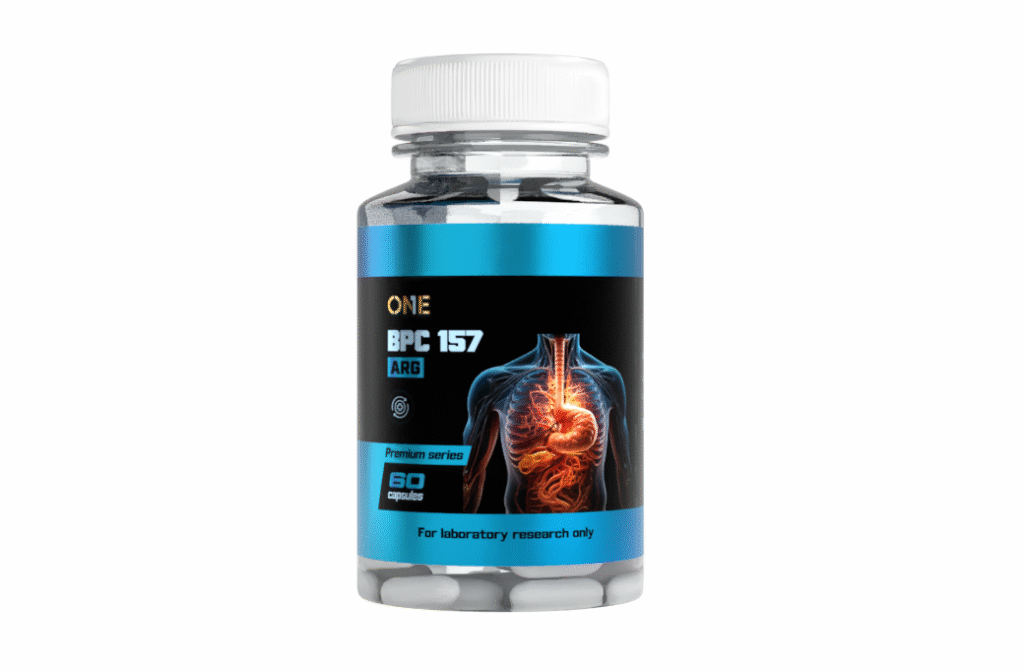
BPC-157 – regenerative peptides
BPC-157 (Body Protection Compound-157) is a synthetic pentadecapeptide consisting of 15 amino acids, which is a fragment of a natural protective protein isolated from gastric juice. Since the 1990s, BPC-157 has remained one of the most intensively studied peptides in the context of tissue repair processes in animal models and cell cultures. Substance intended for research use only (Research Use Only). Browse available BPC-157 variants below — including the BPC-157 10 mg research vial and arginine-salt variants — or learn more about this peptide and its research potential.
What is BPC-157?
BPC-157 (Body Protection Compound-157) is a pentadecapeptide with the sequence Gly-Glu-Pro-Pro-Pro-Gly-Lys-Pro-Ala-Asp-Asp-Ala-Gly-Leu-Val, first described in the 1990s by the research team of Prof. Predrag Sikirić from the University of Zagreb. This peptide is a fragment of a larger BPC (Body Protection Compound) protein, which occurs naturally in the gastric juice of humans and other mammals.
Unlike many research peptides, BPC-157 shows extraordinary stability in aqueous solutions, even in low pH environments – which is rare among peptides of this molecular weight (approximately 1419 Da). This stability makes it a particularly interesting subject of in vitro research.
The mechanism of action of BPC-157 at the molecular level has not been fully elucidated, but scientific literature describes its effect on the NO (nitric oxide) pathway, interactions with the dopamine system and modulation of the expression of growth factors, including VEGF (vascular endothelial growth factor) and EGF (epidermal growth factor). Studies on animal models (Wistar rats, C57BL/6 mice) indicate the involvement of BPC-157 in the processes of angiogenesis, fibroblast proliferation and modulation of the inflammatory response at the tissue level.
BPC-157 is not a medicine, dietary supplement or medicinal product – it is a substance intended for scientific research only.
BPC-157 variants available
| Variant |
Form |
Research use |
| BPC-157 10 mg |
Lyophilisate |
Extended research protocols, experimental series |
| BPC-157 ARG 60 caps |
Cápsulas |
Oral bioavailability studies, formula with arginate |
Each variant is supplied with a Certificate of Analysis (CoA) confirming purity and HPLC and MS analysis results. Detailed specifications and physicochemical data are available on individual product pages.
Which BPC-157 variant should you choose?
The One Peptides catalogue includes two forms of BPC-157, which differ in both form and potential research application.
BPC-157 10 mg (Lyophilisate) is a classic form of peptide intended for reconstitution in an appropriate solvent. It can be used in standard in vitro research protocols on cell cultures and in in vivo experiments on animal models. The lyophilisate provides flexibility in preparing solutions of any concentration, which is important in studies requiring precise measurement of concentrations.
BPC-157 ARG 60 caps (Capsules) is an oral form containing BPC-157 in the form of arginate. This variant is of particular interest to research teams analyzing the bioavailability of the peptide after oral administration and the stability of BPC-157 in the gastrointestinal environment. The capsule form facilitates the design of research protocols requiring repeated oral administration in a research model.
Regardless of the form chosen, BPC-157 shows good stability. After reconstitution, the lyophilisate should be stored at a temperature of 2-8 degrees Celsius and used within a few days, or divided into aliquots and frozen at -20 degrees Celsius. Store capsules according to the instructions on the packaging.
How does BPC-157 differ from similar peptides?
BPC-157 vs TB-500
On the research market, the name TB-500 refers to a synthetic fragment of thymosin β4 — listed in PubChem as Ac-LKKTETQ, with a mass of about 889 Da, i.e. smaller than BPC-157 (about 1419 Da). Full-length thymosin β4 has a mass of about 4963 Da, and most research on repair processes concerns the full molecule — actin binding and cell migration were described for the full molecule. In animal models, BPC-157 acts primarily through the NO pathway and modulation of growth factors (VEGF, EGF). In the scientific literature, some research protocols describe the parallel use of both peptides in animal models. See category: TB-500
BPC-157 vs GHK-Cu
GHK-Cu (copper-glycyl-histidyl-lysine peptide) is a tripeptide naturally occurring in blood plasma, studied mainly in the context of connective tissue remodeling processes and gene expression related to the extracellular matrix. BPC-157 and GHK-Cu belong to different functional classes – the former is a protective peptide derived from gastric juice, the latter is an extracellular matrix regulator related to the copper ion. Their research profiles are complementary. See category: GHK-Cu
FAQ – Frequently asked questions
1. What is BPC-157 and where does it come from?
BPC-157 is a synthetic pentadecapeptide which is a fragment of a natural protective protein isolated from gastric juice. It was first described in the 1990s at the University of Zagreb. It is available as a synthetic equivalent for research use only.
2. What research areas does BPC-157 cover?
BPC-157 is the subject of research in the field of regenerative biology, angiogenesis, modulation of the inflammatory response at the tissue level, and interactions with the dopamine system and the nitric oxide pathway. Research is conducted on animal models and cell cultures.
3. Is BPC-157 a drug or dietary supplement?
NO. BPC-157 offered at One Peptides is a substance intended exclusively for scientific research (Research Use Only). It is not a medicinal product, drug or dietary supplement. It is not intended for any clinical use.
4. Why is BPC-157 considered a stable peptide?
BPC-157 shows unusual stability in aqueous solutions, including in acidic environments (low pH), which is unusual for peptides. This feature distinguishes it from many other research peptides and makes it a relatively easy target for designing in vitro experimental protocols.
5. How should BPC-157 be stored?
Store the lyophilisate at a temperature below -20 degrees Celsius, in the original packaging. After reconstitution, the solution should be stored at 2-8 degrees Celsius and used within a short period of time or divided into aliquots and frozen.
Quality and standards at One Peptides
All peptides in the One Peptides catalogue, including BPC-157, are subject to rigorous quality control. Each batch is analyzed by HPLC (High-Performance Liquid Chromatography) to confirm purity and mass spectrometry (MS) to verify molecular identity. Each product is accompanied by a Certificate of Analysis (CoA) and a Safety Data Sheet (SDS). This translates into the repeatability and reliability of research results.
See also the broader recovery peptides category, which groups BPC-157, TB-500, GHRP, Ipamorelin and related RUO reagents.
 ES
ES  EN
EN  DE
DE