 ES
ES  EN
EN  DE
DE 


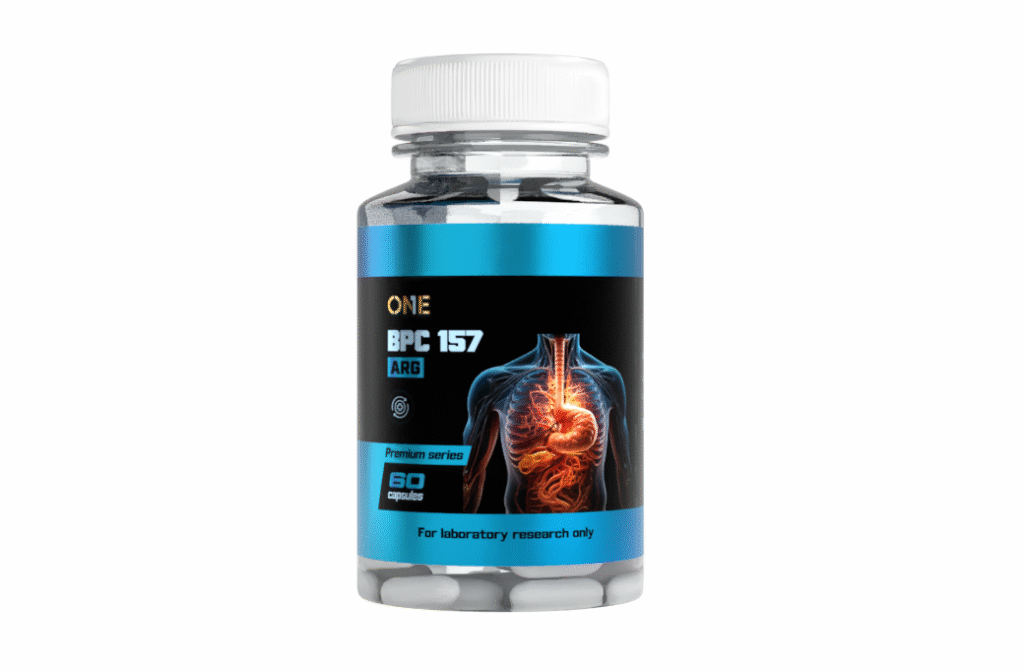
One Peptides ARG BPC-157 in capsules
Research reagent for laboratory use only. Not for human or veterinary use, diagnostic, or therapeutic purposes.
Batch-level quality documentation is available through the central HPLC/COA methodology & batch lookup page.
Ver también BPC-157 10 mg.
Introduction and Research Framework for BPC-157
One Peptides ARG BPC-157 is a research material based on the BPC-157 pentadecapeptide family, packaged in 60 solid units and intended exclusively for laboratory use. The description covers chemical identity, batch quality, confirmation of the ARG variant, characteristics of the solid formulation and data from experimental models.
This product requires greater precision than the classic BPC-157 lyophilisate. The ARG BPC-157 label itself has no single, fully uniform definition in research. In older patent literature Arg-BPC means di-L-arginine salt of bepecin, i.e. BPC-157 in the form of an arginine salt. In more recent patent literature, two entities appear side by side: ARG*BPC-157 as the arginine salt of BPC-157 and Ac-BPC-157-Arg-NH2 as a separate derivative with an additional arginine residue and C-terminal amidation. From the perspective of laboratories, this means a simple rule: without COA, MS spectrum and HPLC chromatogram, there is no way to tell which variant the batch contains.
General characteristics of the compound
BPC-157 is a pentadecapeptide derived from research on proteins present in the gastric juice of mammals. In the literature it often appears under the name Body Protection Compound 157 or bepecin. The most recognizable sequence of classic BPC-157 is:
Gly-Glu-Pro-Pro-Pro-Gly-Lys-Pro-Ala-Asp-Asp-Ala-Gly-Leu-Val
It is this sequence that is the reference point for most studies on fibroblast migration, nitric oxide-related signals, endothelial integrity, angiogenesis, and repair processes in exposed tissues.
The ARG variant is of interest for two reasons. First, the arginine salt may alter the solubility and stability of the solid formulation. Secondly, patent literature also describes derivatives with additional arginine and amidation, designed for unit formulations. This does not mean, however, that every product marked as ARG BPC-157 represents an identical structural variant. This must be stated clearly in the product data sheet.
Main active ingredient
| Active ingredient | Manufacturer’s declaration | Research characteristics |
|---|---|---|
| ARG BPC-157 | 200 mcg per solid unit | BPC-157 family material described in patent nomenclature as the arginine salt of BPC-157 or a related arginine variant requiring confirmation by COA and MS |
| Product parameter | Value |
|---|---|
| Brand | One Peptides |
| Packaging format | 60 capsule units |
| Status | Research Use Only (RUO) |
What is ARG BPC-157?
ARG BPC-157 is best described as an arginine-related variant of BPC-157, whose exact definition depends on batch documentation. For the classic BPC-157, the data are much better established: the peptide has 15 amino acids, CAS 137525-51-0 and a molar mass of approximately 1419 Da. For ARG forms, the situation is more complex.
Two main lines of naming
The first line comes from older patents for pentadecapeptide stable salts. There Arg-BPC is described as the di-L-arginine salt of BPC-157, very soluble in water and exhibiting a favorable stability profile under accelerated aging conditions. This description suggests that the core of the peptide remains the classic BPC-157, and the salt form changes.
The second line appears in more recent applications for unit formulations for peptides. These documents distinguish ARG*BPC-157, the arginine salt of classic BPC-157, from Ac-BPC-157-Arg-NH2, a separate derivative with the sequence:
Ac-Gly-Glu-Pro-Pro-Pro-Gly-Lys-Pro-Ala-Asp-Asp-Ala-Gly-Leu-Val-Arg-NH2
This distinction is important. An arginine salt and a derivative with arginine attached are not the same molecule, even if both circulate under the label ARG BPC-157.
What does this mean for the laboratory?
If a research team plans to compare ARG BPC-157 with classic BPC-157, it must know the actual form of the batch. Otherwise, it is not known whether a salt change or actually a new peptide derivative is being compared. For this reason, the product documentation should include not only the trade name, but also:
- HPLC result,
- MS or LC-MS result,
- information about the sequence or type of salt,
- data on the purity and excipient composition of the solid formulation.
Structure and physicochemical properties
Classic BPC-157 is a highly polar peptide containing many moieties capable of forming hydrogen bonds. This has a direct impact on its behavior in aqueous solutions and buffers. Older patent literature indicates that salt forms containing basic amino acids, especially arginine, have very good solubility in water. This is important for laboratories testing sample reconstitution from solid material.
Stability of the arginine variant
The BPC-157 stable salts patent described that salts containing two moles of basic amino acid per mole of pentadecapeptide, and especially the L-arginine salt, had the most favorable properties. Data from accelerated aging at 50°C and 65% relative humidity are also given, where Arg-BPC retained a very high share of the main compound at subsequent time points. This line of research explains why solid formulations refer to the arginate or ARG form.
Behavior in acidic environments
In the literature about classic BPC-157, it has been repeatedly emphasized that the peptide is stable in human gastric juice. For laboratories testing solid formulations, this parameter is interesting not because of its consumer use, but because it shows the peptide’s unusual resistance to an acidic environment. The arginine variant can be analyzed for stability under similar conditions, dissolution rate and integrity after recovery from a solid support.
Purity, identification and quality control
With ARG BPC-157, batch quality is even more important than with many standard research peptides. The reason is simple: the trade name itself does not determine whether the material is the arginine salt of the classic BPC-157 or a related peptide derivative.
HPLC
Liquid chromatography allows you to determine the chromatographic homogeneity of the sample and assess the presence of impurities and degradation products. In the case of material packaged in solid units, HPLC also helps to assess whether the sample is dominated by signals coming from excipients.
MS or LC-MS
Mass spectrometry is mandatory here. It is MS that decides whether the laboratory is working with classic BPC-157 in a specific salt form or a variant with an additional arginine residue. Without this, the interpretation of biological results would be methodologically too weak.
Homogeneity between units
Since the product is divided into 60 solid units, homogeneity between them must be confirmed. With a low declared content of the compound per unit, even small differences in the net mass or distribution of the active substance may change the real concentration of the solution prepared for the test.
Storage and laboratory handling
For solid peptide materials, cool, dry and light-protected conditions are most practical. If the manufacturer provides a detailed SDS or stability note, this should take precedence. When such data is lacking, a reasonable starting point is to store it at a reduced temperature, in a tight package, without exposure to moisture.
After preparing the working solution, the conditions depend on the solvent used and the purpose of the experiment. In laboratory practice you should:
- mark the batch number precisely,
- record the mass of the sample taken or the number of units used,
- note the composition of the solvent system,
- avoid repeated heating and cooling of the same sample.
When working with solid material, nitrile gloves, safety glasses and a clean work surface remain standard. If the sample is to be used for a cell test, it is also necessary to control the influence of the carrier and auxiliary substances on the model itself.
Mechanism of action at the molecular level
The strongest part of the literature regarding BPC-157 concerns the classic pentadecapeptide. The mechanistic description is based on it; the ARG variant is a form that may change stability or formulation parameters and requires separate validation.
Fibroblast migration and adhesion signals
In a study on tendon fibroblasts, BPC-157 was shown to promote growth from explants, cell survival under stress, and cell migration. The authors associated these observations with the activation of the FAK-paxillin axis. For laboratories dealing with connective tissue, this is an important reference point because it allows the study of the effect of the peptide on cytoskeleton reorganization and cell adhesion.
VEGFR2 receptor and endothelial response
Studies on endothelial cells and a limb ischemia model showed that BPC-157 increased VEGFR2 expression and activation of the Akt-eNOS pathway. This is one of the most highly cited mechanisms for this peptide. From an experimental perspective, this means that BPC-157 can be used as a tool to study angiogenesis, endothelial signaling and the organization of the vascular response in in vitro and in vivo models.
Relationship with the nitric oxide system
BPC-157 has long been analyzed in relation to NO-synthase, L-NAME and L-arginine. Older and more recent works have shown that the peptide affects parameters related to NO generation and can modulate the response of tissues exposed to the presence of inhibitors or precursors of the nitric oxide pathway. In the case of a product marked as ARG BPC-157 this thread is particularly interesting, but it should not be automatically assumed that the mere presence of arginine in the formulation variant translates into an identical molecular profile. This must be shown experimentally.
Growth hormone receptor and connective tissue
In another study in tendon fibroblasts, an increase in growth hormone receptor expression was observed after exposure to BPC-157. This result broadens the picture of the peptide’s action beyond just cell migration and suggests its usefulness in analyses including proliferation, connective tissue maturation and interaction with growth axes.
Research context and laboratory endpoints
1. Models of fibroblasts and connective tissue
ARG BPC-157 can be used as a comparative material against classic BPC-157 in studies of fibroblast migration, cell survival, FAK-paxillin expression and changes in extracellular matrix markers.
2. Endothelial and angiogenesis studies
Endothelial cell models allow us to assess whether the ARG variant retains the signaling profile associated with VEGFR2, Akt and eNOS, or differs in the rate of peptide recovery from solid material and exposure parameters.
3. Models of the gastrointestinal tract and peptide stability
Because the literature describes BPC-157 as a peptide stable in human gastric juice, arginine forms are of interest to laboratories examining sample integrity after exposure to low pH, dissolution rate, and unit formulation compatibility.
4. Research on the NO pathway
Due to the extensive literature on the relationship of BPC-157 with L-NAME and L-arginine, the product can be used in projects involving NO markers, vascular response and transcriptional changes in exposed tissues.
5. Analytical chemistry and comparisons of variants
This is one of the most practical scenarios for this material. The lab can directly compare the classic BPC-157, arginine salt, and possible arginine-attached variant by comparing HPLC, MS, medium stability, and cell model response.
Interpretive limitations
With ARG BPC-157, caution is needed for two reasons. First, much of the available literature concerns classic BPC-157, not the ARG variant from a specific commercial product. Secondly, for the ARG form much of the information comes from patents and formulation descriptions, rather than from an extensive set of comparative publications.
This does not disqualify the research material. It only means that a good product page should openly indicate the boundary between:
- data well confirmed for the classic BPC-157,
- formulation data for arginine salt,
- and hypotheses requiring testing for the One Peptides batch.
Summary
One Peptides ARG BPC-157 is a RUO chemical reagent belonging to the BPC-157 pentadecapeptide family, packaged in 60 solid units and declared by the manufacturer as 200 mcg of the compound per unit. From a scientific point of view, its value comes not from the sales narrative, but from the ability to compare the classic BPC-157 with the arginine variant in terms of stability, solubility, material homogeneity and response of cell models.
The most important rule of thumb, however, is simple: the ARG BPC-157 label alone is not sufficient to identify the molecule. Only COA, HPLC and MS allow us to determine whether a given batch corresponds to the arginine salt of a classic peptide or another derivative from this patent area.
The Peptides for Regeneration category groups RUO reagents associated with recovery-related research contexts.
Related research: recovery peptide research — a guide · BPC-157 vs ARG-BPC-157 — comparison of variants · BPC-157 mechanism of action in research · ARG-BPC research reagents
Science FAQ
Is ARG BPC-157 the same as the classic BPC-157?
Not always. In some sources Arg-BPC means the arginine salt of the classic BPC-157, and in other documents, next to this form, a separate derivative with additional arginine and amidation appears. Verification requires batch documentation.
What is the sequence of classic BPC-157?
Classic BPC-157 has the sequence Gly-Glu-Pro-Pro-Pro-Gly-Lys-Pro-Ala-Asp-Asp-Ala-Gly-Leu-Val and a molar mass of approximately 1419 Da.
Why is LC-MS so important for the ARG variant?
Because the trade name itself does not determine whether the material is an arginine salt or another peptide derivative. LC-MS allows you to confirm the actual mass and profile of the compound.
What does the solid form (60 capsules) offer the laboratory?
It allows you to examine material homogeneity, peptide recovery from the carrier, formulation stability and variability between units. This is a separate research area beyond the biological activity of the peptide itself.
How should ARG BPC-157 be stored?
The most sensible starting point is cool, dry and light-protected conditions and strict adherence to the batch-specific SDS or stability note.
The most important research conclusions
- Classic BPC-157 is a well-described pentadecapeptide with the sequence GEPPPGKPADDAGLV and a mass of approximately 1419 Da.
- On the research market, the
ARGvariant may mean the arginine salt of BPC-157 or another derivative from the patent area, therefore the batch requires confirmation by COA, HPLC and MS. - The literature on the classic BPC-157 indicates the involvement of the FAK-paxillin, VEGFR2-Akt-eNOS axis and the relationship with the nitric oxide system.
- Arginine forms are interesting in terms of formulation due to their solubility, stability and suitability in unit materials.
- The product packaged in 60 solid units requires control of homogeneity and the influence of auxiliary substances on extraction and chromatography.
Scientific sources
- Chang CH, Tsai WC, Lin MS, Hsu YH, Pang JHS. (2011). The promoting effect of pentadecapeptide BPC 157 on tendon healing involves tendon outgrowth, cell survival, and cell migration. J Appl Physiol (1985). (Study on tendon fibroblasts: explant growth, survival and cell migration).
- Hsieh MJ, Liu HT, Wang CN, et al. (2017). Therapeutic potential of pro-angiogenic BPC157 is associated with VEGFR2 activation and up-regulation. J Mol Med (Berl). (Associating the action of BPC-157 with VEGFR2 activation and endothelial signaling).
- Sikiric P, Seiwerth S, Mise S, et al. (2008). Stable gastric pentadecapeptide BPC 157 in trials for inflammatory bowel disease (…) heals ileoileal anastomosis in the rat. Surg Today. (Description of peptide stability and experimental results in an animal model).
- Chang CH, Tsai WC, Hsu YH, Pang JHS. (2014). Pentadecapeptide BPC 157 enhances the growth hormone receptor expression in tendon fibroblasts. Molecules. (Increase in growth hormone receptor expression in tendon fibroblasts).
ARG variant data sources
- Stable salts patent BPC-157 describing the di-L-arginine salt of bepecin (
Arg-BPC) and its high solubility and stability: SI24318A / Google Patents - Newer formulation application distinguishing
ARG*BPC-157as the arginine salt of BPC-157 andAc-BPC-157-Arg-NH2as a separate derivative: WO2025037993A1 / Google Patents
Chemical data source
- PubChem. BPC-157, CID 9941957.







Jim –
It met my expectations and then some.