 ES
ES  EN
EN  DE
DE 


Research reagent for laboratory use only. Not for human or veterinary use, diagnostic, or therapeutic purposes.
SLU-PP-332 is a small-molecule research compound described in the literature as a synthetic pan-agonist of estrogen-related receptors: ERR alpha, ERR beta and ERR gamma. These nuclear receptors regulate transcriptional programs associated with mitochondrial biogenesis, oxidative metabolism and energy expenditure.
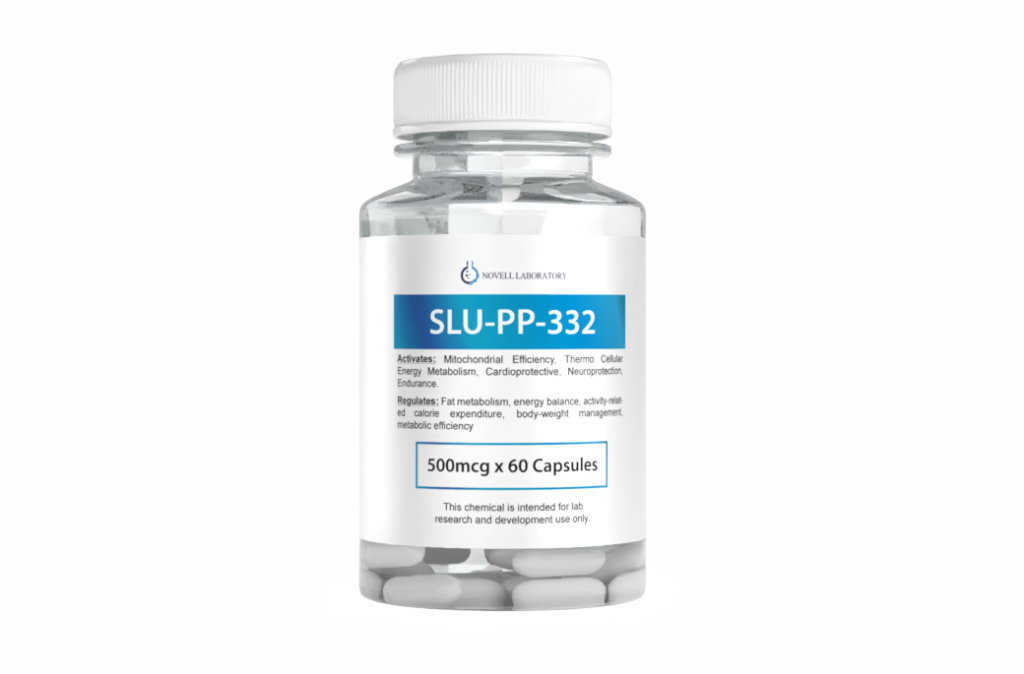
One-Peptides SLU-PP-332 500 mcg is supplied as a capsule-format research reagent containing 500 mcg per package in 60 capsules, approximately 8.3 mcg per capsule. The product is intended for laboratory research only and is documented with HPLC purity testing, MS identity confirmation and batch-level COA documentation.
SLU-PP-332 belongs to the experimental class of ERR pan-agonists. ERRs are orphan nuclear receptors that coordinate transcriptional programs involved in mitochondrial oxidative capacity, skeletal-muscle energy metabolism and adaptive responses associated with exercise-like signaling.
The compound is often discussed in the context of exercise mimetics, a research category that includes compounds designed to reproduce selected molecular signatures of exercise without physical training. This does not mean it replaces exercise in humans; the term refers to experimental pathways and animal-model outcomes.
| Parameter | Value |
|---|---|
| Class | ERR pan-agonist (ERR alpha + ERR beta + ERR gamma) |
| Molecular mass | ~395 Da, small organic molecule |
| Mechanism | ERR nuclear-receptor agonism, strengthening of the ERR-PGC-1 alpha axis |
| Form | Powder packed into research capsules |
| Package content | 500 mcg in 60 capsules, about 8.3 mcg per capsule |
| HPLC purity | >=98% |
| Identification | Mass-spectrometry confirmation (MS) |
| Storage temperature | 2-8 °C cold chain |
In mouse studies, SLU-PP-332 has been reported to induce an ERR alpha-dependent acute aerobic-exercise-like response and to enhance exercise capacity. The mechanistic focus is the ERR-PGC-1 alpha axis, which is involved in mitochondrial biogenesis, oxidative phosphorylation and skeletal-muscle endurance adaptation.
ERR agonism is expected to affect transcriptional regulation rather than acting as a direct stimulant. In experimental models, this places SLU-PP-332 in a different category from sympathomimetic stimulants or simple thermogenic agents. The central research question is whether selective nuclear-receptor activation can reproduce parts of the molecular exercise program.
The initial SLU-PP-332 publication in ACS Chemical Biology described a synthetic ERR alpha/beta/gamma agonist that induced an ERR alpha-dependent exercise-like response and enhanced exercise capacity in mice. The later Journal of Pharmacology and Experimental Therapeutics work discussed a synthetic ERR agonist in the context of metabolic-syndrome models.
These data are experimental and preclinical. They do not establish SLU-PP-332 as a medicine, food product or human-performance product. They provide a mechanistic framework for laboratory research on ERR signaling, mitochondrial metabolism and exercise-mimetic pharmacology.
| Class | Example | Mechanism | Status |
|---|---|---|---|
| AMPK activator / mitochondrial peptide | MOTS-c | AMPK activation, energy-metabolism modulation | RUO research peptide |
| PPAR delta agonist | Cardarine (GW-501516) | PPAR delta activation, fatty-acid beta-oxidation | RUO reagent; carcinogenicity signal in long-term rodent studies |
| Mitochondrial uncoupler | BAM15 | Proton uncoupling of the respiratory chain | RUO reagent |
| ERR pan-agonist | SLU-PP-332 | ERR alpha/beta/gamma agonism, mitochondrial biogenesis, ERR-PGC-1 alpha axis | RUO reagent, Wei 2023 and Billon 2024 |
More information about analytical control and documentation is available on the HPLC/COA methodology & batch lookup page.
Capsule contents can be transferred into a vial under controlled laboratory conditions. As with other low-dose small-molecule reagents, weighing precision, static control, humidity control and proper solvent selection are important.
SLU-PP-332 is discussed as a lipophilic small molecule, so DMSO or other validated solvent systems may be relevant depending on the experimental design. Working solutions should be prepared according to the study protocol, with solvent controls included in cell-culture or animal-model experiments.
All animal work must be approved by the appropriate ethics committee and performed by qualified personnel under local regulations.
SLU-PP-332 is a Research Use Only – RUO reagent. It is not registered as a medicine by EMA, FDA, MHRA or other major authorities. It is not a food product, food product or cosmetic ingredient.
The term exercise mimetic may attract sport-related attention, but it does not mean the compound is safe, approved or appropriate for athletes. WADA status can change, and any sport-related interpretation must be checked against the latest WADA-AMA prohibited list. This product is not intended for human use, animal use outside approved research, or performance enhancement.
Related research: metabolic compound research — a guide · BAM-15 mitochondrial uncoupler research (related metabolic compound) · SLU-PP-332 research reagents
Exercise mimetic means that the compound is studied for its ability to reproduce selected molecular signatures of exercise, such as ERR-PGC-1 alpha signaling and mitochondrial adaptation. It does not mean it replaces exercise or is approved for human performance use.
No. SLU-PP-332 is not registered as a medicine by EMA, FDA or other major regulatory agencies. It is supplied only as a Research Use Only reagent for laboratory studies.
No robust human clinical dataset establishes SLU-PP-332 as a therapeutic or performance compound. The key literature is preclinical and mechanistic, mainly involving mouse models and cellular bioenergetics systems.
Cardarine is a PPAR delta agonist, while SLU-PP-332 is an ERR alpha/beta/gamma pan-agonist. Both are discussed in exercise-mimetic contexts, but they target different nuclear-receptor systems and should not be treated as interchangeable compounds.
Status should always be checked against the current WADA-AMA list. Regardless of listing status, this product is not intended for athletes, performance enhancement or human use. It is supplied only as an RUO reagent.
SLU-PP-332 is a laboratory compound designation used in the medicinal-chemistry literature. It identifies a specific synthetic ERR agonist series rather than a commercial medicine or supplement brand.



Valoraciones
No hay valoraciones aún.