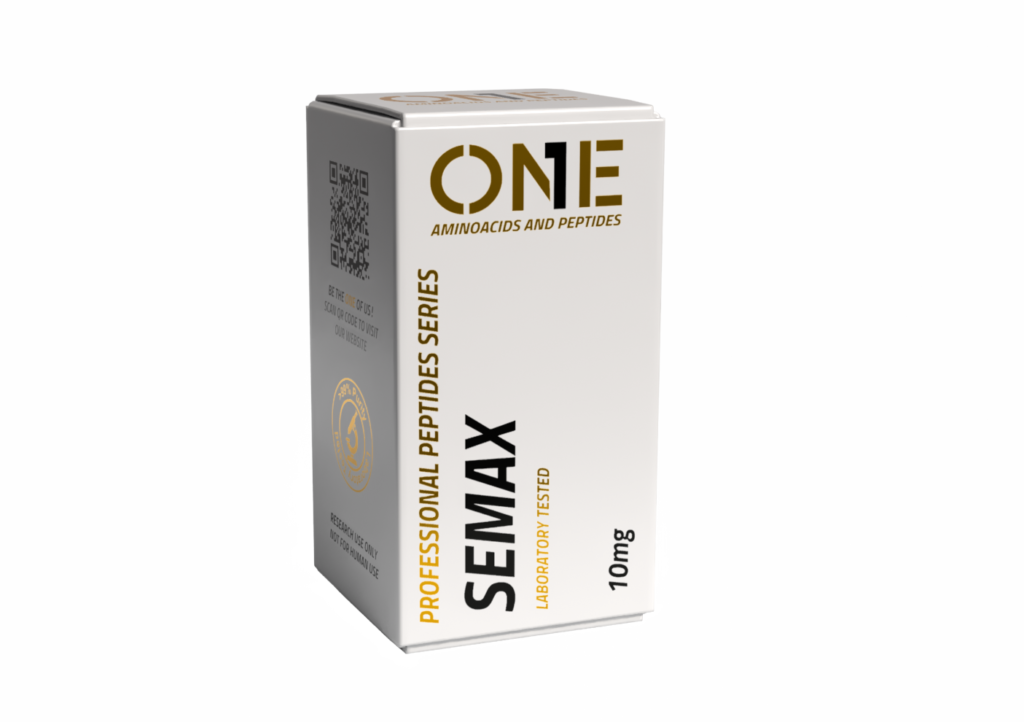
Semax – synthetic ACTH(4-10) analogue for research applications
Semax is a synthetic heptapeptide that is an analogue of the ACTH(4-10) fragment, with the sequence Met-Glu-His-Phe-Pro-Gly-Pro. Developed at the Institute of Molecular Genetics of the Russian Academy of Sciences, Semax is one of the most widely described nootropic peptides in the preclinical literature. Research focuses on the expression of neurotrophic factors BDNF and NGF in neuronal cultures, modulation of the dopaminergic system and neuroprotective observations in animal models. The product is intended solely for research purposes (Research Use Only) – it is not a medicinal product. Check out SEMAX 50 mg in the One Peptides offer.
What is Semax?
Semax is a synthetic heptapeptide with the sequence Met-Glu-His-Phe-Pro-Gly-Pro, designed as a structural analogue of the ACTH(4-10) fragment – a bioactive section of the adrenocorticotropic hormone including amino acids at positions 4-10. The C-terminal tripeptide Pro-Gly-Pro is added to the native ACTH(4-7) sequence, i.e. Met-Glu-His-Phe, whose task is to stabilize the molecule and protect it against degradation by proline peptidases.
The peptide was developed in the 1980s and 1990s at the Institute of Molecular Genetics of the Russian Academy of Sciences (IMG RAN) in Moscow. The work was led by Nikolai Myasoyodov and Ashmarin, the same team that developed Selank. Semax and Selank are two pillars of the Russian school of nootropic peptides, although they are based on completely different molecular frameworks.
In preclinical studies, Semax is analyzed in several areas. In in vitro neuronal cultures, the effect of the peptide on the expression of brain-derived neurotrophic factor (BDNF) and nerve growth factor (NGF) – two proteins of importance in neuronal biology – was observed. In animal models, the effect of Semax on the dopaminergic system, including the levels of dopamine and its metabolites in forebrain structures, was studied. Additionally, observations regarding the neuroprotective properties of the peptide have been reported in rodent models of cerebral ischemia, although the mechanisms of these observations are still under investigation. Semax is therefore a multi-directional research tool in molecular neurobiology.
Semax variants available
| Product |
Form |
Research use |
| SEMAX 50 mg |
Lyophilisate |
BDNF/NGF expression studies, dopaminergic models, animal models, in vitro experiments |
Full specifications are available on the product card.
SEMAX 50 mg — product characteristics
SEMAX 50 mg in the form of a lyophilized product is a universal research product, compatible with most experimental protocols described in the scientific literature – including experiments on in vitro neuronal cultures and in vivo animal models. The 50 mg weight provides a large amount of substance, enabling extensive experimental series, multiple repetitions and long-term research protocols without the need to order additional batches.
The freeze-dried form guarantees high stability during storage and allows for precise measurement of the solution after reconstitution in sterile water or an appropriate buffer. If you have any questions regarding product compatibility with a specific research protocol, the One Peptides technical team is available to assist you.
How does Semax differ from similar peptides?
Semax vs Selank
Semax and Selank are two flagship peptides developed at IMG RAN, often compared in the literature, but their mechanisms are fundamentally different. Semax is an analogue of the ACTH(4-10) fragment and in experimental models it shows primarily modulation of the dopaminergic system – changes in the levels of dopamine and its metabolites were observed in the structures of the forebrain of rodents. Moreover, Semax affects the expression of neurotrophic factors BDNF and NGF in neuronal cultures.
Selank, on the other hand, is an analogue of tuftsin (a fragment of immunoglobulin G) and its research profile focuses on the modulation of the GABAergic system and enkephalin metabolism. Differences in molecular frameworks (ACTH vs tuftsin) and target neurotransmitter systems (dopamine vs GABA) make these peptides complementary research tools, not substitutes. More about Selank in the category Selank.
Semax vs Epithalon
Semax and Epithalon (Epitalon) are peptides developed in Russian research centers, but their molecular targets are completely different. Semax is an ACTH(4-10) analogue studied in the context of neurobiology – expression of neurotrophic factors and modulation of the dopaminergic system. Epithalon (Ala-Glu-Asp-Gly) is a synthetic tetrapeptide developed by Vladimir Khavinson at the Institute of Gerontology in Saint Petersburg, studied in the context of telomerase activation and reverse telomerase (hTERT) expression in cell cultures.
The differences include both chain lengths (heptapeptide vs tetrapeptide), molecular targets (BDNF/NGF/dopamine vs telomerase), and research areas (neurobiology vs biology of aging). More about Epithalon in the category Epithalon.
FAQ — Frequently asked questions
1. Is Semax from the One Peptides offer a medicinal product?
NO. Semax offered by One Peptides is a chemical substance intended exclusively for research purposes (Research Use Only). It is not a medicinal product and is not intended for use in humans or animals outside the context of approved research protocols.
2. What is the ACTH(4-10) fragment and how does it relate to Semax?
ACTH (adrenocorticotropic hormone) is a 39-amino acid peptide secreted by the pituitary gland. The ACTH(4-10) fragment includes amino acids at positions 4-10 of this peptide and has been shown in studies to retain some biological activities of the entire ACTH, unrelated to adrenal function. Semax is a synthetic analogue of this fragment, enriched with the stabilizing tripeptide Pro-Gly-Pro at the C-terminus.
3. What neurotrophic factors are studied in the context of Semax?
In studies on in vitro neuronal cultures and animal models, the effect of Semax on the expression of two neurotrophic factors: BDNF (Brain-Derived Neurotrophic Factor) and NGF (Nerve Growth Factor) was observed. Both proteins have roles in neuronal biology — BDNF is associated with synaptic plasticity and NGF is associated with the development and survival of cholinergic neurons in experimental models.
4. How to store Semax in lyophilized form?
Semax lyophilisate should be stored at a temperature of -20 degrees Celsius, in a dry place, protected from light and moisture. After reconstitution in sterile water or an appropriate buffer, the working solution should be stored at 2-8 degrees Celsius and used according to the requirements of the research protocol.
5. What is the weight of Semax available in One Peptides?
One Peptides offer includes SEMAX 50 mg in the form of a lyophilisate. This grammage allows for extensive research protocols, multiple experimental series and tests requiring large amounts of substances.
Quality and standards at One Peptides
Semax available at One Peptides is tested by HPLC at an independent laboratory to confirm the content and purity of the peptide, and the test is repeated periodically. The reports are published on our quality page.
 ES
 EN
 DE