 ES
ES  EN
EN  DE
DE 

A research-focused comparison of Melanotan II and PT-141, covering melanocortin receptor selectivity, evidence, safety signals and regulatory status.
Two molecules. Two fundamentally different approaches to the same hormonal axis. MK-677 tells the pituitary gland to “produce more growth hormone.” HGH Fragment 176-191 tells fat tissue to “act as if you were getting growth hormone – without the rest of its effects.” One stimulates the endogenous production of the entire hormone. The second provides an isolated fragment responsible for one specific action. Which of these mechanisms suits your research goals? It depends on the question you are looking for an answer to.
📖 The following article is educational and is a review of published scientific literature. The studies described were performed in animal models or in vitro, unless otherwise noted. This does not constitute medical advice.
MK-677 (Ibutamoren) is an oral ghrelin mimetic that binds to the GHS-R1a receptor in the pituitary gland and stimulates pulsatile release of growth hormone (GH). Cascade effect: increase in GH → increase in IGF-1 in the liver → anabolic effect in muscles, bones and other tissues.
Key Feature: MK-677 does not provide external hormone. It activates its own GH production mechanism – maintaining the physiological pulsatile rhythm. Clinical studies in humans (Nass et al., 2008) confirmed an increase in GH and IGF-1 to values observed in young adults, an increase in lean body mass and an improvement in sleep architecture.
It’s a top-down approach – stimulate the pituitary gland and the rest of the GH/IGF-1 axis will respond physiologically. The effects are wide-ranging: not only lipolysis, but also muscle anabolism, improved bone mineralization, improved sleep and regeneration.
A detailed discussion of the mechanism, research and safety profile of MK-677 can be found in a separate article MK-677 (Ibutamoren) – action, research and research use.
HGH Fragment 176-191 is a synthetic peptide corresponding to amino acids 176-191 of human growth hormone – C-terminal fragment, which in preclinical studies has shown lipolytic properties (supporting the breakdown of fat tissue).
The concept is elegant: full-size growth hormone (191 amino acids) produces many effects – anabolic, lipolytic, diabetogenic (insulin resistance), growth of internal organs. Fragment 176-191 is an attempt to isolate one of these effects: lipolysis, without the rest of the “package”.
Preclinical studies in a mouse model have shown that Fragment 176-191:
Research on HGH Fragment 176-191 has been conducted mainly on animal models (obese ob/ob mice). Clinical data from human studies are very limited.
This is a bottom-up approach – you deliver an isolated signal directly to fat tissue, bypassing the rest of the GH/IGF-1 axis.
| Characteristic | MK-677 (Ibutamoren) | HGH Fragment 176-191 |
|---|---|---|
| Class | Ghrelin mimetic (GH secretagogue) | Synthetic peptide (GH fragment) |
| Mechanism | Stimulation of endogenous GH production by the pituitary gland | Direct lipolytic action (C-terminal GH fragment) |
| Effect on GH | Increase in endogenous GH (pulsatile) | None – does not stimulate GH secretion |
| Effect on IGF-1 | Increase in IGF-1 (secondary to increase in GH) | Minimal or none |
| Anabolic effect (muscles) | Yes – through the GH/IGF-1 axis | No – the fragment does not have anabolic properties |
| Lipolytic effect (fat) | Moderate (intermediate, through GH) | Direct and selective |
| Effect on insulin sensitivity | Potentially unfavorable (increase in fasting glucose) | Neutral in preclinical data |
| Effects on sleep | Positive (prolongation of SWS and REM) | No data available |
| Effect on appetite | Significant increase (ghrelin mechanism) | Lack |
| Route of administration | Oral (capsule/tablet) | Subcutaneous injection |
| Half-life | ~24 hours (administered once a day) | ~30 minutes (requires multiple administration) |
| Clinical data (human) | Yes – tests up to 12 months | Very limited |
| Safety profile | Well characterized (short term) | Poorly characterized |
The choice between these molecules in a research context depends on the scientific question:
From a pharmacological perspective, there is no direct interaction between MK-677 and HGH Fragment 176-191 – they act at different levels of the GH axis.
Theoretical synergy: MK-677 provides broad support of the GH/IGF-1 axis (anabolism, sleep, regeneration), and Fragment 176-191 enhances the lipolytic component – acting directly on adipose tissue, regardless of the level of endogenous GH.
Potential concerns:
Researchers planning to combine both molecules should take these variables into account in the experimental design.
Are you looking for reagents for research on the growth hormone axis? At One-Peptides you will find both MK-677 and HGH Fragment 176-191 — each with an HPLC certificate and clear documentation.
NO. MK-677 is an oral ghrelin mimetic that stimulates the pituitary gland to produce growth hormone. HGH Fragment 176-191 is a synthetic peptide – an isolated C-terminal fragment of growth hormone – with a selective lipolytic effect. They differ in mechanism, route of administration, effect profile and evidence base.
MK-677 has a much larger clinical database – including randomized, placebo-controlled studies lasting up to 12 months in hundreds of people. HGH Fragment 176-191 has limited clinical data and is mainly based on preclinical studies.
NO. Fragment 176-191 is an isolated C-terminal fragment of GH, responsible for one function (lipolysis). It does not have anabolic properties (muscle or bone growth), does not affect IGF-1, and does not improve sleep. It is a “snippet” of the full hormone – not a replacement.
Yes – and significantly so. MK-677 mimics ghrelin (hunger hormone), so an increase in appetite is a predictable consequence of the mechanism. HGH Fragment 176-191 does not affect ghrelin receptors and does not increase appetite.
Depends on the research context. If the goal is isolated lipolysis without GH/IGF-1/insulin variables – HGH Fragment. If the goal is comprehensive support of the GH axis with a lipolytic effect as one of many – MK-677. In the context of sarcopenia or cachexia (muscle loss + excess fat) – MK-677, because the Fragment does not support muscle anabolism.
ℹ️ Global disclaimer
All One-Peptides products are reagents intended exclusively for laboratory and scientific research (Research Use Only). They are not medicines, dietary supplements or products intended for human consumption. The information in this article is educational in nature and is a review of published scientific literature; does not constitute medical, pharmaceutical or dietary advice.

A research-focused comparison of Melanotan II and PT-141, covering melanocortin receptor selectivity, evidence, safety signals and regulatory status.
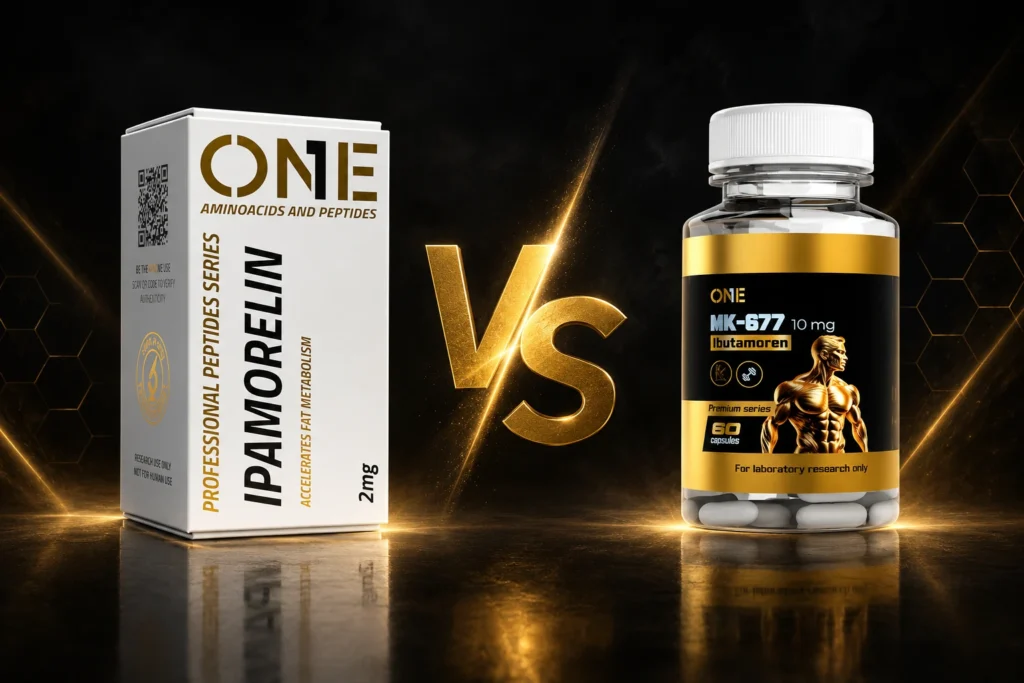
A research comparison of MK-677 and ipamorelin, focusing on GHS-R1a signaling, selectivity, administration route, human evidence and WADA status.
