 ES
ES  EN
EN  DE
DE 
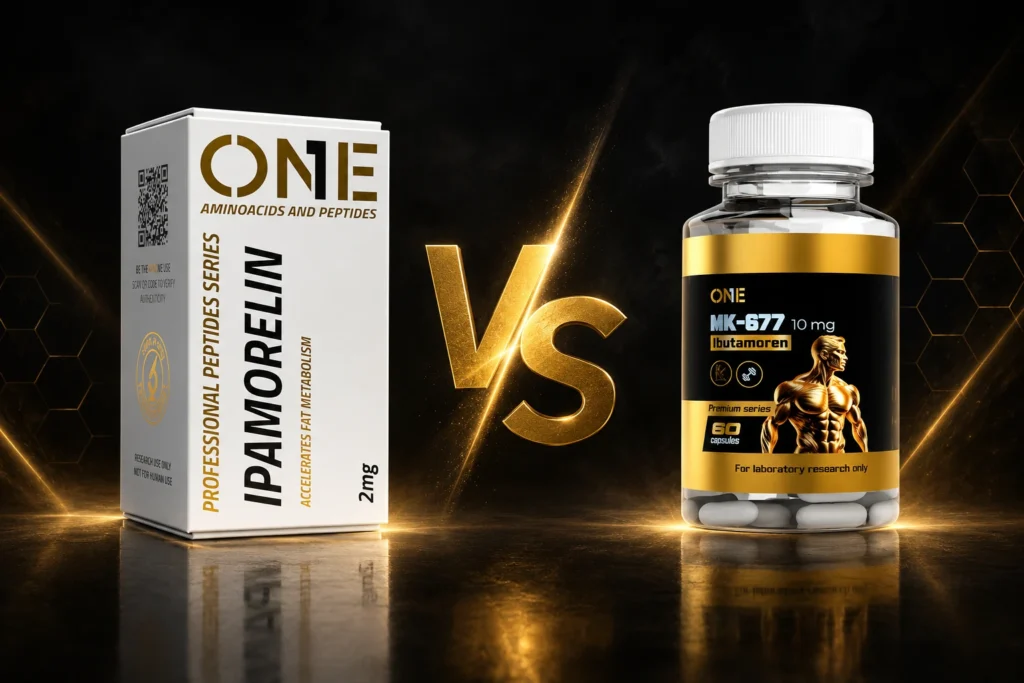
A research comparison of MK-677 and ipamorelin, focusing on GHS-R1a signaling, selectivity, administration route, human evidence and WADA status.
In brief. Melanotan II and PT-141 originate from the same starting molecule — α-MSH, the melanotropic hormone — but their pharmacological profiles diverge. Melanotan II is a non-selective analogue that activates MC1R, MC3R, MC4R and MC5R, combining melanogenic and central signaling. PT-141 (bremelanotide) is a Melanotan II metabolite with markedly lower affinity for MC1R, reducing the dominant melanogenic component. Their regulatory histories also differ: bremelanotide completed clinical development and received FDA approval in 2019 for a narrow indication, whereas Melanotan II did not complete development and has been associated with case reports involving pigmented skin lesions. Research reagents in the catalogue remain a separate regulatory category and are supplied solely for Research Use Only.
This educational article reviews published research on melanocortin receptor pharmacology. Reported effects refer to the specific experimental models described in the cited literature and are not claims about outcomes in readers. This text is not medical advice. References to an approved bremelanotide medicine are included only as regulatory context; One Peptides reagents are intended solely for laboratory research (RUO) and are not medicines.
The difference can be summarized in one word: selectivity. Both compounds belong to the α-MSH analogue family and act on melanocortin receptors, but their affinity profiles differ.
The melanocortin receptor family has five subtypes with distinct roles. MC1R mediates melanogenesis, the production of pigment in melanocytes. MC3R and MC4R are central receptors studied in energy regulation and motivational pathways. MC5R is associated mainly with exocrine glands. MC2R, outside this group, is the ACTH receptor in the adrenal cortex and is not activated by α-MSH analogues.
Melanotan II activates all four α-MSH-sensitive receptor subtypes, so its reported effects encompass both melanogenesis and central signaling. PT-141 has markedly lower activity at MC1R while retaining activity at central receptors. This difference follows directly from the altered C-terminus of the molecule.
| Feature | Melanotan II | PT-141 (bremelanotide) |
|---|---|---|
| Origin | Synthetic α-MSH analogue | Melanotan II metabolite with a free carboxyl group instead of a C-terminal amide |
| Receptor profile | Non-selective — MC1R, MC3R, MC4R, MC5R | Predominantly central, with markedly lower affinity for MC1R |
| Melanogenic component | Present (MC1R) | Markedly reduced |
| Clinical development | Not completed | Completed — FDA approval in 2019 |
| Status as a medicine | Not approved in any jurisdiction | Approved medicinal product for a narrow indication |
| Signals in the literature | Case reports involving pigmented lesions and melanoma | Phase 3 clinical programme with systematic safety assessment |
| Catalogue status | Research reagent (RUO) | Research reagent (RUO), distinct from the approved medicine |
The development history of both compounds begins in the same place. α-MSH analogues were originally investigated for melanogenesis, with the aim of stimulating pigment synthesis. Hadley and Dorr (2006) reviewed the milestones in this programme, while Dorr et al. (2004) described a human study combining a potent melanotropic peptide with ultraviolet exposure.
During this work, researchers observed that Melanotan II also produced effects unrelated to pigmentation through central melanocortin receptors, as reviewed by Wessells et al. (2000). This prompted efforts to separate the two components of activity: retain central signaling while reducing the dominant MC1R-mediated effect.
The result was PT-141, a cyclic heptapeptide with the same core as Melanotan II, but with the C-terminal amide (–NH₂) replaced by a free carboxyl group (–COOH). The compounds therefore have the same chain length, while the terminal group determines their different receptor profiles. Pfaus et al. (2004; 2007) studied its central activity in animal models. This pathway progressed to a full clinical programme, unlike Melanotan II.
Separate reviews provide more detail on the mechanism and research status of Melanotan II and on PT-141 (bremelanotide) in clinical trials.
This is the sharpest distinction between the two compounds and requires precise wording because it is often oversimplified.
Bremelanotide completed the full regulatory pathway. Its phase 3 programme and long-term safety and efficacy analysis were published in peer-reviewed journals (Kingsberg et al., 2019; Simon et al., 2019). In 2019, the US Food and Drug Administration approved bremelanotide as the medicinal product Vyleesi for a narrowly defined indication. Earlier human pharmacokinetic and tolerability data were reported by Diamond et al. (2004).
Melanotan II did not complete clinical development and is not approved as a medicinal product in any jurisdiction.
The regulatory distinction works in both directions. Approval of bremelanotide as a medicine does not make a PT-141 research reagent a medicine. These are separate legal frameworks for the same molecule, as occurs with other compounds available both as approved medicinal products and as chemical reagents. A catalogue reagent is not a medicinal product, has no indication and does not replace medical treatment.
The evidence is most asymmetrical in this area because only one of the compounds completed clinical development.
Melanotan II: dermatological signals in case reports. Non-selective MC1R activation affects melanocytes, and the clinical literature reflects this mechanism. Reports include eruptive pigmented nevi after exposure to α-MSH analogues (Cardones and Grichnik, 2009) and a melanoma case in a person using Melanotan II (Hjuler and Lorentzen, 2013). A case report provides limited evidence, but the direction of the signal is biologically consistent with activity in pigment cells.
PT-141: data from a structured clinical programme. Bremelanotide safety was assessed in phase 3 trials and in a long-term analysis (Simon et al., 2019), providing a qualitatively different evidence base from isolated case reports. This does not imply an absence of adverse effects; it means that they were collected systematically and published.
In practical terms, the Melanotan II literature contains signals outside a controlled-trial framework, whereas PT-141 has data from a structured programme. Neither evidence base changes the status of catalogue research reagents, which are not intended for administration to humans.
The distinction follows from receptor selectivity, not from which compound is supposedly more powerful.
For studies of MC1R and melanogenesis, Melanotan II is the more direct research tool. Its non-selectivity, a limitation in other contexts, is useful when this signaling axis is the object of study.
For studies of central pathways without a dominant pigment component, PT-141 is the more selective tool because its lower MC1R affinity reduces melanogenesis as a confounding variable.
Research reagents are available in the Melanotan II and PT-141 categories. Both are supplied with batch-specific analytical documentation, including chromatographic purity, identity confirmation by mass spectrometry and a certificate of analysis.
One entry in the RUO reagent catalog is Melanotan 2 Spray; details of the kit are provided on the product page.
Is PT-141 the same compound as Melanotan II? No. PT-141 (bremelanotide) is a Melanotan II metabolite formed by replacing the C-terminal amide with a free carboxyl group. The principal difference is receptor selectivity: Melanotan II activates all α-MSH-sensitive melanocortin receptors, including melanogenic MC1R, whereas PT-141 has markedly lower activity at MC1R.
Why is PT-141 approved while Melanotan II is not? Bremelanotide completed a full clinical programme, including phase 3 trials with published safety data, and received FDA approval for a narrow indication in 2019. Melanotan II did not complete clinical development and is not approved in any jurisdiction.
Is the PT-141 reagent sold in the catalogue a medicine? No. Approval of a bremelanotide medicinal product belongs to a separate regulatory framework. A catalogue research reagent is not a medicine, has no therapeutic indication and is intended solely for laboratory research.
Which receptors does Melanotan II activate? Melanotan II is non-selective across MC1R, MC3R, MC4R and MC5R. MC1R mediates melanogenesis, MC3R and MC4R are central receptors, and MC5R is associated mainly with exocrine glands.
What safety signals have been reported for Melanotan II? The clinical literature includes reports of eruptive pigmented nevi after exposure to α-MSH analogues (Cardones and Grichnik, 2009) and a melanoma case in a person using Melanotan II (Hjuler and Lorentzen, 2013). Case reports provide limited evidence, but the signal is biologically consistent with activity in pigment cells.
Are melanocortin analogues prohibited in sport? Melanotan II and bremelanotide are not listed as separate entries on the current WADA Prohibited List. The list and its general clauses can change, so an athlete subject to testing must verify current status independently.
Are both compounds available as research reagents? Yes. Both are marketed as chemical reagents for Research Use Only with batch-specific analytical documentation. They are not intended for consumption or administration to humans.
Melanotan II and PT-141 illustrate how one structural modification can separate two molecules pharmacologically. Melanotan II remained a non-selective analogue involving MC1R and melanogenesis and did not complete clinical development; its literature includes case reports involving pigmented lesions. PT-141 replaced the C-terminal amide with a free carboxyl group, has markedly lower affinity for MC1R and completed a regulatory pathway that led to FDA approval in 2019 for a narrow indication.
For readers evaluating the literature, the relevant distinction is the receptor profile and the resulting scope of evidence, not which compound is described as stronger.
RUO disclaimer. Melanotan II and PT-141 in the One Peptides catalogue are chemical reagents intended solely for laboratory and scientific research (Research Use Only). They are not medicines, dietary supplements or products intended for consumption or administration to humans or animals outside a controlled experimental setting. FDA approval of a bremelanotide medicinal product is cited only as a regulatory fact and belongs to a separate legal framework; a PT-141 research reagent is not a medicine and does not replace medical treatment. All effects described are findings reported in the cited models, not claims of efficacy or indications for use. This information is educational and scientific and is not medical or pharmaceutical advice.

A research comparison of MK-677 and ipamorelin, focusing on GHS-R1a signaling, selectivity, administration route, human evidence and WADA status.
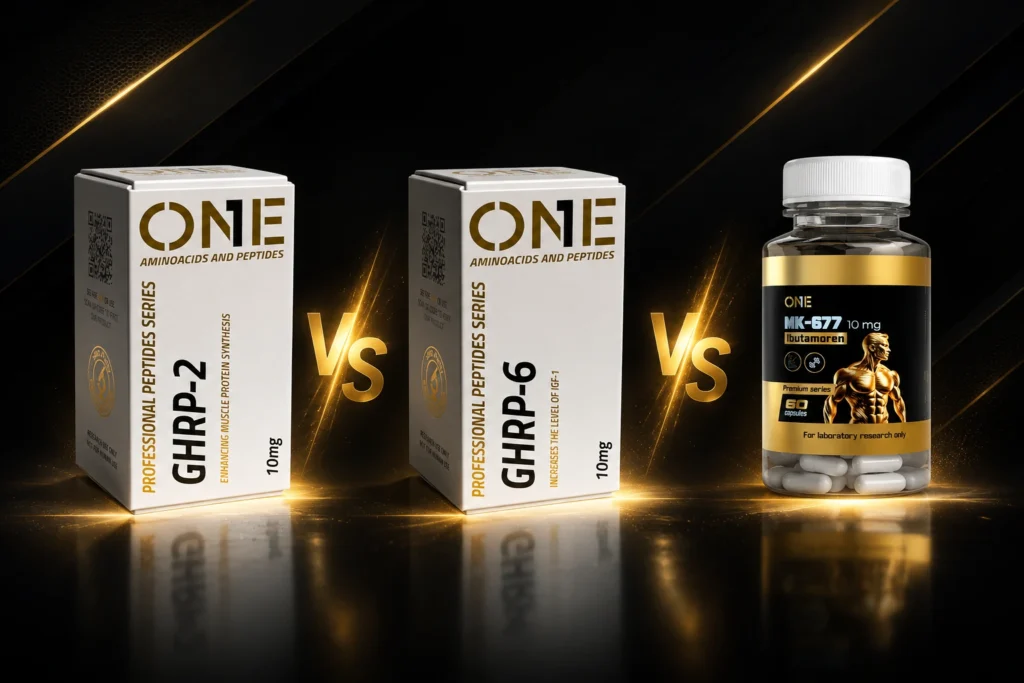
A research comparison of MK-677, GHRP-2 and GHRP-6, including receptor action, molecular class, administration route, evidence and WADA status.
