 ES
ES  EN
EN  DE
DE 

A research-focused comparison of Melanotan II and PT-141, covering melanocortin receptor selectivity, evidence, safety signals and regulatory status.
PT-141 was developed by a team of pharmacologists Mac Hadley at the University of Arizona he worked on synthetic analogues α-melanocyte-stimulating hormone (α-MSH) — endogenous peptide derived from proopiomelanocortin, regulating skin pigmentation through MC1R receptors in melanocytes. The hypothesis was practical: a stable α-MSH analogue could serve as an alternative to UV exposure in the induction of a protective tan. This is how the first analogue was created – Melanotan I (afamelanotide) — and optimized soon after Melanotan II, a cyclic heptapeptide with higher affinity for melanocortin receptors.
During early trials of Melanotan II for pigmentation effects, the team observed something unexpected – some male participants reported erectile episodes within hours of injection. The observation was too repetitive to ignore. Hadley’s team introduced structural modifications that were intended to separate melanogenic activity from the central effect on sexual function. This is how he was born PT-141 (Bremelanotide) — a fragment of 7 amino acids of Melanotan II with the final amide chain removed, retaining high affinity for central melanocortin receptors (mainly MC4R), but showing significantly lower activity towards MC1R.
This is how the hypothesis was developed melanocortin regulation of libido — the first central mechanism agonist towards melanocortin receptors stimulating sexual functions, acting independently of the vascular system on which PDE5 inhibitors are based (sildenafil, tadalafil, vardenafil). Bremelanotide does not affect blood flow to erectile tissues – it modulates the signal in the paraventricular nucleus of the hypothalamus and the ventral tegmental area, centers of the central regulation of motivation and desire. After two decades of clinical trials, the FDA approved bremelanotide under its brand name in 2019 Vyleesi for a selected indication in premenopausal women (Flibanserin/Addyi was previously approved in 2015 for the same indication, but acts through 5-HT and dopamine, not melanocortin receptors). In the European Union, peptide NO has obtained EMA registration and is available in the One Peptides catalog only as a chemical reagent for laboratory tests.
📖 The following article is educational in nature and is a review of published scientific literature about PT-141 (bremelanotide). Some of the cited studies are phase II/III clinical trials conducted in the USA, based on which the FDA registered bremelanotide (Vyleesi) in 2019 for a selected indication. In the European Union, the peptide is not registered as a medicine; in the One Peptides catalog it is available only as a chemical reagent for laboratory tests (Research Use Only). The text does not constitute medical advice.
PT-141 (Bremelanotide) it’s synthetic cyclic heptapeptide about the sequence:
Ac-Nle-cyclo[Asp-His-D-Phe-Arg-Trp-Lys]-OH
The molecule is a fragment of Melanotan II with the C-terminal amide chain removed. The cyclic conformation is stabilized by an amide (lactam) bond between the carboxyl group of aspartic acid (Asp) and the ε-amino group of lysine (Lys), which creates a rigid ring structure resistant to proteolysis typical of linear peptides. The N-terminus is acetylated (Ac-), which additionally blocks aminopeptidases.
Chemical features important from a laboratory perspective:
Design Strategy PT-141 is a textbook example of peptide medicinal chemistry. Natural α-MSH is a peptide that is rapidly degraded by proteases in serum – its half-life is measured in minutes. Three modifications to native α-MSH were introduced in the design: methionine replacement in position 4 norleucine (Nle) reduced susceptibility to oxidation; phenylalanine replacement in position 7 on D-Phe increased stability against proteases (including chymotrypsin); cyclization by a lactam bond between aspartate (item 5) and lysine (item 10) stiffened the conformation of the molecule. Together, they produce a molecule several times more metabolically stable than the parent hormone, while maintaining high affinity for MC4R.
Critical difference against Melanotan II: removal of the C-terminal amide significantly weakens the activity against MC1R (pigmentation receptor), retaining activity against MC4R (central receptor). This allows us to treat PT-141 as a relatively selective MC4R agonist compared to the panagonist Melanotan II.
PT-141 is an agonist of the melanocortin receptor family – seven-transmembrane GPCRs that activate the cyclic AMP cascade. There are five subtypes in mammals (MC1R–MC5R) with different tissue distribution. The affinity profile of PT-141 is distinguished by dominant central activity.
The paraventricular nucleus of the hypothalamus (PVN) is the central node regulating sexual motivation in both sexes. Activation of MC4R in the PVN by PT-141 leads to release dopamine in the ventral tegmental area (VTA) and nucleus accumbens (NAc) — basic structures of the mesolimbic reward pathway (Pfaus et al., 2007). Consequence: strengthening the motivational signal directed at sexual stimuli.
The mechanism is fundamentally different from the action phosphodiesterase 5 (PDE5) inhibitors. PDE5 inhibitors act peripherally – they inhibit the breakdown of cGMP in the smooth muscle of the penile blood vessels, allowing the dilation of the cavernous vessels in response to a sexual stimulus. PT-141 does not affect blood flow to erectile tissues; works at the level of the central generation lust and motivational readiness.
MC4R receptors in arcuate nucleus (ARC) are a central element of the appetite regulation pathway – activation of MC4R inhibits food intake. In animal models, PT-141 shows moderate effects on reducing food intake, although the scale of the effect is smaller than in the case of selective MC4R agonists developed in monogenic obesity (e.g. setmelanotide). The anorexigenic effect remains peripheral to mainstream research.
Activation of melanocortin receptors in the brainstem and hypothalamus is associated with stimulation of sympathetic activity and a transient increase in blood pressure. In Vyleesi clinical trials, a mean transient increase in systolic blood pressure of 1.9 mmHg and diastolic blood pressure of 1.7 mmHg was observed, with normalization within 24 hours (Kingsberg et al., 2019). In a subset of participants, the increases were more pronounced – about 1% had individual readings of 180/110 mmHg or higher – which became the basis for the FDA’s contraindication warning in uncontrolled hypertension and cardiovascular disease.
Unlike Melanotan II – where activation of MC1R leads to visible darkening of the skin and the formation of pigmentation marks – PT-141 has minimal melanogenic activity. In Vyleesi clinical trials, focal hyperpigmentation was observed in 1-3% of participants with long-term exposure (especially in light-exposed areas), indicating residual activity against MC1R, but on a dramatically smaller scale than with Melanotan II.
The first work documenting the pro-sexual effects of PT-141 was conducted on male rats in tests of erection induced by contact with a female in estrus and in tests of penile appearance (Wessells et al., 2000). Subcutaneous injection of PT-141 caused repeated stimulation of copulatory behavior, shortening of latency to mount and an increase in the frequency of intromission. The effect was abolished by the administration of a selective MC4R antagonist, which confirmed the involvement of this receptor.
Research on female rats showed modulation of receptive behavior – an increase in the frequency of lordosis in response to the male stimulus (Pfaus et al., 2004). These models were particularly relevant in the context of subsequent clinical development of the peptide for hypoactive sexual desire disorder in women.
The most extensive clinical program for PT-141 was hypoactive sexual desire disorder (HSDD) in premenopausal women. The program was managed by the company Palatin Technologies, later AMAG Pharmaceuticals as a licensee in the commercialization phase (after AMAG withdrew in 2020, the rights returned to Palatin Technologies). Pivotal trials phase III, RECONNECT 301 and RECONNECT 302 (NCT02333071, NCT02338960), were randomized, double-blind, placebo-controlled trials involving a total of approximately 1,247 women (Kingsberg et al., 2019; Simon et al., 2019).
The results showed statistically significant improvement in two co-primary endpoints – the desire domain of the Female Sexual Function Index (FSFI) and the desire-related stress scale (FSDS-DAO). The effect size was moderate (Cohen’s d ~0.2–0.3 for most endpoints), the safety profile was favorable in the monitored clinical context. Based on this data The FDA approved Vyleesi on June 21, 2019 for HSDD in premenopausal women, administered “on-demand” by subcutaneous injection.
An earlier arm of the clinical program explored the use of PT-141 in men with ED refractory to PDE5 inhibitors (Diamond et al., 2004; Rosen et al., 2004). Phase II trials showed moderate improvement in erectile function in response to sexual stimuli after PT-141 injection, in a group where sildenafil was ineffective. An intranasal form was also being prepared to optimize pharmacokinetics.
However, the clinical program in men remained completed without proceeding to registration — due to, among other things, the blood pressure elevation profile in certain subgroups of participants and the company’s strategic decisions to focus on the HSDD indication in women.
The activity of PT-141 against MC4R in the arcuate nucleus means that the peptide has been studied in animal models of obesity and food intake disorders (Molinoff et al., 2003). The magnitude of effect was moderate compared with dedicated MC4R center therapies. Isolated preclinical work also suggests potential neuroprotective and anti-inflammatory effects of melanocortin activity; the influence of MC4R activators in the models was also initially explored hemorrhagic hypovolemic shock due to the observed pressure stabilization in some injury models. The data are fragmentary and would require validation in independent laboratories.
In practice, in the European Union, PT-141 can only be offered as a laboratory reagent intended for in vitro work and animal models, without any therapeutic claims. One Peptides offers a peptide with full analytical documentation in accordance with the RUO regime.
Three routes of administration of PT-141 dominate in the scientific literature:
For laboratory tests involving the peptide, appropriate protocols for reconstitution with bacteriostatic water and preparation of the experimental matrix should be used in accordance with the research plan. Peptide calculator facilitates mass conversion between milligrams of lyophilisate and molar concentrations in solution.
Specification of PT-141 available in the One Peptides catalog:
| Parameter | Value | Method |
|---|---|---|
| Cleanliness | ≥98% | RP-HPLC (gradient acetonitrile/water + 0.1% TFA) |
| Identity | Molecular mass 1025.2 Da | Mass spectrometry (ESI-MS) |
| Sequence | Ac-Nle-cyclo[Asp-His-D-Phe-Arg-Trp-Lys]-OH | SPPS synthesis, quality control |
| Humidity | ≤5% | Karl Fischer |
| Bacterial endotoxins | ≤1 EU/mg | LAL test |
| Appearance | White or creamy-white lyophilisate | Visual inspection |
Each batch of peptide receives certificate of analysis (COA) with a serial number allowing for full traceability – from the chemical synthesis phase, through freeze-drying, HPLC and MS analytical control, to delivery to the recipient’s laboratory. Cold chain 2–8°C is maintained at every stage of transport and storage. Full analytical documentation is described on the website quality tests and certificates.
The stability of PT-141 is significantly higher than that of linear peptide analogues, which is due to the cyclic structure, N-terminal acetylation and the presence of D-Phe at position 7 of the parent α-MSH molecule. In laboratory conditions:
The cyclic peptide is significantly less susceptible to proteolytic and oxidative degradation than linear peptides – making PT-141 a relatively convenient tool in long-term preclinical experiments. The detailed procedure for dissolving the lyophilisate is described in the guide how to dissolve peptides. Any change in solution color, opalescence or precipitate indicates degradation and requires replacement of the material.
All data below comes from Vyleesi’s American clinical trials and does not constitute a recommendation for the use of PT-141 in humans in the European Union, where the peptide is not registered as a drug.
In the RECONNECT 301/302 trials (Kingsberg et al., 2019; Simon et al., 2019), the most frequently reported effects:
FDA warnings on the Vyleesi label: not recommended for people with cardiovascular diseases and uncontrolled hypertension; dosage limit of 8 doses per month due to the risk of hyperpigmentation; no combination with alcohol is recommended due to the hypotensive effects of the combination.
Safety profile in long-term exposure outside clinical trial conditions remains limited. There are no data on the safety of concomitant use with PDE5 inhibitors at clinical doses. There are no validated clinical data in the male population after completion of the clinical development program. All the above restrictions are particularly important in the context of the fact that PT-141 remains in the EU only a research reagent.
PDE5 inhibitors act peripherally – they inhibit the breakdown of cGMP in the muscularis of penile blood vessels, facilitating the dilation of cavernous vessels in response to the stimulus. PT-141 acts centrally – by activating MC4R receptors in the hypothalamus and brainstem, it modulates sexual motivation and desire, without directly affecting blood flow to erectile tissues. These are two fundamentally different mechanisms.
In the USA – yes. The FDA approved bremelanotide on June 21, 2019 under the brand name Vyleesi for hypoactive sexual desire disorder (HSDD) in premenopausal women. In the European Union, the peptide has NOT obtained EMA registration and remains a chemical intended for laboratory testing (RUO). Bremelanotide in the One Peptides catalog is offered only as a research reagent.
PT-141 is a fragment of Melanotan II – a cyclic heptapeptide with the C-terminal amide chain removed. The structural consistency is pharmacologically important: PT-141 retains high affinity for MC4R (central receptor modulating libido and appetite), but shows significantly less activity towards MC1R (melanocyte receptor responsible for pigmentation). Melanotan II is a panagonist of all melanocortin receptors, PT-141 is a relatively selective MC4R agonist.
MC4R (melanocortin receptor 4) is a G protein-coupled receptor (GPCR) found mainly in the central nervous system – in the paraventricular nucleus and arcuate nucleus of the hypothalamus, and in the brainstem. MC4R activation regulates sexual motivation (PVN), appetite and energy expenditure (ARC), and sympathetic activity (brain stem). It is the molecular target of PT-141.
To a limited extent – unlike Melanotan II. In Vyleesi clinical trials, focal hyperpigmentation was observed in 1-3% of participants with long-term exposure. The mechanism is due to the residual activity of PT-141 against MC1R in melanocytes. The scale of the effect is dramatically smaller than in the case of Melanotan II, where skin darkening is the primary pharmacological effect.
Status of PT-141 in the European Union – chemical for research uses (Research Use Only). The peptide is not registered by the EMA as a medicine, it is not approved as a dietary supplement or as a product for human consumption. As a laboratory reagent, it can be offered for preclinical tests in vitro and in animal models. Any suggestion of human use falls outside the EU regulatory framework.
After reconstitution with bacteriostatic water, PT-141 remains pharmacologically stable for 28–30 days at a temperature of 2–8°C, provided it is sterile and protected from light. The factory-sealed lyophilisate remains stable for up to 24 months at -20°C. The peptide’s cyclic structure and N-terminal acetylation provide significantly better stability than linear peptide analogues.
Yes, to the extent seen in animal models, MC4R activation in the arcuate nucleus of the hypothalamus inhibits food intake. In Vyleesi clinical trials, the anorexigenic effect was not a primary endpoint and was reported sporadically. The magnitude of the effect is smaller than in the case of selective MC4R agonists developed in monogenic obesity (e.g. setmelanotide). The thread remains peripheral to the mainstream of central applications of PT-141.
PT-141 (bremelanotide) 10 mg is available in the One Peptides catalog as a research reagent (RUO) with full QC documentation and a certificate of analysis for each batch. Parent peptide Melanotan II 10 mg is available in a separate catalog item.
ℹ️ Global disclaimer
All One-Peptides products are reagents intended exclusively for laboratory and scientific research (Research Use Only). They are not medicines, dietary supplements or products intended for human consumption. The information in this article is educational in nature and is a review of published scientific literature; does not constitute medical, pharmaceutical or dietary advice. PT-141 (bremelanotide) is approved as a drug (Vyleesi) only by the FDA in the US – in the European Union it remains an investigational reagent without EMA registration.

A research-focused comparison of Melanotan II and PT-141, covering melanocortin receptor selectivity, evidence, safety signals and regulatory status.
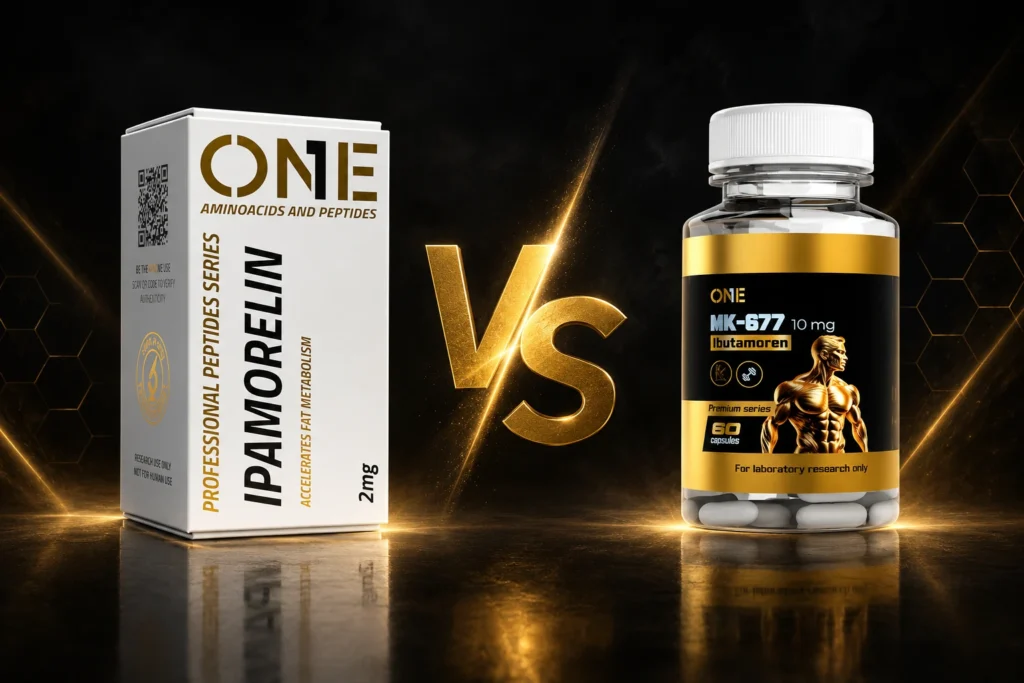
A research comparison of MK-677 and ipamorelin, focusing on GHS-R1a signaling, selectivity, administration route, human evidence and WADA status.
