 ES
ES  EN
EN  DE
DE 

A research-focused comparison of Melanotan II and PT-141, covering melanocortin receptor selectivity, evidence, safety signals and regulatory status.
DSIP, a peptide that has revolutionized the approach to sleep? In the mid-1970s, two Swiss neurophysiologists – Marcel Monnier and Guido Schoenenberger, working at the University of Basel – conducted a series of experiments that were to forever change the way we think about humoral substances that regulate sleep. The research hypothesis was bold: if deep sleep is neurochemical in nature, then in the blood of an animal in a state of deep delta wave sleep there should be a soluble substance that, when transferred to another animal, will cause an analogous state. This hypothesis was part of an older tradition of humoral experiments on sleep, dating back to Pieron’s 1913 work on the cerebrospinal fluid of sleep-deprived dogs.
Monnier and Schoenenberger worked in a rabbit model in which delta wave sleep was induced by electrical stimulation of the interlaminar area of the thalamus. The peptide was isolated from extracorporeal dialysate of cerebral veins animals in this condition and administered the fraction to other, sleep-deprived rabbits. The effect was consistent: animals receiving the fraction showed a marked increase in delta waves in the EEG. After ten years of analytical work, in 1977, the team published the sequence of the isolated peptide and named it Delta Sleep-Inducing Peptide (DSIP) — delta wave sleep-inducing peptide.
This was supposed to be a breakthrough. An endogenous factor regulating the deepest phase of sleep – a tool that could potentially allow us to understand and therapeutically modulate sleep disorders in humans. The reality turned out to be much more complicated. Over the following decades, independent research groups attempted to replicate Monnier and Schoenenberger’s original results. The results were inconsistent – some studies confirmed a sleep-inducing effect, others showed no significant change in sleep architecture. At the same time, further surprising properties of the peptide were discovered: anti-stress, antioxidant, neuroprotective properties, modulation of the HPA axis, and alleviation of withdrawal symptoms. The paradox of DSIP is that the “sleep” peptide has, over time, generated waves of research doubts about its original function — and its actual mechanisms of action have turned out to be much broader than the “sleep-inducing” nature suggested by its name.
Nowadays, DSIP remains a fascinating research tool with rich but fragmentary literature. Reviewers – especially Kovalzon (2006) At work “Delta sleep-inducing peptide (DSIP): a still unresolved riddle” — emphasize that the name of the peptide is historical and potentially misleading; it is better to understand it as multidirectional neuroendocrine modulator, the sleep-inducing component of which is just one of many observed activities. This article organizes the current state of knowledge about this controversial peptide.
📖 The following article is educational in nature and is a review of published scientific literature about DSIP. Most of the studies cited were conducted in animal models and in vitro; some results—particularly regarding sleep effects—are inconsistent between study groups and require further validation. The text does not constitute medical advice. The peptide from the One Peptides catalog is intended only for laboratory tests (Research Use Only).
DSIP is nonapeptide — a short peptide composed of nine amino acids, with the sequence Trp-Ala-Gly-Gly-Asp-Ala-Ser-Gly-Glu (single-letter notation: WAGGDASGE). The molecule contains several structural features relevant to the biology of the peptide:
Chemical features important from a laboratory perspective:
The endogenous origin of DSIP is documented. The peptide has been detected in the brain (mainly in the hypothalamus, amygdala, hippocampus) and peripheral blood of both laboratory animals and humans (Bjartell et al. 1989). Concentrations are low and fluctuate daily, with an increasing tendency in the phases of slow-wave sleep. The identification of DSIP in human tissues provides a compelling argument for its physiological function—though it does not solve the problem of identifying a specific receptor, to which the peptide would bind. Moreover, despite almost five decades of research neither the DSIP gene nor the precursor protein has been isolated — an unprecedented situation among known neuropeptides (Kovalzon 2006).
The most important and at the same time most frustrating feature of DSIP from the point of view of molecular pharmacology: despite four decades of research, no specific receptor has been identified, to which the peptide would bind with high affinity. This is the central research problem of DSIP. Without a known receptor, it is difficult to clearly interpret the mechanisms of the observed behavioral and biochemical effects. Signal transduction pathways – second messenger cascades activated after peptide administration – are also unidentified.
Instead, DSIP shows multidirectional modulatory activity, which suggests systemic action via multiple parallel pathways rather than classical receptor–ligand binding. The following sections organize the observed effects.
The most consistent pool of data concerns the effects of DSIP on the hypothalamic-pituitary-adrenal axis. In models of chronic stress (immobilization, cold stress, electrical stress), the peptide reduces excessive corticosterone response, normalizes the ACTH circadian rhythm and modulates CRH activity in the hypothalamus. This effect is reproducible in independent research groups (e.g. Sudakov 1996) and is one of the best documented aspects of DSIP pharmacology.
DSIP modulates the activity of several neurotransmitter systems:
In models of oxidative stress, DSIP reduces lipid peroxidation, normalizes the activity of antioxidant enzymes (superoxide dismutase, catalase, glutathione peroxidase) and modulates oxidative phosphorylation in mitochondria. These mechanisms are particularly important in models of neurodegeneration and ischemic brain injury, where DSIP has a protective effect.
The original work of Monnier and Schoenenberger indicated an increase in the share of delta waves in the EEG after DSIP administration. In the following decades, this effect was observed in some animal models – especially rabbits and cats – but replications in other species (rats, mice, humans) produced contradictory results. Some studies show no significant effect of DSIP on sleep architecture, others show an effect dependent on dose, time of administration and experimental protocol. Modern reviewers treat the sleep-inducing effect of DSIP as unproven in the strict sense — observed in selected conditions, but not translating into a universal, repeatable mechanism.
DSIP has analgesic activity in classic models of nociception (hot plate test, tail flutter test, formalin test). The mechanism involves modulation of the opioidergic system and the HPA axis, although the precise site of action remains unclear.
The original work by Schoenenberger, Monnier, and colleagues in the 1970s and 1980s described the sleep-inducing effects of DSIP in rabbit and feline models. Subsequent independent replications have been inconsistent. Kovalzon (2006) in the review “Delta sleep-inducing peptide (DSIP): a still unresolved riddle” highlights key problems: lack of an identified receptor, lack of isolation of the gene and precursor protein, inconsistency in the replication of the hypnotic effect between study groups, small study samples, and non-uniform dosing protocols in the original works. Contemporary authors emphasize that DSIP may have an effect on sleep in selected models, but does not meet the criteria for a universal “sleep-inducing substance” as its name suggests.
The strongest pool of data comes from stress models. DSIP alleviates the behavioral and biochemical effects of chronic stress – reduces excessive corticosterone response, normalizes sleep patterns disturbed by stress, reduces depressive behavior in Porsolt and hang-by-tail tests. Work by the teams of Sudakov, Ivanov and others consistently shows the anti-stress effect in independent models.
An interesting and repeatable observation is the alleviation of alcohol and opioid withdrawal symptoms by DSIP. The most famous work is Schneider-Helmert et al. (1988) In Neuropsychobiology: in a group of 67 patients (28 with alcohol withdrawal, 39 with opiate withdrawal), iv administration of DSIP (25 nmol/kg) led to a reduction in symptoms in 87% of alcoholics and 97% of opioid-dependent patients – with an immediate onset of action and good suppression of somatic symptoms. Single European works (including Dick et al., Karger Eur Neurol) confirmed the observation. Single Russian-language works from the 1980s–90s. provided additional observations. The mechanism probably involves modulation of the HPA axis, the opioidergic system and the adrenergic response. The methodology of this work was limited – no randomization, no placebo, small trials – and never led to clinical registration.
DSIP shows analgesic activity in classic behavioral tests – hot plate test, lateral tail flap test, formalin test. The magnitude of the effect is moderate, smaller than that of classic opioids, but observed consistently in independent models.
In models of glutamatergic toxicity (kainic acid, NMDA), cerebral ischemia and neurotoxin poisoning, DSIP has a protective effect. The mechanism is related to antioxidant activity, stabilization of mitochondrial function and modulation of NMDA receptors. These properties make DSIP an interesting tool in research on neuroprotection mechanisms.
Individual studies suggest the cardioprotective effect of DSIP in models of myocardial ischemia. The data is fragmentary and requires further validation.
Most available clinical trials with DSIP date back to the 1980s and 1990s, with applications in insomnia, fibromyalgia, stress disorder syndromes, and withdrawal syndromes reported. Most of these studies have significant methodological limitations: small study groups, no placebo, no blind trial, limited standardization of preparations. There are no contemporary, well-controlled phase II/III clinical trials that confirm the effectiveness of DSIP in any clinical indication.
Critical reviews (including Kovalzon 2006; classic reviews – Graf and Kastin 1986, Iyer and McCann 1987) list the following research problems related to DSIP:
These limitations make DSIP an interesting research object with a complex history, but they do not claim to be a tool with a clear pharmacological profile.
In the research literature, DSIP has been administered through various routes:
The oral route is not practical due to the susceptibility of the peptide to enzymatic digestion in the gastrointestinal tract.
DSIP in the One Peptides catalog it is delivered as research material with an analytical profile adapted to laboratory needs:
| Parameter | Specification |
|---|---|
| Purity (RP-HPLC) | ≥ 98% |
| Identity (MS) | Confirmation of a molecular mass of 848.8 Da |
| Humidity | ≤ 5% |
| Endotoxins | ≤ 1 EU/mg |
| Physical condition | White to off-white lyophilisate |
| Packing | 5 mg vials, sterile, stopper under argon |
| COA per batch | Yes, available for every batch |
| Cold chain | Transport at 2-8°C |
| Batch traceability | Full batch traceability |
Detailed quality data and analytical certificates are available on the website quality tests and certificates. Each batch of DSIP undergoes independent validation by RP-HPLC and identity confirmation by mass spectrometry.
DSIP in the form of lyophilisate shows high long-term stability under appropriate storage conditions:
Bacteriostatic water (0.9% benzyl alcohol) is standardly used for reconstitution due to its preservative properties. Detailed dilution and concentration calculation protocols are available in peptide calculator and in the guide how to dissolve peptides.
In preclinical models, DSIP shows a favorable safety profile. Acute toxicity tests (LD₅₀) in rodent models did not reveal significant toxicity at doses many times higher than the pharmacologically active doses. The peptide does not show genotoxic or teratogenic activity in standard tests. In the Schneider-Helmert trials, tolerability was good, except for headache reported by a few patients.
Despite a good profile in preclinical models, important limitations of the state of knowledge should be highlighted:
These limitations are of fundamental importance for the interpretation of the literature and for planning research experiments involving the peptide.
The original work of Monnier and Schoenenberger from the 1970s indicated an increase in the share of delta waves in the EEG after administration of the peptide. Replications in independent research groups are inconsistent – some studies confirm the effect, others show no significant changes in sleep architecture. The contemporary assessment of this issue is cautious: DSIP may modulate sleep in selected patterns and conditions, but does not meet the criteria for a universal “sleep-inducing substance.”
Despite four decades of research, it has not been possible to identify a specific receptor protein to which DSIP would bind with high affinity. Moreover, neither the DSIP gene nor the precursor protein has been isolated – an unprecedented situation among known neuropeptides (Kovalzon 2006). This may be due to the fact that the peptide acts through multiple distributed pathways rather than through a single classical receptor – or to technical difficulties in identifying receptors for low-affinity peptides. Receptor deficiency is a central problem in DSIP molecular pharmacology.
Melatonin is an indoleamine (modified tryptamine) synthesized in the pineal gland, acting through specific MT1 and MT2 receptors. DSIP is a nonapeptide with an unknown receptor that acts by modulating the HPA axis and multiple neurotransmitter systems. The mechanisms of both molecules are fundamentally different and the pharmacokinetic profiles are incompatible.
In the European Union, DSIP functions only as a research reagent (Research Use Only). It is not registered as a medicine or dietary supplement. Sales for research purposes are permitted provided proper labeling (RUO) and no therapeutic claims.
The inconsistency of DSIP replication results from several factors: different model species (the effect is observed in rabbits and cats, weaker in rats and mice), different dosage and administration protocols, different times of the experiment (the effect depends on the circadian rhythm), and different purity of the preparations used in different studies. The lack of an identified receptor further complicates the standardization of experimental protocols.
The oral route is not practical for DSIP experiments – the peptide is susceptible to enzymatic digestion in the gastrointestinal tract and its oral bioavailability is negligible. In animal models, injections (s.c., i.p., i.v.) are standard.
DSIP solution in bacteriostatic water or physiological saline solution is stable for approximately 28-30 days at 2-8°C, provided it is protected from light and avoids freeze-thaw cycles. The lyophilisate stored at −20°C is stable for at least 24 months.
In the research literature, DSIP is sometimes combined with other neuroregulatory peptides in experimental protocols – most often with peptides acting on the HPA axis, opioidergic or neuroprotective systems. Decisions about combining compounds should be based on published mechanistic data and the assumptions of the specific research protocol.
Global disclaimer
All One-Peptides products are reagents intended exclusively for laboratory and scientific research (Research Use Only). They are not medicines, dietary supplements or products intended for human consumption. The information in this article is educational in nature and is a review of published scientific literature; does not constitute medical, pharmaceutical or dietary advice.

A research-focused comparison of Melanotan II and PT-141, covering melanocortin receptor selectivity, evidence, safety signals and regulatory status.
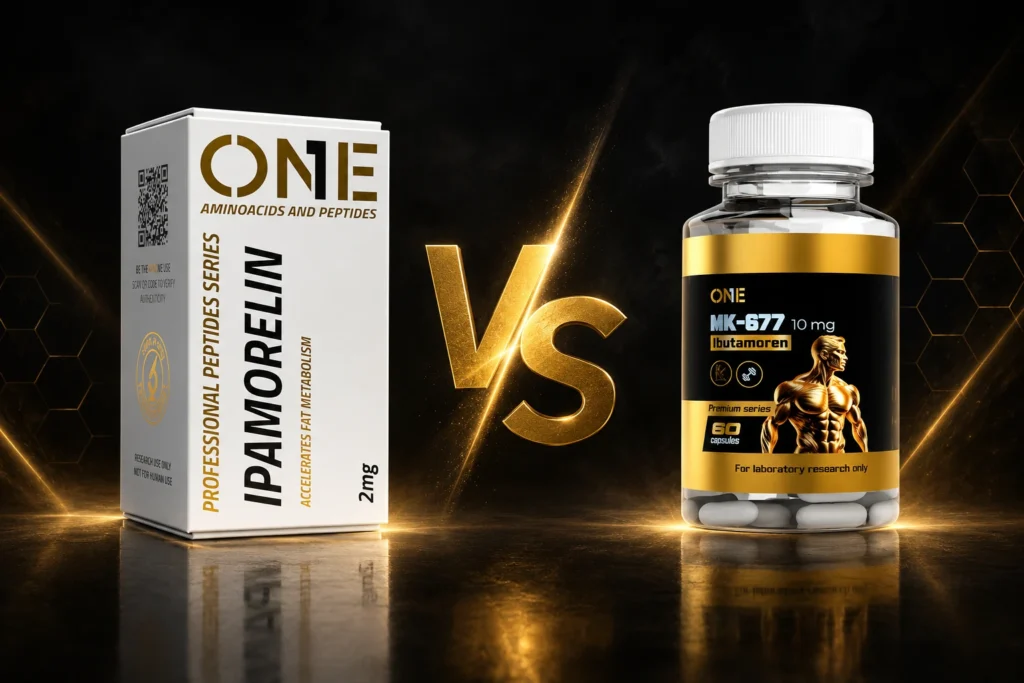
A research comparison of MK-677 and ipamorelin, focusing on GHS-R1a signaling, selectivity, administration route, human evidence and WADA status.
