 DE
DE  EN
EN  ES
ES 

A research-focused comparison of Melanotan II and PT-141, covering melanocortin receptor selectivity, evidence, safety signals and regulatory status.
In 1953, the American biochemist Vincent du Vigneaud from Cornell University published a paper in the Journal of the American Chemical Society that won him the Nobel Prize in Chemistry two years later. Du Vigneaud chemically synthesized the first hormonal peptide – oxytocin. Success was not a minor laboratory achievement; it was a historical validation of the concept that small peptide molecules could perform hormonal functions in the body and could be produced synthetically from pure amino acids.
Over the following decades, oxytocin was known mainly for two classic physiological functions – inducing uterine contractions during labor and stimulating lactation. It wasn’t until the 1990s that research teams began systematically exploring another side of this peptide – its role in the brain as neuromodulator of social behavior. Experiments on prairie voles – a monogamous species in which oxytocin turned out to be necessary for forming partnership bonds – opened up a completely new direction of research on the neurobiology of social bonds, trust and empathy.
Two decades of research fever (2005–2015) led to oxytocin being dubbed the “trust peptide” in the popular science media – and to a growing wave of skeptical criticism in academia. The modern picture of oxytocin as a neuropeptide is much more nuanced than ever — and much more scientifically interesting than the simple “love everyone” narrative.
📖 The following article is educational and is a review of scientific literature on oxytocin as a neuromodulator of social behavior. Most of the cited studies come from animal models and clinical trials with intranasal administration of oxytocin in humans. The text does not constitute medical advice. Peptides from the One Peptides catalog are intended only for laboratory tests (Research Use Only).
Oxytocin is there nonapeptide — a peptide with nine amino acids. Sequence:
Cys-Tyr-Ile-Gln-Asn-Cys-Pro-Leu-Gly-NH₂
A characteristic feature of oxytocin is disulfide bridge between cysteine residues at positions 1 and 6, forming a 6-amino acid closed ring. Three amino acids from the C-terminus (Pro-Leu-Gly-NH₂) form a “tail” extending beyond the ring.
The C-terminal amino acid (glycine) is amidated – the carboxyl group is replaced by an amide group. This is a typical modification of hormonal peptides that increases their biological activity.
| Parameter | Value |
|---|---|
| Number of amino acids | 9 |
| Molecular mass | 1007.2 Da |
| Summary formula | C₄₃H₆₆N₁₂O₁₂S₂ |
| Disulfide bridge | Cys¹ — Cys⁶ |
| C-terminal amide | Yes |
| Structurally close to | Vasopressin (differences at positions 3 and 8) |
Oxytocin is synthesized in neurons supraoptic nucleus (SON) and paraventricular nucleus (PVN) hypothalamus. From there, it travels axonally to the posterior pituitary, where it is stored in secretory vesicles and released into the systemic circulation in response to stimuli.
Over the last two decades, direct oxytocinergic projections from the PVN to various brain structures have also been identified and constitute the anatomical basis for the neuromodulatory functions of oxytocin in the brain.
Oxytocin receptor (OXTR) is a class A G protein-coupled receptor (rhodopsin family). Once activated, it triggers signaling pathways:
The oxytocin receptor is abundant in areas of the brain involved in the processing of social signals:
| Structure | Function in social processing |
|---|---|
| Amygdala (amygdala) | Threat detection, social anxiety |
| Ventral striatum | Social reward processing |
| Prefrontal cortex | Executive control, social decisions |
| Hippocampus | Social memory |
| NAcc (nucleus accumbens) | Reward and social bonding |
| Ventral tegmental area (VTA) | Dopaminergic reward |
| Lateral septum | Social memory, aggression |
The breadth of OXTR distribution in social areas of the brain explains why oxytocin is a neuropeptide with such a strong influence on interpersonal behavior.
Research on oxytocin in social neuroscience can be divided into several historical phases.
The first breakthrough discoveries came from research on prairie voles (Microtus ochrogaster), a monogamous species in which mate pairs form lasting bonds after copulation. Insel and Young in their work from the 1990s showed that:
These results—robustly replicated by various groups—established oxytocin as a “bonding peptide” in mammalian neurobiology.
After 2005, numerous groups began testing oxytocin in humans for intranasal administration — a path that allows the peptide to partially bypass the blood-brain barrier. The number of published works increased exponentially. Most frequently cited results:
The work of Kosfeld et al. in 2005 in Nature was particularly influential—it quickly became one of the most cited papers in social neuroscience of the decade.
After 2015, the community began to systematically try to replicate key experiments from previous years. The results were inconclusive:
The modern model: oxytocin enhances the salience (significance) of social signals — which in some contexts translates into increased empathy and trust, in others into increased in-group bias or even aggression towards the out-group. Quintana et al. (2021) summarized this turn in an extensive methodological review.
Ongoing research suggests that oxytocin has real but contextual effects in:
Clinical trials of oxytocin are ongoing for several clinical indications. Status (2026):
The most frequently explored clinical indication. Phase II and III trials of intranasal oxytocin in children with autism spectrum disorder have yielded results inconclusive results:
Oxytocin tests in the aspect of negative symptoms of schizophrenia (anhedonia, alogia, avolition) – promising results in smaller studies, ambiguous in larger samples.
Single trials in people with social anxiety suggest an effect when administered intranasally during exposure to social stimuli. The data requires validation.
Exploring oxytocin in BPD—the subject of several small trials. Controversial results, negative effects in some subgroups (increased paranoid bias).
⚠️ None of the neuropsychiatric uses of oxytocin have achieved drug registration in major jurisdictions. The therapeutic status remains under investigation. Between the promises of 2005–2015 and the current skeptical consensus lies a methodological lesson in the importance of replication.
Oxytocin as a research reagent from the One Peptides catalog meets the following quality criteria:
| Parameter | Specification | Method |
|---|---|---|
| Cleanliness | ≥98% | RP-HPLC |
| Molecular mass identity | 1007.2 Da | ESI-MS |
| Humidity | ≤5% | Karl Fischer |
| Endotoxins | ≤1 EU/mg | LAL test |
| Identity of the disulfide bridge | Confirmed | MS/MS |
Each vial is marked with a batch number associated with a certificate of analysis (COA). Full QC documentation is available on the website quality tests and certificates.
Oxytocin is a relatively sensitive peptide due to the presence of a disulfide bridge (prone to reduction) and instability in solution:
The procedure for dissolving the lyophilisate is described in the guide how to dissolve peptides step by step, and details of the temperature regime – a guide to laboratory practice with research peptides.
Oxytocin as a drug has a long history of safe use in obstetric indications. In intranasal neuropsychiatry trials, reported side effects were usually mild:
Contextual risks:
In contexts. Research suggesting a simple “trust increase” effect from 2005 to 2015 has not been robustly replicated. The modern picture: Oxytocin modulates the processing of social stimuli in a contextual manner – it may increase trust in the in-group, but in other settings it increases in-group bias or activates memory of negative social experiences.
These are two nonapeptides with almost identical structure (they differ only in positions 3 and 8). They come from the same evolutionary precursor. Oxytocin performs mainly “social” and obstetric functions, vasopressin – functions of regulating water balance and some social functions (especially in males). Both receptors are related, and the peptides can cross-activate the other peptide’s receptors.
Yes – for obstetric indications (labor induction, uterine atony) as Pitocin or Syntocinon. It is not registered for any neuropsychiatric indications (autism, schizophrenia, anxiety) – it remains a research peptide in these areas.
A methodological question that remains under discussion. Assumption: intranasally administered peptide can bypass the blood-brain barrier through olfactory and trigeminal neurons. Practice: an increase in oxytocin concentration in the cerebrospinal fluid after intranasal administration is documented, but quantitatively small. The mechanism of effect may involve both direct (nasal) and indirect (vascular absorption and peripheral effects).
A combination of several factors. Low statistical power of primary studies, publication of mainly positive results (publication bias), contextual effects (oxytocin does not have a fixed “direction” – it may act differently depending on the person and situation), variety of doses and protocols, methodological problems with intranasal administration. The field has become an example of a “replication crisis” in psychology and social neuroscience.
Weaker than in people with deficits. In meta-analyses, the effects of oxytocin in healthy volunteers are usually modest (effect sizes are small). Stronger effects are observed in populations with significant social deficits (autism, social anxiety, schizophrenia with dominant negative symptoms) – although even here the results are not clear.
No registration for this indication and limited clinical data. Speculation about the “love hormone” in the media is not supported by solid literature validating such use. For partner bonding in humans, psychological mechanisms (intimacy, shared experiences, time spent together) are probably much more important than the actual administration of the peptide.
Catalog category: Oxytocin organizes RUO products associated with this molecule.
Oxytocin available in the One Peptides catalog as a research reagent with full QC documentation: oxytocin 10 mg. Each batch with a certificate of analysis.
ℹ️ Global disclaimer
All One-Peptides products are reagents intended exclusively for laboratory and scientific research (Research Use Only). They are not medicines, dietary supplements or products intended for human consumption. Oxytocin for obstetric indications is a registered drug (Pitocin, Syntocinon) – it requires a medical prescription and medical supervision. It remains an investigational peptide for neuropsychiatric indications. The information in this article is educational in nature and critically discusses the scientific literature; does not constitute medical, pharmaceutical or dietary advice.

A research-focused comparison of Melanotan II and PT-141, covering melanocortin receptor selectivity, evidence, safety signals and regulatory status.
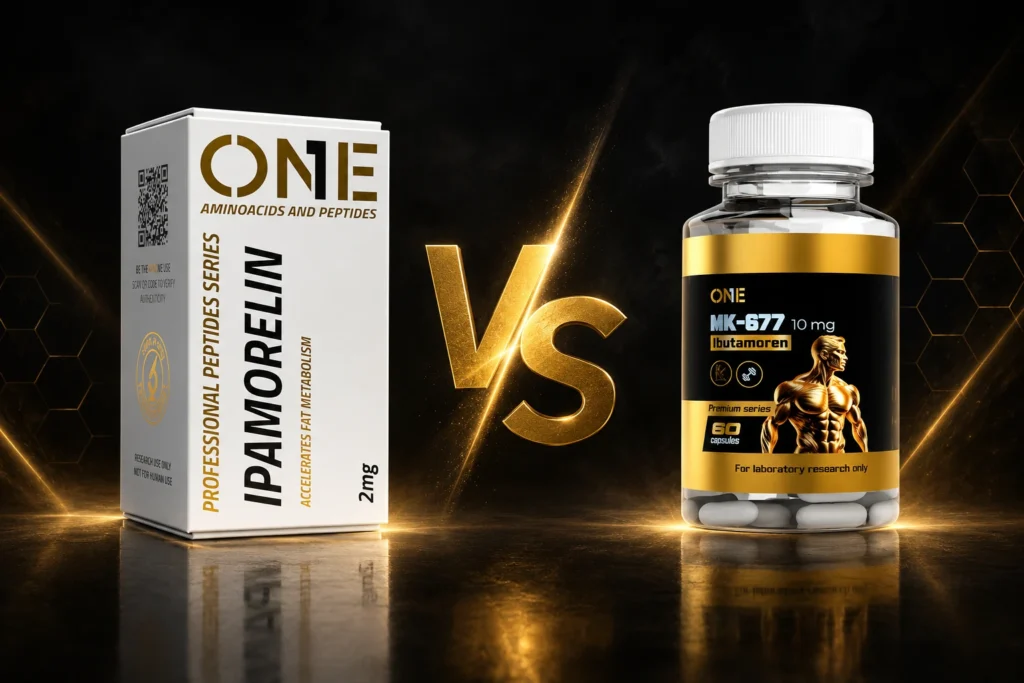
A research comparison of MK-677 and ipamorelin, focusing on GHS-R1a signaling, selectivity, administration route, human evidence and WADA status.
