 DE
DE  EN
EN  ES
ES 

A research-focused comparison of Melanotan II and PT-141, covering melanocortin receptor selectivity, evidence, safety signals and regulatory status.
The evolution of the pharmacology of obesity treatment in the last decade has been in the sequence of “adding receptors” – from the GLP-1 monoagonist (semaglutide → Ozempic, Wegovy), by GLP-1 + GIP agonist (tirzepatide → Mounjaro, Zepbound), up to the triagonist GLP-1 + GIP + glucagon (retatrutide in phase III). CagriSema adds to this narrative a separate signaling pathway – amylin — still not through a new molecule, but through combination of two peptides in one clinical protocol.
The informal shorthand used for retatrutide in online searches is explained in a separate entry: the shorthand “reta”: terminology explained.
CagriSema is a combination of semaglutide (a long-acting GLP-1 analogue) and cagrilintide (a long-acting amylin analogue), developed by Novo Nordisk and currently in phase III clinical trials in the REDEFINE program. The two peptides activate two different satiety signaling pathways simultaneously – the GLP-1 receptor and the amylin receptor – which in Phase II clinical trials resulted in higher body weight reduction than with semaglutide monotherapy.
Regulatory Frame – A Critical Distinction
CagriSema operates in two separate legal statuses:
CagriSema is not a registered medicine in any major jurisdiction. Semaglutide as monotherapy is a registered medicine (Ozempic, Wegovy, Rybelsus – Novo Nordisk). Cagrilintide as a monotherapy and CagriSema as a combination are not registered. Products marked “CagriSema” or “Sema+Cagri” in the research peptide catalog operate within the RUO framework – without protocols for use in humans.
CagriSema is a combination of two synthetic peptides administered together in one clinical protocol:
In Novo Nordisk clinical protocols, peptides are administered in one solution, with one subcutaneous injection, once a week. The dose ratio is typically 1:1 (e.g. 2.4 mg semaglutide + 2.4 mg cagrilintide) or in optimized variants. The manufacturer develops the combination as a combined drug with fixed dose proportions — that is, a single pharmaceutical preparation containing both peptides in fixed proportions.
The clinical program is run under the name REDEFINE. In the catalog of research reagents, the same blend of two peptides functions as Sema+Cagri PEN 2mg+2mg — separate regulatory frame.
Cagrilintide is a new peptide in the Metabolic Pharmacology Catalog – not previously described in a separate article in the One Peptides Knowledge Base. It is worth devoting a chapter to it, because understanding the biology of amylin is necessary to explain why adding cagrilintide to semaglutide makes mechanistic sense.
Amylin (also known as Islet Amyloid Polypeptide, IAPP) is a peptide consisting of 37 amino acids, produced by pancreatic β-cells along with insulin. Secreted in response to a meal together with insulin – in a ratio of approximately 1:100 (one molecule of amylin per 100 molecules of insulin). It performs three main physiological functions:
Amylin receptor is the assembly of the calcitonin receptor (CTR) with a modulating protein (RAMP – Receptor Activity Modifying Protein). The three receptor isoforms (AMY1, AMY2, AMY3) differ in RAMP composition and have slightly different tissue distribution. Receptor activation in CNS circuits signals “satiety” independently of the GLP-1 axis.
Endogenous amylin has very short half-life (~10 minutes) – which would make it impractical as a weekly medication. Pramlintide (approved by the FDA in 2005 to support insulin therapy in diabetes) has a half-life of only ~50 minutes and requires administration several times daily.
Cagrilintide is a long-acting amylin analogue, developed by Novo Nordisk with structural modifications extending the half-life to about 7 days — comparable to semaglutide. Modifications include:
Thanks to these modifications, cagrilintide can be administered once a week — compatible with the semaglutide regimen, which allows for a convenient combination of both peptides in one solution.
| Parameter | Value |
|---|---|
| Class | Long-acting amylin analogue |
| Producer | Novell |
| Number of amino acids | ~37 (amylin analogue) |
| Molecular mass | ~4,500 Da (estimate) |
| Structural modifications | Acylation, stabilizing substitutions |
| Plasma half-life | ~7 days – weekly schedule in clinical protocols |
| Target receptor | Amylin receptor (AMY) – CTR + RAMP |
| Registration status | No registration as a drug (monotherapy or combination) |
The hypothesis behind the combination of semaglutide and cagrilintide is simple: activate two different satiety signaling pathways simultaneously and obtain an additive or synergistic effect, which cannot be achieved in monotherapy. Full physiology of the incretin axis article about the incretins GLP-1, GIP and glucagon.
Activation of the GLP-1 receptor modifies:
Activation of the amylin receptor modifies:
Main synergy hypothesis: GLP-1 and amylin signal satiety through distinct neuroanatomical circuits whose activation in monotherapy has a sublimit effect. Satiety in response to the GLP-1 signal is inhibited by counterregulation (e.g., increased expression of Agouti-Related Peptide – in the arcuate nucleus). The amylin signal can bypass this counterregulation by acting in the area postrema, an anatomically different structure. By combining both signals, the body experiences stronger subjective feeling of satiety and lower food intake than in monotherapy.
The second hypothesis concerns stomach emptying. Both peptides slow gastric emptying, but in part through different hormonal and neuronal mechanisms. Combining both may result in a stronger reduction in postprandial glycemia than in monotherapy.
CagriSema is one of the high-profile metabolic pharmacology programs of recent years. The clinical program includes early phase II studies (combination of cagrilintide with semaglutide) and advanced phase III studies called REDEFINE.
In Phase II of the clinical program, Novo Nordisk tested the combination of cagrilintide with semaglutide in patients with obesity (BMI ≥30) and type 2 diabetes. The most frequently cited early data reported body weight reduction of ~15–17% after 32 weeks in the combination group vs ~5–6% in the placebo group (Enebo et al. 2021 Lancet — first published Phase 1b/2a data for this combination).
Program REDEFINE includes many phase III studies in various populations:
Full results are being published. Lau et al (2021, Lancet) published early phase 2 data for cagrilintide in monotherapy and combination.
| Test | Phase | Population | Main result | Year |
|---|---|---|---|---|
| Enebo et al. | 1b/2a | Obesity | Body weight reduction ~17% (combination) vs ~6% (semaglutide mono) at 20 weeks. | 2021 |
| Lau DCW Lancet | 2 | Obesity | Dose-finding cagrilintide monotherapy | 2021 |
| REDEFINE 1 | III | Obesity without diabetes | Results in the publication phase | 2024+ |
| REDEFINE 2 | III | Obesity + T2D | Results in the publication phase | 2024+ |
CagriSema’s position becomes clear in direct comparison with other incretin class molecules. A direct comparison of mono- and tri-agonists can be found in comparison of semaglutide and retatrutide; full class review in GLP-1 peptide guide.
| Molecule | Active receptors | Class | Registration status |
|---|---|---|---|
| Semaglutide | GLP-1R | Monoagonist | Medicine (Ozempic, Wegovy, Rybelsus – Novo Nordisk) |
| Tirzepatide | GLP-1R + GIPR | GLP-1R agonist + GIPR | Medicine (Mounjaro, Zepbound – Eli Lilly) |
| Retatrutide | GLP-1R + GIPR + GCGR | Tri-agonist | Phase III TRIUMPH (no registration) |
| CagriSema | GLP-1R + amylin receptor | Combination of two pathways (two peptides) | Phase III REDEFINE (no registration) |
CagriSema differs in molecular architecture from the others: tirzepatid and retatrutide are single-molecule peptides activating several receptors simultaneously; CagriSema is a combination of two separate peptides given together. This is important for researchers evaluating pharmacokinetic and interaction data – the kinetics of combinations may differ from those of single-molecule dual-agonists.
The most frequently asked comparison. Both achieve high weight reductions in the clinical phase. Differences:
A direct comparison between CagriSema and tirzepatide has not yet been published.
CagriSema’s safety profile in clinical trials mirrors that of each component individually – with additional potential for interaction.
From Phase 1b/2a (Enebo 2021) and early REDEFINE data:
⚠️ The security data described above comes from clinical trials on CagriSema as a combination of pharmaceutical candidates Novo Nordisk. In the context of the RUO research reagent, both peptides are not intended for use in humans – the clinical protocols of the REDEFINE studies do not translate to the use of laboratory research reagents. For clinical questions regarding molecules, consult your doctor.
Semaglutide Is GLP-1 receptor monoagonist — a single molecule activating one signaling pathway. CagriSema is combination of two peptides (semaglutide + cagrilintide) activating two different signaling pathways — GLP-1 and the amylin receptor. Two satiety pathways simultaneously signal the feeling of fullness through various neuroanatomical circuits, which in clinical trials translated into higher body weight reduction than in semaglutide monotherapy.
Cagrilintide is long-acting synthetic amylin analogue developed by Novo Nordisk. Amylin is a pancreatic hormone secreted by β-cells along with insulin in response to a meal; functions to regulate satiety, gastric emptying and postprandial glucagon secretion. Endogenous amylin has a half-life of ~10 minutes – which is impractical for a weekly drug. Cagrilintide has structural modifications (acylation, amino acid substitutions) extending the half-life to ~7 days — compatible with semaglutide.
Direct comparison has not been published yet. Tirzepatide (Mounjaro, Zepbound) is a GLP-1 + GIP agonist in one molecule, registered as a drug. CagriSema is a combination of two peptides (GLP-1 + amylin), in phase III clinical trials. Early results from both programs (SURMOUNT for tirzepatide, REDEFINE for CagriSema) reported strong weight reductions – full comparative data is an area of active investigation.
The REDEFINE program includes multiple phase III studies of CagriSema in various populations (obesity without diabetes, obesity with type 2 diabetes, special populations). Full results are being published. Early data (Enebo 2021 Lancet, Lau 2021 Lancet) suggest a high level of weight loss – exceeding what was achieved with semaglutide monotherapy.
Currently – NO. CagriSema is combination of pharmaceutical candidates in phase III clinical trials under the supervision of Novo Nordisk. No registration with EMA, FDA or other major jurisdictions. Semaglutide as monotherapy is a registered medicine (Ozempic, Wegovy, Rybelsus). Cagrilintide as monotherapy is not registered. CagriSema combination is not registered.
CagriSema expands the narrative of the evolution of incretin analogues with an additional dimension – amylin pathway. This is a natural complement to the existing articles: semaglutide (mono GLP-1), tirzepatide (dual GLP-1/GIP), retatrutide (tri GLP-1/GIP/glucagon) and mechanism of the incretin axis. For researchers analyzing the pharmacology of obesity, the picture falls into four parallel paths:
Adjacent non-incretin pathways include tesofensine (triple monoamine reuptake inhibitor – CNS mechanism), BAM-15 (mitochondrial uncoupler), SLU-PP-332 (ERR panagonist, i.e. “exercise mimetic”) and 5-amino-1MQ (NNMT inhibitor). Together, these two groups form a broad map of 21st century metabolic pharmacology.
CagriSema is a combination of semaglutide and cagrilintide — two peptides activating two different satiety signaling pathways simultaneously (GLP-1 receptor and amylin receptor). Novo Nordisk’s REDEFINE program includes multiple Phase III studies; full results pending publication. Early data (Enebo 2021 Lancet, Lau 2021 Lancet) suggest weight reduction at a level exceeding that of semaglutide monotherapy.
Cagrilintide as monotherapy or CagriSema as a combination are not registered medicines in any major jurisdiction. Semaglutide monotherapy – yes (Ozempic, Wegovy, Rybelsus).
In the field of research reagents, both peptides function as Research Use Only reagents — in the One Peptides catalog available as Sema+Cagri PEN 2mg+2mg. They are not registered medicines, are not dietary supplements and are not intended for use in humans.
ℹ️ Disclaimer
CagriSema (a combination of semaglutide and cagrilintide) in the One Peptides catalog functions only as a set of chemical reagents intended for laboratory tests (Research Use Only). It is not a medicinal product, dietary supplement or food. The information in this article is educational in nature and describes the clinical literature regarding CagriSema as a combination of pharmaceutical candidates in Novo Nordisk’s Phase III clinical trials – it does not constitute medical advice, does not encourage the use of peptides in a non-exploratory manner, and does not provide protocols for use for the end purchaser.

A research-focused comparison of Melanotan II and PT-141, covering melanocortin receptor selectivity, evidence, safety signals and regulatory status.
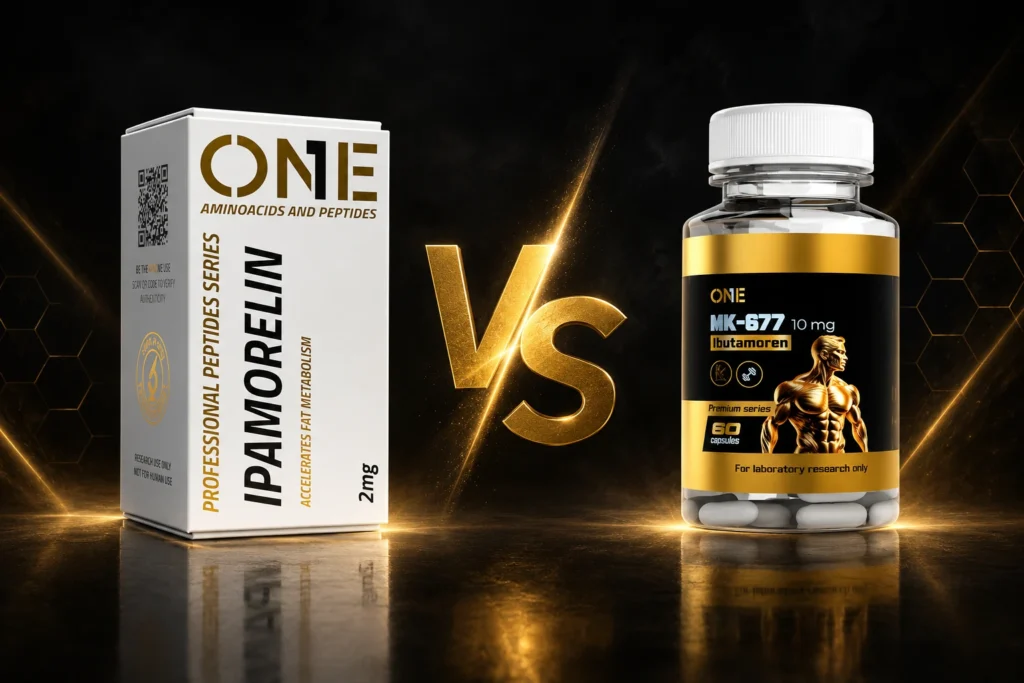
A research comparison of MK-677 and ipamorelin, focusing on GHS-R1a signaling, selectivity, administration route, human evidence and WADA status.
