 DE
DE  EN
EN  ES
ES 

A research-focused comparison of Melanotan II and PT-141, covering melanocortin receptor selectivity, evidence, safety signals and regulatory status.
In the mid-1990s, a team led by Croatian pharmacologist Predrag Sikiric at the University of Zagreb was working on a puzzle that had long intrigued gastroenterologists: why does human gastric juice — with its aggressive pH 1–2 and the presence of pepsin — fail to digest itself. While studying mechanisms of gastric cytoprotection, Sikiric isolated from gastric juice a 15-amino-acid fragment of a larger protein — a derivative of a cytoprotective gastric protein named BPC (Body Protection Compound). The sequence turned out to be surprisingly biologically active: it regenerated tissue in injury models where other peptides had failed. BPC-157 was born — and three decades later it is one of the best-described members of the recovery-peptide class, the fuller picture of which is covered in the how recovery peptides work review.
Thirty years on, BPC-157 is among the most widely cited research peptides in the regeneration literature, with a bibliography running into hundreds of experimental papers — predominantly from the Sikiric group and its collaborators. The molecule has gained meaningful popularity in the soft-tissue repair research community, though — to be clear from the start — it remains a research peptide, unapproved as a drug in any major jurisdiction.
📖 This article is educational and reviews the published scientific literature. The majority of the cited studies were conducted in animal models (mainly rat) or in vitro. Data from human clinical trials are very limited. This is not medical advice.
BPC-157 is a synthetic pentadecapeptide with the sequence Gly-Glu-Pro-Pro-Pro-Gly-Lys-Pro-Ala-Asp-Asp-Ala-Gly-Leu-Val. The acronym stands for Body Protection Compound, fragment 157 — referencing the amino-acid position in the larger protein from which the peptide was originally isolated.
Chemical features relevant from a laboratory standpoint:
The last feature — resistance to gastric proteolysis — sets BPC-157 apart from most research peptides. Typically a peptide given orally is broken down in the gastrointestinal tract into individual amino acids before it reaches the bloodstream. BPC-157 retains its molecular structure even after several hours of incubation in gastric juice, as documented by in vitro pharmacokinetic studies.
BPC-157 does not have a single receptor or signaling pathway through which it acts. The molecule influences several parallel repair mechanisms — which is why its effects observed in experiments are often pleiotropic (multi-directional). That is rare in pharmacology, and one of the reasons the peptide draws so much research interest.
One of the best-documented mechanisms of BPC-157 is its effect on the nitric oxide system. In vascular injury models, the peptide modulated both nitric oxide synthase (NOS) activity and the response to L-NAME — a NOS inhibitor (Sikiric et al., 2020). Effect: BPC-157 supports NO/cGMP signaling in injured tissue, which translates into improved microcirculation and healing.
Models of Achilles-tendon injury, muscle injury, and gastrointestinal tissue injury showed that BPC-157 increases the expression of vascular endothelial growth factor (VEGF) and accelerates the formation of new blood vessels at the injury site (Hsieh et al., 2017). Angiogenesis is the foundation of tissue repair — without new vessels there is no transport of oxygen, nutrients, and progenitor cells into the damaged area.
In in vitro and in vivo experiments BPC-157 increased expression of:
A less obvious but well-documented mechanism is the modulation of dopaminergic and serotonergic neurotransmission in the brain. Animal models have shown that BPC-157 alleviates symptoms in Parkinson’s disease models, haloperidol-induced tardive dyskinesia, and addiction models (Vukojević et al., 2022). The mechanism — while research-interesting — remains poorly described at the molecular level.
In acute and chronic inflammation models BPC-157 reduced inflammation markers — TNF-α, IL-6, IL-1β — and modulated NF-κB activity. The effect is not as strong as that of classical NSAIDs, but it has an important feature: BPC-157 does not produce the typical NSAID-induced gastric mucosal damage. On the contrary — in models induced by indomethacin or diclofenac, the peptide showed protective activity toward the gastric mucosa (Sikiric et al., 2013).
The BPC-157 bibliography spans several hundred experimental papers, organized around several main research areas. The overview below does not exhaust the literature, but it presents the most important lines of evidence.
This is the oldest and best-documented research path — naturally, given the peptide’s origin in gastric protection studies. In rat models, BPC-157 accelerated the healing of:
The second most studied area is soft-tissue repair in the musculoskeletal system. Models with severed Achilles tendons in rats showed that BPC-157 accelerates:
Similar effects were observed in medial collateral ligament and anterior cruciate ligament injury models in rats (Cerovecki et al., 2010).
Quadriceps-crush models in rats showed that BPC-157 accelerates muscle-fiber regeneration, reduces the area of necrosis, and improves muscle function on behavioral testing (Pevec et al., 2010). The mechanism likely involves stimulation of muscle satellite cells and improved angiogenesis in the injury area.
In rat models of fractures and bone defects, BPC-157 accelerated fracture consolidation and increased mineral density in the regeneration area (Sebecic et al., 1999). The mechanism likely involves osteoblast modulation and improved vascularization in the healing area.
Models with a severed sciatic nerve in rats showed that BPC-157 accelerates reinnervation, improves motor function, and reduces hyperalgesia at the injury site (Gjurasin et al., 2010). The effect was observed for both peripheral and systemic administration.
Single papers suggest a cardioprotective effect in models of myocardial ischemia, arrhythmia, and endothelial injury. The data, however, are significantly more limited than in the other areas.
Across BPC-157 studies, different routes of administration have been used, depending on the model:
Each route has produced positive results in the appropriate models, but direct bioavailability comparisons remain a subject of further study.
As a research peptide, BPC-157 shows high stability:
A full guide to peptide reconstitution and storage is available in the laboratory practice section.
BPC-157 from the One-Peptides catalog — the BPC-157 10 mg product — meets the following quality criteria:
| Parameter | Specification | Method |
|---|---|---|
| Purity | ≥98% | RP-HPLC |
| Molecular mass identity | 1419.53 Da | ESI-MS |
| Moisture content | ≤5% | Karl Fischer |
| Endotoxins | ≤1 EU/mg | LAL test |
Each vial is labeled with a batch number linked to a certificate of analysis (COA). Full QC documentation is available on the quality testing and certificates page.
In animal models BPC-157 shows an exceptionally favorable toxicology profile — in the Sikiric group’s papers no toxic doses were recorded in LD₅₀ tests across a wide dose range. Long-term models (up to 12 months) did not show toxicity accumulation or organotoxic side effects.
This does not, however, waive several methodological caveats:
⚠️ The majority of the data come from a single research group (the Sikiric team) or from closely collaborating groups. Independent replications by Western teams are significantly less common. There is no clinical data from well-controlled human trials.
Specific limitations to keep in mind:
The distinguishing feature is stability in the gastrointestinal tract and resistance to proteolysis, which enables oral administration. Most recovery peptides — such as TB-500 or GHK-Cu — require parenteral administration. The second distinguishing feature is a multi-directional mechanistic profile: BPC-157 does not act through a single receptor but modulates several repair pathways in parallel.
Yes, as a research reagent (Research Use Only). BPC-157 is not approved as a drug or dietary supplement and should not be used in any way other than research. The RUO status means the peptide is legally sold as a chemical substance for laboratory research.
No. BPC-157 does not stimulate the GH/IGF-1 axis and has no anabolic effect comparable to ghrelin mimetics — such as MK-677 ibutamoren. The BPC-157 repair mechanism rests on modulation of angiogenesis, growth factors at the injury site, and the NO/cGMP system — not on systemic GH elevation.
Most peptides administered orally are broken down in the stomach by pepsin and acidic pH into individual amino acids before reaching the intestine. BPC-157, thanks to a specific amino-acid sequence (with proline at positions 3, 4, 5, and 8), is exceptionally resistant to proteolytic cleavage. In in vitro studies the peptide retained its structure after several hours of incubation in gastric juice. This feature is leveraged commercially by the BPC-157 60 capsules (BPC-157 ARG) variant — an oral formulation that most research peptides do not enable.
After reconstitution in bacteriostatic water and storage at 2–8°C, the peptide remains stable for 28–30 days. The lyophilizate before reconstitution can be stored at -20°C for 18–24 months.
Data are very limited. The literature contains a handful of pilot papers on small patient groups (mainly with gastrointestinal conditions), but these do not meet phase III standards. The bulk of the BPC-157 bibliography comes from animal models. There are no well-designed, large-scale double-blind clinical trials.
At the time of writing, BPC-157 is on the WADA Prohibited List, category S0, prohibited at all times. This status may change — athletes under anti-doping testing should verify the current status on the official WADA page before any use.
BPC-157 is available in the One-Peptides catalog as the BPC-157 10 mg vial (injectable after reconstitution) and as the oral BPC-157 60 capsules (BPC-157 ARG) variant — both with full QC documentation.
ℹ️ Global disclaimer
All One-Peptides products are reagents intended exclusively for laboratory and scientific research (Research Use Only). They are not medicinal products, dietary supplements, or products intended for human consumption. The information in this article is educational and reviews the published scientific literature; it is not medical, pharmaceutical, or dietetic advice.
For broader context, see our guide to how recovery peptides work.

A research-focused comparison of Melanotan II and PT-141, covering melanocortin receptor selectivity, evidence, safety signals and regulatory status.
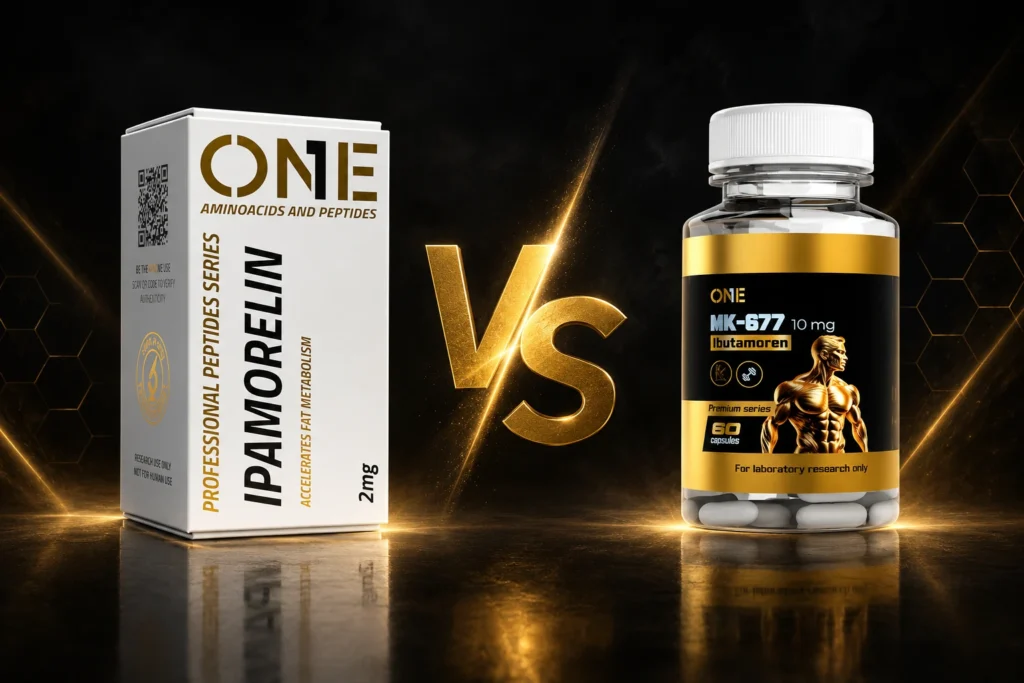
A research comparison of MK-677 and ipamorelin, focusing on GHS-R1a signaling, selectivity, administration route, human evidence and WADA status.
