 DE
DE  EN
EN  ES
ES 

A research-focused comparison of Melanotan II and PT-141, covering melanocortin receptor selectivity, evidence, safety signals and regulatory status.
In the Research Use Only reagent market, the term “BPC-157” covers several chemical variants – differing in salt form, quality of synthesis and sometimes peptide sequence. The abbreviation ARG BPC-157 functions in suppliers’ catalogs as a separate marking and can be a source of real confusion – because it does not always refer to the same compound. For a researcher evaluating two “BPC-157” reagents for the repeatability of an experimental protocol, the distinction between these variants is fundamental. The chemical identification in the certificate of analysis (COA) is the only reliable signal; a trade name alone is not sufficient.
For the wider regeneration framework, see how recovery peptides work.
This article compares classic BPC-157 (most often as an acetate salt) with variants described as “ARG BPC-157” – along five axes: chemical identity and nomenclature, solution stability and preservation, pharmacokinetics and route of administration, mechanistic profile in research models, regulatory status, and limitations of the evidence base. The idea is to give the reader the tools to evaluate each vial by COA, not to rank the “better” variant.
📖 The following article is educational and is a review of published scientific literature. Most of the cited studies were conducted on animal models or in vitro. The text does not constitute medical advice. All One Peptides products in the freeze-dried peptides category are intended exclusively for laboratory tests (Research Use Only).
The term “ARG BPC-157” functions in the trade of research peptides in two senses. For a reliable COA interpretation, you need to know which one you are dealing with.
In this variant, the peptide sequence remains identical to the classic BPC-157 (Gly-Glu-Pro-Pro-Pro-Gly-Lys-Pro-Ala-Asp-Asp-Ala-Gly-Leu-Val, 15 amino acids). Only the salt form changes — i.e. the counterion with which the peptide is paired during synthesis and crystallization.
The standard form of BPC-157 in circulation is acetate salt (BPC-157 acetate) or trifluoroacetate salt (BPC-157 TFA salt – typical after HPLC purification). Arginine salt is an alternative – the peptide is bound to an arginine residue acting as a pH buffer and solution stabilizer. The amino acid sequence of the peptide itself does not change; counterion is different.
Marketing arguments for arginine salt in RUO supplier catalogs:
These arguments are mechanistically coherent, but there is a lack of head-to-head peer-reviewed research directly comparing the bioavailability and stability of arginine vs. acetate salt of BPC-157 under experimental conditions.
In this (rare but real) sense, “ARG BPC-157” is a peptide with a modified sequence — with an arginine residue attached to the N-terminus or C-terminus of classic BPC-157. The sequence becomes e.g. Arg-Gly-Glu-Pro-Pro-Pro-Gly-Lys-Pro-Ala-Asp-Asp-Ala-Gly-Leu-Val (16 amino acids instead of 15).
This is a structurally different peptide. The molecular mass is higher by ~156 Da (mass of the arginine residue with a guanidine group). The charge profile at physiological pH is different (Arg contributes a positive charge at the end of the peptide). The mechanistic implications of such a modification are only partially predictable – a positively charged Arg can influence binding to the anionic domains of proteins, the way they interact with cell membranes and the stability against proteases.
The certificate of analysis (COA) must include:
In practice – if the COA shows a mass of ~1419 Da, you have classic BPC-157 in the form of any salt. If it shows ~1575 Da, you have a peptide with an Arg residue added in the sequence. These are two separate reagents.
| Characteristic | BPC-157 (classic, acetate/TFA) | ARG BPC-157 (arginine salt) | ARG BPC-157 (with added Arg in sequence) |
|---|---|---|---|
| Sequence | 15 aa (GEPPPGKPADDAGLV) | 15 aa (identical) | 16 aa (Arg-GEPPPGKPADDAGLV or C-Arg) |
| Molecular mass of the peptide | 1419.53 Da | 1419.53 Da | ~1575.71 Da |
| Salt form (counterion) | Acetate or trifluoroacetate | Arginine | Acetate / TFA / arginate (variable) |
| HPLC reference purity | ≥98% (RUO standard) | ≥98% (RUO standard) | ≥98% (RUO standard) |
| MS Identity – Measured mass | ~1419 Da | ~1419 Da + arginine signal | ~1575 Da |
| Net charge at physiological pH | Close to neutral | Close to neutral | Slightly positive (Arg) |
Peptide stability covers two horizons: dry lyophilisate (storage before reconstitution) and solution after dissolution.
Classic BPC-157 in the form of lyophilisate is a relatively stable peptide thanks to four proline residues in the sequence (positions 3, 4, 5, 8). These residues introduce a rigid conformation that protects the peptide from proteolytic degradation and loss of structure. At storage conditions of 2–8°C, the lyophilisate remains active for up to 36 months from the date of synthesis.
The arginine salt does not significantly affect the stability of the lyophilisate – in dry form, the peptide is stable regardless of the counterion. The difference may only be visible in solution.
The variant with an added Arg residue in the sequence has theoretically similar lyophilized stability – the additional residue does not change the fundamental resistance of the prolines to proteolysis.
After reconstitution in bacteriostatic water, the stability of the solution depends on three factors: solution pH, peptide concentration and storage temperature.
All variants require identical storage conditions for the lyophilisate – tight container, 2-8°C, protection from light. The peptide calculator will help you calculate the appropriate volume of solvent for the planned working concentration.
Classic BPC-157 is one of the few research peptides with documented evidence of oral bioavailability in animal models. Four proline residues block the cleavage of the peptide by pepsin, which allows BPC-157 to pass through the stomach to further sections of the digestive tract in an active form (Sikiric 2018¹).
Three main routes of peptide administration are reported in experimental models:
As for the arginine salt variants and Arg-BPC-157 – documentation in the literature is incomplete:
The pharmacokinetic profiles for classic BPC-157 are well described (Hsieh 2017²): the half-life in the serum of rat models after injection is approximately 2–4 hours, the peptide is widely distributed into tissues, and is mainly metabolized by the liver and kidneys. For arginine variants, data have not been published to the same extent of detail.
This question requires a distinction between two interpretations of “ARG BPC-157”:
If the peptide sequence is identical, the mechanism of action is the same as that of classic BPC-157. Counterion does not affect the way the peptide interacts with receptors and signaling pathways. Once dissolved in physiological solution, the salt dissociates and the peptide acts according to its mechanistic profiles.
The BPC-157 mechanistic profile includes:
These mechanisms are widely documented in the work of Sikiric and related groups (Chang 2014³, Cerovecki 2010⁴). The arginine salt retains this full profile if the peptide sequence remains 15 amino acids long.
Adding an arginine residue to the N- or C-terminus of the peptide may modify the mechanistic profile in a way that is difficult to predict from the structure itself:
With no published head-to-head studies comparing the biological activity of Arg-BPC-157 with classic BPC-157 in identical experimental models, inferring behavior or activity modification remains a hypothesis.
This is an important methodological limitation for the researcher: if the experimental protocol aims to replicate literature results obtained with classic BPC-157, using the Arg-BPC-157 variant introduces an uncontrolled variable.
The peer-reviewed body of work on classic BPC-157 includes over 100 experimental studies across tissue regeneration models:
For arginine variants:
| Purpose of the experiment | Reagent selection |
|---|---|
| Replication of results from the literature (Sikiric, Chang, Cerovecki) | Classic BPC-157 acetate or TFA — the same variant on which the original evidence base is based |
| Experiment with emphasis on solution stability over a long time window | BPC-157 acetate — documented stability 28-30 days / optional arginate if an internal laboratory protocol verifies stability based on its own tests |
| A comparative experiment of both salt variants | Classic BPC-157 + arginate in parallel groups with an identical protocol; requires independent COA verification for both variants |
| Sequence modification experiment – testing the effect of added Arg on activity | Arg-BPC-157 (with Arg residue added) compared to classic BPC-157 as control; requires unambiguous identification in COA by molecular weight |
| Introduction of a new protocol with low risk of an uncontrolled variable | Classic BPC-157 acetate/TFA — the most documented variant in the literature |
All BPC-157 variants—regardless of salt form and minor sequence modifications—remain research peptides (Research Use Only) in the European Union. None of the forms has been registered as a medicinal product by the EMA (European Medicines Agency). They are not classified as dietary supplements under EFSA.
In some markets, BPC-157 in the form of oral capsules is sold as a dietary supplement under a separate registration — a different regulatory framework that One Peptides does not use. In our catalogue every form of BPC-157, capsules included, is a Research Use Only reagent.
WADA status of classic BPC-157: the peptide is located on the WADA Prohibited List, category S0 (non-approved substances), and it is prohibited at all times; athletes subject to anti-doping control must not use it. Arginine variants are not listed separately in WADA guidelines, but due to sequence identity (in the case of salt) or close relatedness (in the case of Arg-BPC-157) they should be treated analogously.
It depends on interpretation. If the designation refers to the arginine salt of the classic BPC-157, the peptide sequence is identical – the difference lies only in the salt form (counterion). If the designation refers to a variant with an added arginine residue in the sequence (e.g. Arg-Gly-Glu-Pro…), it is a structurally different peptide. Unambiguous identification is provided by COA – amino acid sequence, molecular mass (1419 Da vs ~1575 Da) and MS spectrum.
The mechanistic argument is based on the interaction of arginine with the amino acid transporters PEPT1/PEPT2 in the intestinal epithelium. This is biochemically consistent, but there are no peer-reviewed head-to-head studies comparing the oral bioavailability of both variants in animal or human models. The inference remains a hypothesis.
From a purely mechanistic point of view, if the peptide sequence is identical (1419 Da, 15 amino acids), the biological activity should be the same. From the point of view of methodological rigor, changing the counterion during the experiment introduces a variable whose impact on the kinetics of peptide release in solution has not been verified head-to-head. For protocol repeatability, consistency in the choice of salt form is recommended.
Check two fields in the COA: amino acid sequence (classic BPC-157: 15 aa, Gly-Glu-Pro-Pro-Pro-Gly-Lys-Pro-Ala-Asp-Asp-Ala-Gly-Leu-Val) and major molecular mass in MS (classic: 1419 Da; variant with added Arg: ~1575 Da). The difference is immediately visible in the spectrum. If the COA does not contain this data, ask the supplier to provide it.
In practice – no. Classic BPC-157 acetate, TFA salt and arginate in the form of lyophilisate show similar stability (up to 36 months at 2–8°C). Differences may become apparent in the solution after reconstitution – the arginine salt theoretically stabilizes pH better than the acetate salt, but the difference has not been documented in head-to-head studies.
Classic BPC-157 is on the WADA Prohibited List, category S0. Arginine variants are not listed separately, but due to sequence identity (salt) or close relatedness (sequence modification), athletes subject to doping control should treat them analogously and verify current guidelines before use.
Supplier marketing sometimes suggests that “stable arginine salt with optional sequence modification” combines the benefits of both forms. From a researcher’s perspective, such products require special attention when verifying COA – it often turns out to be a variant with an added Arg residue in the sequence (1575 Da), advertised under a name suggesting identity with the classic BPC-157 (1419 Da). Identification by MS mass is the only reliable way to tell them apart.
Classic BPC-157 available in the One Peptides catalog in the form of lyophilisate: BPC-157 10 mg. Each batch with HPLC certificate of analysis ≥98% and MS identity confirmation – sequence, molecular weight and salt form documented in COA available to the public. The full range of regenerative peptides is in the BPC-157 category and, more broadly, in the research peptide categories.
ℹ️ Disclaimer
All One Peptides products in the freeze-dried peptides category (including all BPC-157 variants) are chemical reagents intended exclusively for laboratory tests (Research Use Only). They are not medicinal products, dietary supplements or foodstuffs. The information in this article is educational in nature and is a review of published scientific literature; it does not constitute medical, pharmaceutical or dietary advice. BPC-157 is on the WADA Prohibited List, category S0 – athletes subject to doping control should verify current guidelines before use. BPC-157 in the form of oral capsules (see separate product card) is also a Research Use Only reagent — only the packaging form differs.

A research-focused comparison of Melanotan II and PT-141, covering melanocortin receptor selectivity, evidence, safety signals and regulatory status.
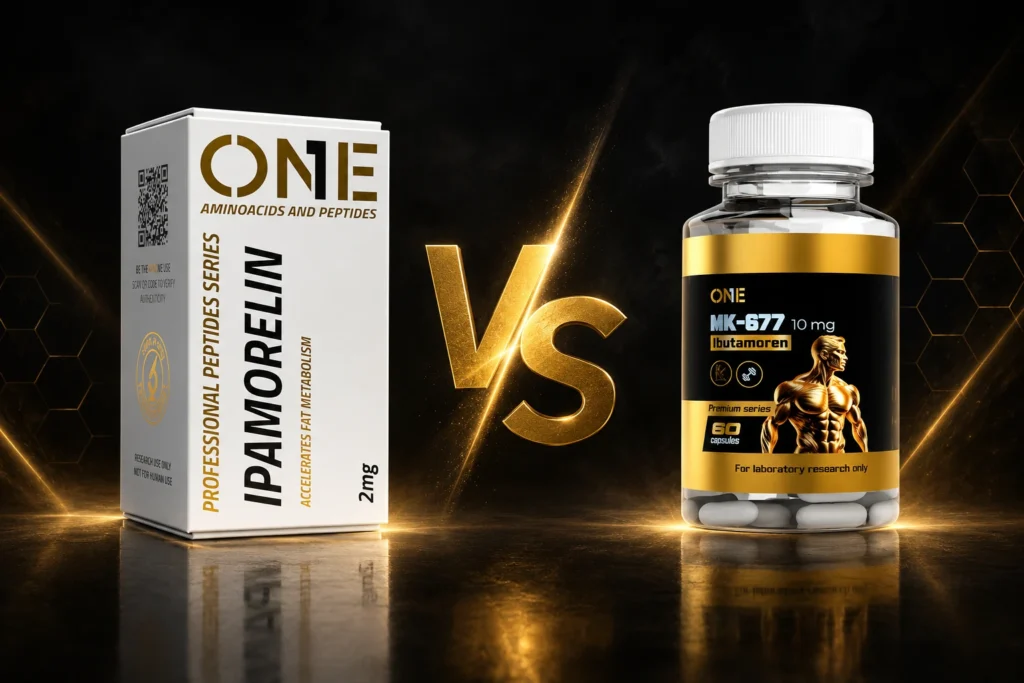
A research comparison of MK-677 and ipamorelin, focusing on GHS-R1a signaling, selectivity, administration route, human evidence and WADA status.
