 DE
DE  EN
EN  ES
ES 

A research-focused comparison of Melanotan II and PT-141, covering melanocortin receptor selectivity, evidence, safety signals and regulatory status.
BAM-15 is a relatively new compound in energy-metabolism research. Metabolic pharmacology has a long and disturbing history with mitochondrial uncouplers. 2,4-dinitrophenol (DNP) was used in the 1930s as a weight-loss drug — and left a trail of deaths from hyperthermia, cataracts, and multiple organ failure. The Food and Drug Administration withdrew DNP from the market as an anti-obesity drug in 1938. A class of molecules that seemed from a biochemical perspective to be the perfect tool to fight obesity has turned out to be a safety disaster. Despite this, the mechanism of uncoupling oxidative phosphorylation has never ceased to interest scientists – because the problem was not in the idea itself, but in lack of DNP selectivity.
It is against this background that it appears BAM-15 — a molecule developed in academia in 2014 as an attempt to design a mitochondrially selective, gentle uncoupler. In mouse models it actually shows a promising metabolic and safety profile. However, the data are early, limited almost exclusively to animal models, and the regulatory status is clear: BAM15 is not a drug, is not a dietary supplement, and there are no protocols for its use in humans. In the One Peptides catalog the molecule is available as BAM-15 25 mg.
BAM-15 is a small organic molecule from the class of mitochondrial proton uncouplers (protonophores) – an experimental alternative to the banned DNP, tested in mouse models of obesity, insulin resistance and non-alcoholic fatty liver disease. No registration as a drug, no long-term clinical data in humans.
BAM15 in the One Peptides catalog functions only as chemical reagent intended for laboratory research (Research Use Only):
BAM15 (full chemical name: (2-fluorophenyl){6-[(2-fluorophenyl)amino]-1,2,5-oxadiazolo[3,4-e]pyrazin-5-yl}amine) is a small organic molecule with a molecular weight of approximately 415 Da, synthesized and characterized in Virginia academic laboratories and partner research centers around 2014. The first systematic publication describing BAM15 as a candidate for a mild mitochondrial uncoupler comes from the team of Kenwood and Hoehn (Molecular Metabolism, 2014).
BAM15 is not a peptide. It is a fully synthetic, low molecular weight substance from the class mitochondrial protonophores. Mechanistically, BAM15 belongs to the same broad family as DNP, FCCP, and CCCP – but was designed with a significant modification of the pharmacological profile.
| Parameter | Value |
|---|---|
| Working name | BAM15 |
| Pharmacological class | Mitochondrial protonophore uncoupler |
| Molecule type | Small organic molecule (NOT peptide) |
| Molecular weight | ~415 Da |
| First scientific report | Kenwood et al., 2014 (Molecular Metabolism) |
| Clinical development stage | Very early – mostly preclinical studies |
| Registration status as a drug | No registration in any jurisdiction |
| WADA status | Prohibited — 2026 List, S4.4.1 (metabolic modulators) |
To understand what exactly BAM15 does, a brief description is necessary oxidative phosphorylation — the process by which cell mitochondria convert the chemical energy of substrates (fatty acids, glucose, amino acids) into adenosine triphosphate (ATP).
A mitochondrial uncoupler is a molecule that allows protons to pass back into the matrix by bypassing ATP synthase. The gradient energy is then dissipated as heat, without generating ATP. From the cell’s perspective:
The fundamental feature of BAM15, which is highlighted by researchers (Kenwood et al., 2014; Alexopoulos et al., 2020), is selectivity towards the inner mitochondrial membrane. DNP, FCCP and CCCP molecules uncouple not only mitochondria – they also disrupt proton gradients in other cell membranes (lysosomes, plasma membrane). This off-target activity is largely responsible for the toxicity of DNP.
BAM15 in published cell models shows significantly higher activity on the inner mitochondrial membrane than on other cell membranes. Consequences observed in mouse models: wider therapeutic window, no significant hyperthermia in metabolically effective doses, no significant effect on blood pressure and heart rate.
It should be emphasized directly: all above observations are from preclinical studies, mainly mouse models. Whether BAM15’s mitochondrial selectivity translates into a truly broader window of safety in humans remains an open question.
| Test | Model | Main result | Year |
|---|---|---|---|
| Kenwood et al. | In vitro cell models + short mouse studies | Characterization of BAM15 as a mitochondrially selective uncoupler | 2014 |
| Alexopoulos et al. | HFD obese mice | Reduction of fat tissue mass, improvement of insulin sensitivity, no hyperthermia | 2020 |
| Goedeke et al. | NAFLD/MASH models (nonhuman primates) | Reducing the content of triglycerides in the liver, improving hepatological parameters | 2019 |
| Axelrod et al. | Models of insulin resistance in rodents | Improvement of glucose metabolism, modulation of AMPK | 2020 |
| Childress et al. | Overview of the uncouplers class | Positioning of BAM15 in the class of mitochondrial-selective protonophores | 2018 |
In the model DIO (Diet-Induced Obesity) — mice fed a high-fat diet for 8–16 weeks — administration of BAM15 was associated in published protocols (Alexopoulos et al., 2020) with reduction of visceral and subcutaneous fat mass, improvement of the glucose-insulin profile and increase in markers of fatty acid oxidation.
In rodent models of NAFLD/MASH (Goedeke et al., 2019), BAM15 administration was associated with reduction of triglyceride content in hepatocytes, improvement of inflammatory markers and a decrease in liver enzyme activity.
2,4-dinitrophenol was originally introduced as an anti-obesity drug in the US in the 1930s. The safety profile was disastrous: hyperthermia (40–42°C), cataract, multi-organ failure, deaths. The FDA withdrew DNP as an anti-obesity drug in 1938.
| Characteristic | DNP | BAM15 (mouse model) |
|---|---|---|
| Mitochondrial selectivity | Low | High |
| Therapeutic window | Narrow | Wide |
| Hyperthermia | Occurs | Not observed in published mouse models |
| Regulatory status in humans | Banned as a drug since 1938 | No registration |
| Commercial availability | Chemical reagent/pesticide | RUO chemical reagent |
In published preclinical studies, BAM15 shows: a wide therapeutic window, no significant hyperthermia, no significant effect on hepatotoxicity markers, no significant effect on muscle mass, AMPK modulation.
Hyperthermia remains a theoretical risk of the mitochondrial uncoupler class — because the mechanism of action involves dissipating energy as heat. The mitochondrial selectivity of BAM15 reduces this risk against DNP in a mouse model, but does not eliminate it completely.
In the One Peptides catalog BAM-15 25 mg is a chemical reagent intended for laboratory research on the pharmacology of mitochondrial uncouplers. Standards: HPLC ≥98%, MS, COA per batch, cold chain. Details of the QA process in quality tests and certificates.
In mouse models (Alexopoulos et al., 2020), BAM15 administration was associated with a reduction in adipose tissue mass, an increase in fatty acid oxidation and an improvement in the metabolic profile. However, these are data from mouse models, not from human clinical trials. There are no published complete phase II/III studies in humans.
Both compounds belong to the same pharmacological class – proton uncouplers of oxidative phosphorylation. The difference lies in selectivity. DNP uncouples more than just mitochondria. BAM15 shows significantly higher selectivity towards the inner mitochondrial membrane. DNP has been banned as a drug since 1938; BAM15 has not been approved as a drug in any jurisdiction.
In the mouse model, the safety profile is described as favorable, with a wide therapeutic window and no significant hyperthermia. The profile in humans remains unexplored. There are no published long-term phase II/III studies.
Very early. Most of the published literature concerns preclinical studies. There are no published complete Phase II/III protocols in any human population.
Yes. BAM-15 (BAM15) is named on the World Anti-Doping Agency Prohibited List for 2026 — section S4.4.1 (metabolic modulators, AMPK activators). It is prohibited at all times. Athletes subject to doping control should check the current version of the List, which is updated every year.
BAM15 belongs to the group of compounds studied in relation to non-incretin pathways. This group also includes other research chemicals acting on different mechanisms:
In contrast, it embraces classic incretin agonists: semaglutide, tirzepatide, retatrutide, CagriSema. Full class review in GLP-1 peptide guide and article about incretins GLP-1, GIP and glucagon.
BAM-15 is a small organic molecule from the class of mitochondrial proton uncouplers — an experimental alternative to the banned DNP, designed for selectivity towards the inner mitochondrial membrane. In mouse models of obesity, NAFLD/MASH and insulin resistance (Kenwood 2014, Alexopoulos 2020, Goedeke 2019, Axelrod 2020), the molecule shows a promising metabolic profile.
However, human data remains at a very early stage. No full Phase II/III studies published, no long-term safety data. In the market of research reagents, BAM15 functions exclusively as Research Use Only reagent.
BAM15 in the One Peptides catalog functions only as chemical reagent intended for laboratory research (Research Use Only). Molecule is not a medicinal product, dietary supplement or food. Any information about the metabolic efficacy of BAM15 comes from animal models and should not be extrapolated to humans without clinical validation.

A research-focused comparison of Melanotan II and PT-141, covering melanocortin receptor selectivity, evidence, safety signals and regulatory status.
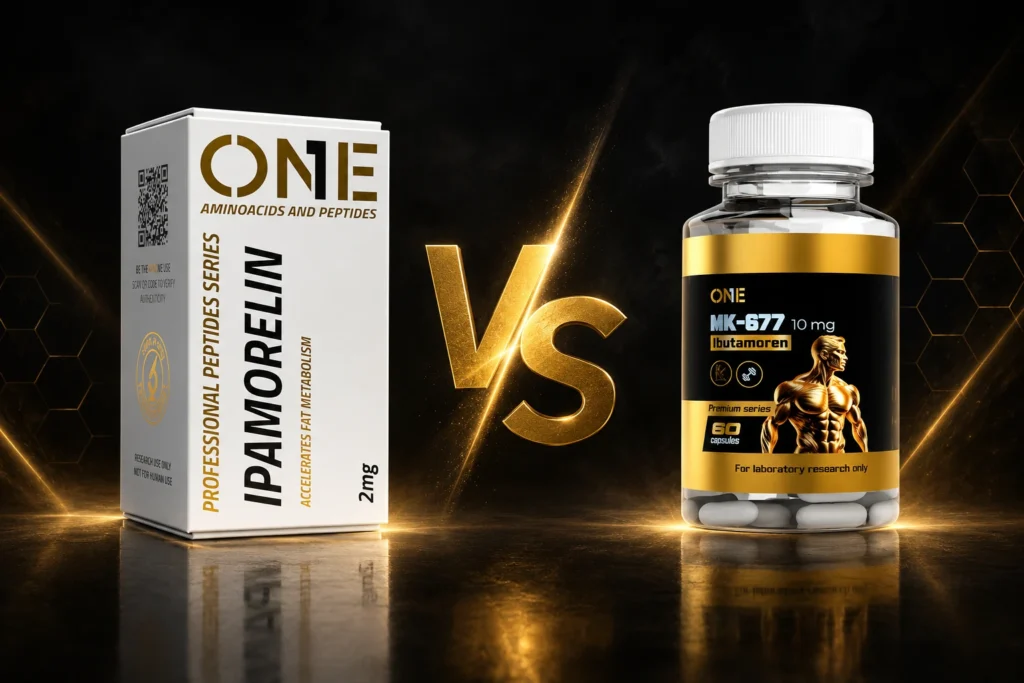
A research comparison of MK-677 and ipamorelin, focusing on GHS-R1a signaling, selectivity, administration route, human evidence and WADA status.
