 ES
ES  EN
EN  DE
DE 

A research-focused comparison of Melanotan II and PT-141, covering melanocortin receptor selectivity, evidence, safety signals and regulatory status.
Two peptides from the same broad pharmacological class – incretin agonists — but two completely different philosophies of molecule design. Semaglutide, developed by Denmark’s Novo Nordisk and launched in 2017, is a GLP-1 receptor monoagonist – a continuation of the lineage previously started by liraglutide, exenatide and lixisenatide. The design assumption was conservative: take a proven mechanism (activation of one incretin receptor), improve the pharmacokinetics through structural modifications, obtain the most effective GLP-1RA available on the market.
Retatrutide, developed by the American Eli Lilly and currently in phase III clinical trials, represents a different – radical philosophy. The molecule activates not one but Three hormonal receptors simultaneously: GLP-1, GIP and glucagon. The design assumption was ambitious: instead of perfecting monoagonism, open a new therapeutic category through the coordinated activity of three complementary metabolic pathways.
This article compares both peptides along five axes: origin and class, structure and mechanism, clinical outcomes, safety profile, regulatory status. The idea is to give an idea of the differences – not to suggest that one peptide is “better”. Each axis shows compromises and specific applications.
📖 The following article is educational and is a review of published scientific literature about semaglutide and retatrutide. The text does not constitute medical advice. Semaglutide is an EMA and FDA registered drug – it requires a prescription. Retatrutide is in Phase III clinical trials – at the time of writing it is not approved. Peptides from the One Peptides catalog are intended only for laboratory tests (Research Use Only).
Semaglutide (Novo Nordisk internal designation: NN9535) is a GLP-1 receptor monoagonist. First phase I clinical trial – 2008. First registration as a drug (Ozempic, type 2 diabetes) – 2017 (FDA). Manufacturer: Novo Nordisk (Denmark).
Retatrutide (Eli Lilly internal designation: LY3437943) is a triple agonist of GLP-1, GIP and glucagon receptors (GLP-1R/GIPR/GCGR). First phase I clinical trial – 2020. Status (2026): in phase III clinical trials in the TRIUMPH program. Producer: Eli Lilly (USA).
The informal shorthand used for retatrutide in online searches is explained in a separate entry: the informal name “reta”.
| Characteristic | Semaglutide | Retatrutide |
|---|---|---|
| Producer | Novo Nordisk (Denmark) | Eli Lilly (USA) |
| Internal marking | NN9535 | LY3437943 |
| Pharmacological class | GLP-1R monoagonist | GLP-1R/GIPR/GCGR triple agonist |
| First phase I | 2008 | 2020 |
| First registration | 2017 (Ozempic, USA) | none (phase III ongoing) |
| Status (2026) | Registered in 4 indications | Phase III TRIUMPH |
| Trade brands | Ozempic, Wegovy, Rybelsus | lack |
The semaglutide sequence is based on human GLP-1 (7-37) with three modifications:
Molecular mass: 4113.6 Da. Number of amino acids: 31.
Retatrutide is a 39 amino acid peptide with structural modifications that extend the half-life. The molecule was designed to retain affinity for three receptors simultaneously – GLP-1R, GIPR and GCGR. Relative affinities (published by Coskun et al., 2022):
| Receptor | Relative potency of retatrutide |
|---|---|
| GLP-1R | ~94% |
| GIPR | ~135% (stronger than natural GIP) |
| GCGR | ~52% (weaker than natural glucagon) |
Molar mass: 4,731 g/mol (C221H342N46O68). Structural modification: fatty chain acylation for binding to albumin, stabilizing substitutions against proteolysis.
| Characteristic | Semaglutide | Retatrutide |
|---|---|---|
| Number of amino acids | 31 | 39 |
| Molecular mass | 4113.6 Da | 4,731 g/mol |
| Receptors activated | GLP-1R | GLP-1R + GIPR + GCGR |
| Main scale mechanism | Reduction of appetite, delay in gastric emptying | Reduced appetite + increased energy expenditure |
| Effect on thermogenesis | Indirect | Direct (via GCGR) |
| Effect on liver fat | Indirect | Direct (via GCGR) |
The results of STEP-1 (semaglutide) and phase II Jastreboff (retatrutide) are most often compared in obese groups without type 2 diabetes. Methodological differences should be taken into account – STEP-1 is a phase III trial (n=1961, 68 weeks), the Jastreboff trial is a phase II trial (n=338, 48 weeks).
| Parameter | Semaglutide 2.4 mg (STEP-1) | Retatrutide 12 mg (phase II) |
|---|---|---|
| Duration | 68 weeks | 48 weeks |
| Number of participants | 1961 | 338 (entire sample) |
| Average weight loss | 14,9% | 24,2% |
| Placebo | 2,4% | 2,1% |
| Effect plateau | Partial after 60 weeks | None – the curve continues to decline |
| Parameter | Retatrutide: TRIUMPH-1 (phase III, topline) |
|---|---|
| Duration | 80 weeks |
| Participants | Over 2,300 |
| Mean body-weight change, 12 mg group (efficacy estimand) | −28.3% |
| Placebo | −2.2% |
| Data status | Manufacturer topline announcement, 21 May 2026; not peer-reviewed results |
The significantly higher body weight reduction in the retatrutide group suggests that the addition of GIPR and GCGR activity produces a stronger effect than GLP-1R monoagonism. A definitive comparison requires peer-reviewed publication of TRIUMPH results and direct head-to-head evidence. A phase III study is ongoing (NCT06260722), but it concerns people with type 2 diabetes rather than obesity alone. The registry still lists August 2026 as the estimated primary completion date; this is not confirmation that primary completion has occurred, and results have not been posted in the registry.
| Parameter | Semaglutide (SUSTAIN-2) | Retatrutide (phase II, Rosenstock 2023) |
|---|---|---|
| Duration | 56 weeks | 36 weeks |
| Average reduction in HbA1c | 1.5–1.8% | 1.6–2.02% |
| Average weight loss | 4.3–6.1 kg | 2.8–16.9% |
In type 2 diabetes, HbA1c reduction is similar for both peptides (slight difference). A greater difference is seen in body weight reduction – retatrutide has a stronger effect on body weight, which is probably due to GCGR activity (increased energy expenditure).
| Parameter | Semaglutide | Retatrutide |
|---|---|---|
| Reduction of liver fat | Yes (moderate) | Yes (Strong – by GCGR) |
| Effect on cholesterol | Reduction of LDL and triglycerides | Reduction of LDL and triglycerides |
| Effect on blood pressure | A slight reduction | A slight reduction |
| Impact on heart rate | Little increase | Increase greater than in semaglutide |
| Effects on MASLD/MASH | Positive (research in progress) | Phase II MASLD substudy data; TRIUMPH-4 concerns knee osteoarthritis |
| Parameter | Semaglutide | Retatrutide |
|---|---|---|
| Route of administration | Subcutaneous or oral injection (Rybelsus) | Subcutaneous injection |
| Frequency | Once a week | Once a week |
| Half-life | ~165 hours (~7 days) | ~6 days |
| Time to constant concentration | 4–5 weeks | 4–5 weeks |
| Binding to albumin | Strong (via C18 chain) | Strong (via fatty chain) |
| Oral form | Available (Rybelsus) | Lack |
Semaglutide has the significant advantage of an available oral formulation (Rybelsus) – although oral bioavailability is low (0.4-1%), this option expands the choice for those who are averse to injection. Retatrutide is only available by injection.
The safety profile of semaglutide is well documented – several years on the market, tens of thousands of participants in clinical trials, millions of patients in post-marketing circulation. Most common side effects (≥10%):
Specific signals requiring attention: pancreatitis (rare), gallbladder disease (increased frequency), contraindication in people with a personal or family history of medullary thyroid cancer.
The safety profile of retatrutide is described on a Phase II basis – the full picture requires publication of Phase III results. In TRIUMPH-3 (manufacturer topline readout, 80 weeks), fewer cardiovascular events occurred than anticipated in both arms. The MACE-3 analysis recorded 27 events with retatrutide and 23 with placebo; the analysis was not powered to evaluate this outcome. Manufacturer announcement. A dedicated cardiovascular and kidney outcomes trial is ongoing (NCT06383390), with estimated completion in 2029. The most common side effects in Jastreboff phase II (dose dependent):
The incidence of gastrointestinal symptoms is higher than with semaglutide, especially at higher doses (8 and 12 mg). Gradually increasing the dose reduces the intensity. Retatrutide-specific signals:
⚠️ The full safety profile of retatrutide remains under evaluation in Phase III. Final evaluation requires TRIUMPH results and longer post-marketing follow-up after registration.
| Indication | Mark | Year of authorisation (EU / FDA) |
|---|---|---|
| Type 2 diabetes | Ozempic | 2018 |
| Type 2 diabetes (oral) | Rybelsus | 2020 |
| Obesity | Wegovy | 2022 |
| MACE reduction in obesity | Wegovy (extension) | 2024 |
| Obesity: 7.2 mg maintenance dose (injection) | Wegovy | 2026 (European Commission) |
| Obesity: oral 25 mg formulation | Wegovy tablet | 2025 (FDA), 2026 (EU) |
Semaglutide is widely available in pharmaceuticals. In the event of market shortages (as occurred in 2023–2024 due to increased demand), availability may be limited.
At the time of writing, retatrutide is not registered in any major jurisdiction. Expected path:
In the Research Peptide Outlet (RUO), retatrutide is available as a laboratory reagent.
| Parameter | Semaglutide | Retatrutide |
|---|---|---|
| Purity (HPLC) | ≥98% | ≥98% |
| Molecular mass (MS) identity | 4113.6 Da | Compliance with the theoretical M.W. |
| Humidity (Karl Fischer) | ≤5% | ≤5% |
| Endotoxins (LAL) | ≤1 EU/mg | ≤1 EU/mg |
Each vial is marked with a batch number associated with a certificate of analysis (COA). Full QC documentation is available on the website quality tests and certificates.
A practical summary for researchers planning experiments with incretin peptides:
| Purpose of the experiment | A better choice |
|---|---|
| Models of type 2 diabetes – insulinotropic effect | Semaglutide (more data) or retatrutide (stronger effect) |
| Obesity models – weight reduction | Retatrutide (stronger effect on mass) |
| MASLD/MASH models (hepatic steatosis) | Retatrutide (by GCGR) |
| Cardiological models | Semaglutide (more clinical data – SELECT) |
| Neuroprotection models | Semaglutide (more data) |
| Experiments requiring a constant long-term dose | Semaglutide (longer half-life) |
| Models requiring activity at the glucagon receptor | Retatrutide (only option) |
In a direct comparison of results from different trials – retatrutide. In STEP-1, semaglutide 2.4 mg/week resulted in a 14.9% weight reduction at 68 weeks. In Jastreboff phase II, retatrutide 12 mg/week gave a 24.2% reduction after 48 weeks. The difference is important, although a definitive comparison requires a head-to-head study in Phase III.
NO. Retatrutide is in phase III clinical trials (TRIUMPH program). At the time of writing, it is not registered with the EMA, FDA or other regulatory agencies. Expected enrollment – 2027-2028.
Both are available as research reagents (Research Use Only) in peptide supplier catalogs. RUO status means that the peptides are legally sold for laboratory use but are not registered as drugs.
It is not always better – it depends on the therapeutic goal. Retatrutide triple agonist results in stronger body weight reduction by adding GIPR (synergy with GLP-1R) and GCGR (increased energy expenditure, hepatic lipolysis) activity. Semaglutide monoagonism, however, is better researched, has a longer history on the market and simpler mechanisms of side effects.
There is no clinical data on combining two incretin peptides simultaneously. This is not used in clinical practice – the effects of both peptides overlap at the GLP-1 receptor, so combining it does not make pharmacological sense and increases the risk of side effects from the gastrointestinal tract.
Semaglutide. The incidence of gastrointestinal symptoms (nausea, vomiting, diarrhea) is lower than with retatrutide, especially at higher doses. Retatrutide, however, has a stronger effect on body weight – the strength-tolerance trade-off is typical of incretin pharmacology.
The expected registration path covers both obesity and type 2 diabetes – TRIUMPH-2 evaluates retatrutide in diabetes. Phase II results in type 2 diabetes (Rosenstock 2023) were promising, reducing HbA1c to 2.02% in the highest dose group. Full confirmation requires peer-reviewed publication of phase III results.
NO. Semaglutide has an established market position, millions of patients using it and a wide range of indications (diabetes, obesity, cardiology, nephrology). Once approved, retatrutide will probably occupy the highest effectiveness segment (advanced obesity, MASH) and will not replace semaglutide in all applications. The GLP-1RA class will expand, not shrink.
see tirzepatide (dual GIP/GLP-1 agonist) as a separate research register for the mechanism and metabolic data.
Both peptides available in the One Peptides catalog: semaglutide 2 mg (SEMA G) and retatrutide 5 mg (Triple G peptide). Each batch with a certificate of analysis.
ℹ️ Global disclaimer
All One-Peptides products are reagents intended exclusively for laboratory and scientific research (Research Use Only). They are not medicines, dietary supplements or products intended for human consumption. Semaglutide is a drug registered by the EMA and FDA for the indications of type 2 diabetes, obesity and cardiovascular risk reduction – its use requires a medical prescription. Retatrutide is in Phase III clinical trials – at the time of writing it is not registered as a drug. The information in this article is educational in nature; does not constitute medical, pharmaceutical or dietary advice.

A research-focused comparison of Melanotan II and PT-141, covering melanocortin receptor selectivity, evidence, safety signals and regulatory status.
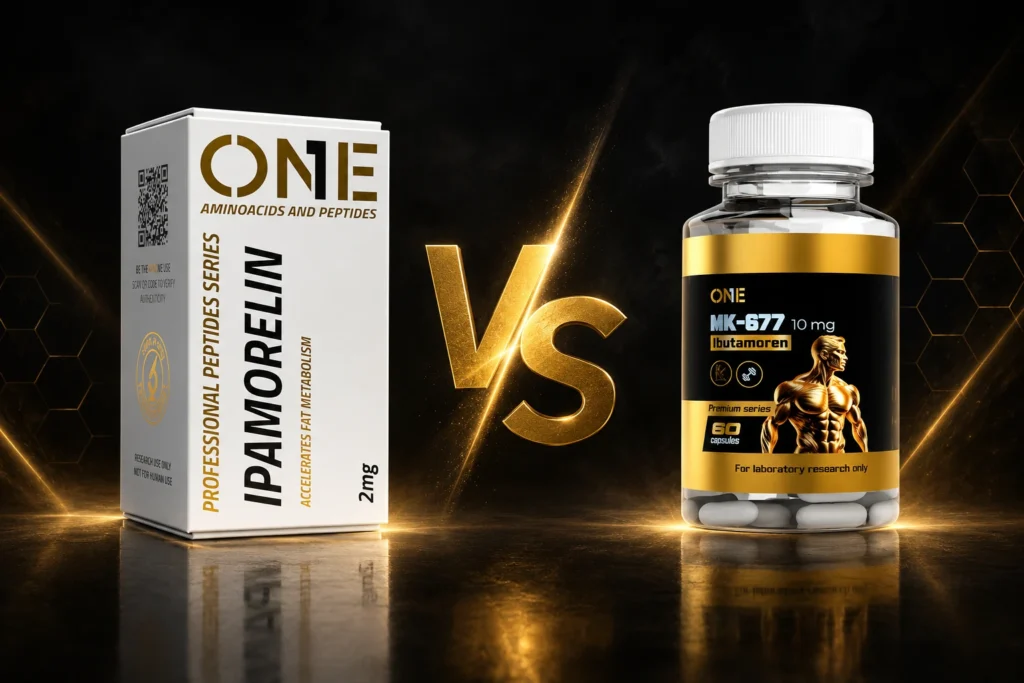
A research comparison of MK-677 and ipamorelin, focusing on GHS-R1a signaling, selectivity, administration route, human evidence and WADA status.
