 ES
ES  EN
EN  DE
DE 


L-carnitine 600 mg – Research Use Only (RUO). Chemical reagent intended only for laboratory tests. It is not intended for human consumption or diagnostic purposes.
L-Carnitine (levocarnitine) is a naturally occurring organic compound, an amino acid derivative that plays a key role in the energy metabolism of cells. It is necessary for the transport of long-chain fatty acids across the inner mitochondrial membrane, where they undergo β-oxidation.
Carnitine was discovered at the beginning of the 20th century in muscle tissue (Latin: carnis – meat) and has since become the subject of intensive biochemical research. Its central role in lipid metabolism and ATP production makes it an important tool in cellular bioenergetics research.
L-Carnitine is β-hydroxy-γ-trimethylaminobutyrate, a quaternary amino acid synthesized in the body from lysine and methionine. Its main biological function is the transport of acyl CoA residues to the mitochondrial matrix in a process called the carnitine cycle.
In scientific research, L-carnitine is used as:
One Peptides L-Carnitine 600 mg is supplied at a higher concentration, ideal for studies requiring larger amounts of substrate or longer experimental protocols.
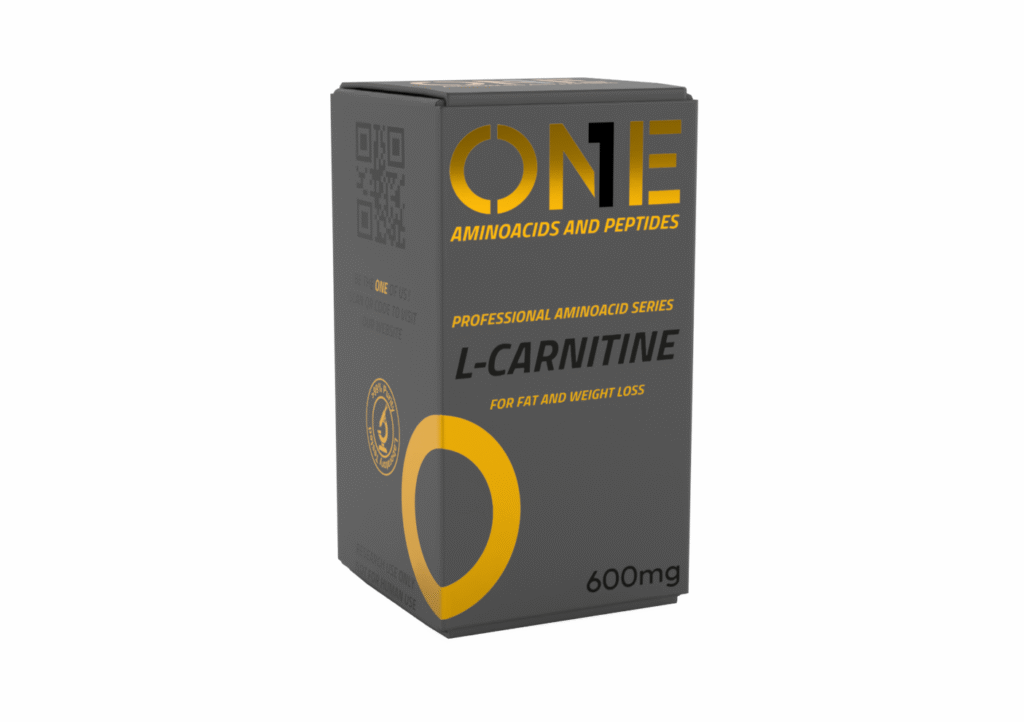
L-Carnitine is an endogenous compound present in all mammalian tissues, with particularly high concentrations in skeletal muscles and the heart. The body synthesizes carnitine in the liver and kidneys, but a significant part also comes from the diet (mainly red meat).
| Stage | Enzyme | Substrate | Product |
|---|---|---|---|
| 1 | Methyltransferase | Lysine | ε-N-trimethyllysine |
| 2 | Hydroxylase | ε-N-TML | β-hydroxy-ε-N-TML |
| 3 | Aldolase | β-OH-ε-N-TML | γ-butyrobetainaldehyde |
| 4 | Dehydrogenase | Aldehyde | γ-butyrobetaine |
| 5 | γ-BB hydroxylase | γ-BB | L-Carnitine |
| Compartment | Concentration |
|---|---|
| Plasma | 40-60 μM |
| Skeletal muscles | 3-5mM |
| Heart | 1-3mM |
| Liver | 0.5-1mM |
| Year | Event |
|---|---|
| 1905 | Muscle isolation (Gulewitsch, Krimberg) |
| 1927 | Determining the structure |
| 1955 | Discovery of a function in β-oxidation |
| 1973 | Characteristics of CPT (palmitoyltransferase) |
L-Carnitine is β-hydroxy-γ-trimethylaminobutyrate with one chiral center in the (R) configuration.
Scientific name (IUPAC):
(3R)-3-hydroxy-4-(trimethylazaniumyl)butanoate
| Parameter | Value |
|---|---|
| Summary formula | C7H15NO3 |
| Molar mass | 161.20 g/mol |
| CAS number | 541-15-1 |
| Appearance | White crystalline powder |
| Melting point | 197-212°C (decomposition) |
| pi | ~3.8 (zwitterjon) |
| Solubility in water | >2500 g/L (very good) |
| Configuration | (R) or L |
| Form | Zwitterjon |
| Hygroscopicity | Yes |
Only the L-form (R configuration) is biologically active and recognized by the enzymes of the carnitine system:
| Form | Characteristic | Aplicación |
|---|---|---|
| L-Carnitine free | Standard | General examinations |
| L-Carnitine L-tartrate | Stable salt | Better durability |
| Acetyl-L-carnitine | C2 ester | CNS research |
| Propionyl-L-carnitine | C3 ester | Cardiovascular tests |
| Palmitoyl-L-carnitine | C16 ester | Standard for CPT |
HPLC:
– Detection at 210 nm or after derivatization
– HILIC column or C18 ion-pairing
– Chiral analysis to confirm enantiomers
Mass spectrometry:
– ESI-MS: [M+H]+ = 162.1 m/z
– Characteristic fragmentation: loss of 59 (trimethylamine)
Solubility:
– Water: >2500 mg/ml (excellent)
– Water buffers: excellent
– Ethanol: moderate
– DMSO: okay
For a 600 mg preparation with a molar mass of 161.20 g/mol:
L-Carnitine is a key element of the carnitine cycle, enabling the transport of acyl-CoA across the inner mitochondrial membrane (IMM), which is impermeable to CoA.
Detailed stages of the cycle:
Acyl-CoA + L-carnitine → Acyl-carnitine + CoA-SHAcyl-carnitine + CoA-SH → Acyl-CoA + L-carnitine| Regulator | Effect | Mechanism |
|---|---|---|
| Malonyl-CoA | Braking | Allosteric inhibitor |
| Nutritional status | Modulation | By AMPK and ACC |
| Insulin | ↓ activity | Via ↑ malonyl-CoA |
| Glucagon | ↑ activity | Via ↓ malonyl-CoA |
L-carnitine tested on various cell types:
L-Carnitine is an endogenous compound that plays a key role in the transport of long-chain fatty acids to the mitochondria. The 600 mg formulation offers a larger amount of substrate for studies requiring higher concentrations or longer experimental protocols.
Check out the rest too amino acids in our store.
L-Carnitine (C7H15NO3, mass 161.20 g/mol, CAS 541-15-1) is an endogenous quaternary amino acid necessary for the transport of long-chain fatty acids to the mitochondrial matrix via the carnitine cycle. Enables β-oxidation of lipids and ATP production.
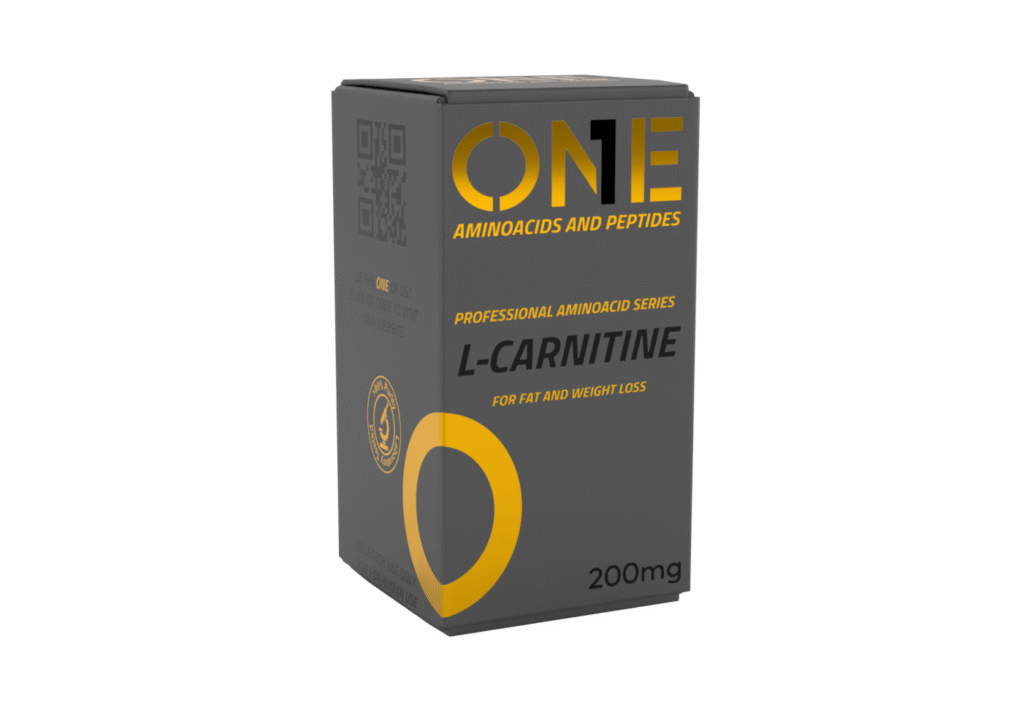
The difference only concerns the content of the active substance (600 mg vs 200 mg). Purity, quality and chemical properties are identical. The higher content of 600 mg is beneficial for studies requiring larger amounts of substrate or the preparation of higher concentration solutions.
Store aqueous solutions at -20°C and use within a few weeks.
The molar mass of L-carnitine is 161.20 g/mol. The 600 mg preparation contains 3.72 mmol. Dissolving in 10 ml gives a concentration of 372 mM. Typical working concentrations for cellular studies are 0.1-10 mM.
L-carnitine is used for in vitro research on: mitochondrial bioenergetics, β-oxidation of fatty acids, kinetics of CPT-1 and CPT-2 enzymes, lipid metabolism and as a substrate in acylcarnitine transport tests. It is not intended for use on humans or animals.
 DHL Express



Valoraciones
No hay valoraciones aún.