 DE
DE  EN
EN  ES
ES 

A research-focused comparison of Melanotan II and PT-141, covering melanocortin receptor selectivity, evidence, safety signals and regulatory status.
In the research-reagent trade, the name “CJC-1295” covers two distinct variants of the same peptide — differing by a single chemical modification that changes the half-life by two orders of magnitude. The DAC variant and the no-DAC variant are frequently confused, yet the difference between them is fundamental for anyone evaluating a reagent for the reproducibility of an experimental protocol. The certificate of analysis (COA) — sequence and molecular weight — is the only binding signal that distinguishes them; the trade name alone is not sufficient.
CJC-1295 is a synthetic analogue of growth hormone-releasing hormone (GHRH), occurring in two variants: with DAC (Drug Affinity Complex — long half-life, around 6–8 days) and without DAC (known as Mod GRF 1-29 — short half-life, around 30 minutes). Both are studied as stimulators of the growth hormone axis, but their pharmacokinetic profile differs radically. A chemical reagent intended for laboratory research (Research Use Only).
The following article is educational in nature and constitutes a review of the published scientific literature. All One Peptides products in the lyophilised peptides category are chemical reagents intended exclusively for laboratory research (Research Use Only). They are not medicinal products, dietary supplements or foodstuffs.
CJC-1295 is a synthetic analogue of growth hormone-releasing hormone (GHRH) — a peptide produced by the hypothalamus that stimulates the pituitary to secrete growth hormone (GH). The molecule is based on the GHRH(1-29) fragment — the first 29 amino acids of natural GHRH, which constitute the minimal region retaining the hormone’s full biological activity.
Natural GHRH has a very short half-life — on the order of a few minutes — owing to rapid degradation by the enzyme dipeptidyl peptidase IV (DPP-4) and other plasma peptidases. CJC-1295 introduces stabilising modifications to the GHRH(1-29) sequence against this degradation: four amino acid substitutions (tetrasubstitution) protecting against proteolysis. It is on this shared core that both variants are built — the difference comes down to the presence or absence of an additional structural element called DAC.
This is the crux of the distinction. Both variants share the same GHRH(1-29) core with stabilising substitutions, but they differ in the presence of the Drug Affinity Complex (DAC) — a chemical moiety that drastically alters the pharmacokinetics.
| Feature | CJC-1295 with DAC | CJC-1295 without DAC (Mod GRF 1-29) |
|---|---|---|
| Additional modification | Maleimide moiety (DAC) | None — stabilising tetrasubstitution only |
| Albumin binding | Covalent, permanent | None |
| Half-life | ~6–8 days | ~30 minutes |
| GH release profile | Continuous, prolonged elevation (the “bleed”) | Pulsatile, short peaks |
| Molecular weight | Higher (with the DAC moiety) | Lower |
| Alternative trade name | CJC-1295 DAC | Mod GRF 1-29, CJC-1295 no DAC |
DAC (Drug Affinity Complex) is a maleimide moiety attached to the peptide which, once introduced into the system, binds covalently to serum albumin — the most abundant plasma protein. Albumin binding functions as a reservoir: it protects the peptide from degradation and renal excretion, extending the half-life from minutes to days. The DAC variant therefore has a half-life on the order of 6–8 days.
The no-DAC variant — widely known in the trade as Mod GRF 1-29 (modified GRF 1-29) — has no maleimide moiety. It possesses only the tetrasubstitution protecting against DPP-4, which yields a half-life on the order of 30 minutes. Without albumin binding, the molecule is cleared rapidly.
The difference in molecular weight resulting from the presence of the DAC moiety is visible in mass spectrometry — it is one of the binding signals for distinguishing the two variants at the analytical level.
Both CJC-1295 variants bind the GHRH receptor (GHRHR) on pituitary somatotroph cells, stimulating growth hormone secretion. The difference in half-life, however, translates into a fundamentally different temporal pattern of GH release — which has significant research implications.
The no-DAC variant (Mod GRF 1-29) — with its short half-life — produces a pulsatile pattern of stimulation. A short peak of peptide activity elicits a short burst of GH, after which the hormone level returns to baseline. This pattern is closer to the physiological rhythm of GH secretion, which in a healthy organism occurs in pulses — mainly nocturnal.
The DAC variant — with a half-life measured in days — maintains a continuous, prolonged elevation of GH and IGF-1 levels. In the literature this phenomenon is sometimes termed the “bleed” — a steady, low background of GHRH activity instead of distinct pulses. The research implications of this continuous profile differ from those of the pulsatile profile — among other things, in the context of receptor sensitivity and feedback within the GH axis.
For a researcher designing an experiment on the growth hormone axis, the distinction matters: the no-DAC variant models pulsatile stimulation, the DAC variant continuous exposure. These are two different experimental systems.
CJC-1295 has been the subject of pharmacokinetic and pharmacodynamic studies, mainly in the context of its effect on GH and IGF-1 levels in healthy volunteers. The table below summarises the main areas of research.
| Research area | Model | What was observed |
|---|---|---|
| Pharmacokinetics of the DAC variant | Human studies (healthy volunteers) | Prolonged elevation of GH/IGF-1, half-life measured in days |
| Effect on GH secretion | Human studies | Increase in serum GH and IGF-1 concentrations |
| GHRH(1-29) profile and stabilisation | Preclinical and analytical studies | Resistance to DPP-4 thanks to tetrasubstitution |
The literature on CJC-1295 encompasses pharmacokinetic work on the DAC variant as well as studies on GHRH(1-29) and its analogues. Full identification of the sources can be found in the bibliography at the end of the article.
In the research literature and in laboratory protocols, CJC-1295 (a GHRH analogue) is sometimes combined with Ipamorelin — a selective agonist of the growth hormone secretagogue receptor (GHS-R). The basis for this pairing is the complementarity of the mechanisms: CJC-1295 acts through the GHRH receptor, Ipamorelin through the distinct GHS-R receptor. Activating two different receptors of the GH axis simultaneously produces, in research, a stronger effect than activating either one alone — two independent pathways of somatotroph stimulation.
The selectivity of Ipamorelin — releasing GH without a significant effect on cortisol and prolactin — makes it a frequent partner of CJC-1295 in research protocols on the growth hormone axis. The mechanism and profile of Ipamorelin are described in detail in a separate article devoted to that peptide.
Distinguishing the DAC variant from the no-DAC variant rests on two fields of the certificate of analysis:
The trade name alone does not identify the variant unambiguously — “CJC-1295” without the qualifier “DAC” or “no DAC / Mod GRF 1-29” is insufficient. If a COA does not include the sequence and molecular weight, require the supplier to supply them. A full description of the quality control procedure can be found in the section on quality testing and certificates.
CJC-1295 remains a research reagent without medicinal status. Its safety profile is known solely from limited pharmacokinetic studies on the GH axis — there are no long-term data on chronic exposure in humans. The continuous profile of the DAC variant (prolonged elevation of GH/IGF-1) differs from the physiological pulsatile pattern, which the literature indicates as an area requiring further research with respect to feedback within the somatotrophic axis.
GHRH analogues and growth hormone secretagogues are on the WADA list of prohibited substances (category S2 — peptide hormones, growth factors and secretagogues). Athletes subject to anti-doping control should verify the current status before any use.
In the One Peptides catalogue, both CJC-1295 variants — with DAC and without DAC — are available as separate RUO research-reagent SKUs. Every batch of each variant undergoes five-stage analytical control: HPLC ≥98% (chromatographic purity), MS confirmation (structural identity confirming the presence or absence of the DAC moiety), COA per batch, cold chain 2–8°C and batch traceability. The certificate of analysis with the molecular weight is the document that distinguishes the two variants — it is its MS field that allows the DAC variant to be told apart from Mod GRF 1-29 unambiguously.
CJC-1295 DAC vs no DAC — what is the difference?
Both variants have the same GHRH(1-29) analogue core, but the DAC variant additionally has a maleimide moiety (Drug Affinity Complex), which binds covalently to serum albumin and extends the half-life from around 30 minutes (the no-DAC variant) to around 6–8 days (the DAC variant). The no-DAC variant produces a pulsatile GH release profile, the DAC variant a continuous prolonged elevation. The molecular weight in the COA distinguishes the two variants.
What is DAC?
DAC (Drug Affinity Complex) is a maleimide moiety attached to the CJC-1295 peptide. Once introduced into the system, it binds covalently to serum albumin — the most abundant plasma protein — which protects the peptide from degradation and extends the half-life from minutes to days. It is a technology that prolongs the peptide’s action by using albumin as a reservoir.
What is Mod GRF 1-29?
Mod GRF 1-29 (modified GRF 1-29) is another name for the no-DAC variant of CJC-1295. “GRF” is the abbreviation for growth hormone-releasing factor (a synonym for GHRH), “1-29” denotes the fragment of the first 29 amino acids, and “modified” indicates the tetrasubstitution stabilising it against DPP-4. It is a peptide with a short half-life (~30 minutes) and a pulsatile GH release profile.
CJC-1295 with Ipamorelin — why this combination?
CJC-1295 (a GHRH analogue) and Ipamorelin (a GHS-R agonist) act through two different receptors of the growth hormone axis. In research, simultaneous activation of both receptors produces a stronger effect on GH secretion than activation of either one alone — these are complementary mechanisms. The selectivity of Ipamorelin (no significant effect on cortisol and prolactin) makes it a frequent partner of CJC-1295 in research protocols.
Is CJC-1295 on the WADA list?
Yes. GHRH analogues and growth hormone secretagogues are on the WADA list of prohibited substances under category S2 (peptide hormones, growth factors and related substances). The prohibition applies all year round. Athletes subject to anti-doping control may not use CJC-1295 at any time.
CJC-1295 belongs to the growth hormone secretagogue (GHS) group of research peptides. Thematically it links to Ipamorelin (a selective GHS-R agonist, a frequent partner in protocols), GHRP-2 and GHRP-6 (classic peptides that release GH through the ghrelin receptor), PEG-MGF (an IGF-1 splice variant with a distinct regenerative mechanism), MK-677 (an oral GH secretagogue) and HGH Fragment 176-191 (a growth hormone fragment). Each of these peptides has its own article and product page with a full chemical characterisation.
CJC-1295 is a GHRH analogue available in two variants differing by a single modification — the presence of the Drug Affinity Complex (DAC). The DAC variant binds covalently to albumin and has a half-life of around 6–8 days with a continuous GH release profile. The no-DAC variant (Mod GRF 1-29) has a half-life of around 30 minutes with a pulsatile profile closer to physiology. The difference in molecular weight in the COA is the binding signal that distinguishes the two variants — the trade name alone is not sufficient.
For a researcher designing an experiment on the growth hormone axis, the choice of variant determines the exposure system: pulsatile (no DAC) or continuous (with DAC). Both remain RUO research reagents, on the WADA prohibited list (S2), without medicinal status.
Disclaimer
All One Peptides products in the lyophilised peptides category (including both CJC-1295 variants) are chemical reagents intended exclusively for laboratory research (Research Use Only). They are not medicinal products, dietary supplements or foodstuffs. They are not intended for administration to humans or animals outside a controlled experimental environment. CJC-1295 is on the WADA list of prohibited substances (category S2). The information in this article is educational in nature and constitutes a review of the published scientific literature; it does not constitute medical advice or a suggestion of use in humans.

A research-focused comparison of Melanotan II and PT-141, covering melanocortin receptor selectivity, evidence, safety signals and regulatory status.
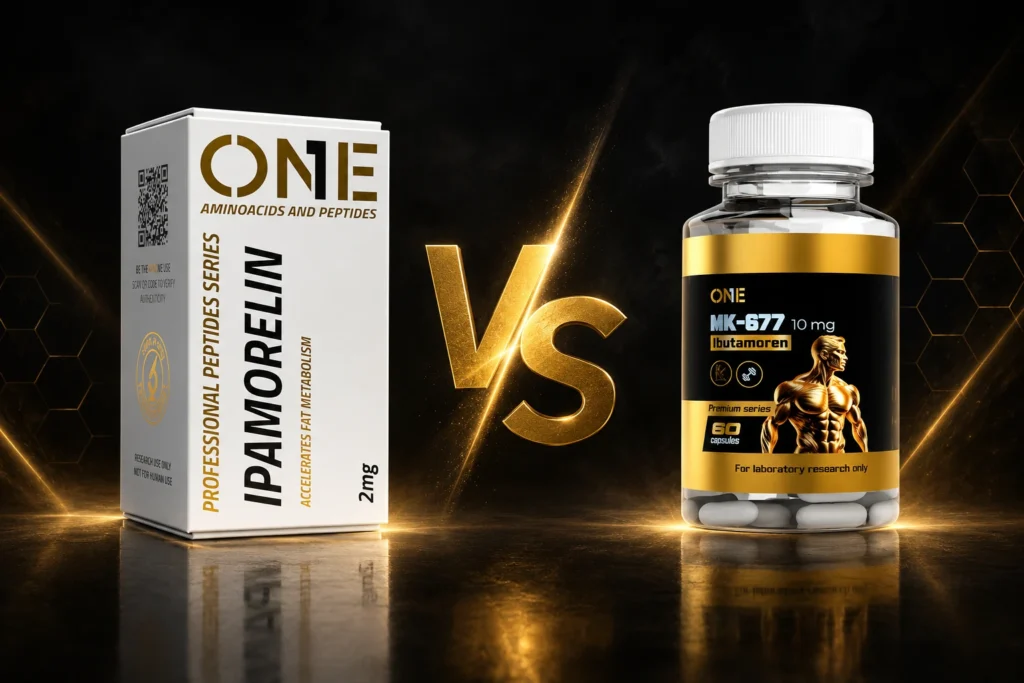
A research comparison of MK-677 and ipamorelin, focusing on GHS-R1a signaling, selectivity, administration route, human evidence and WADA status.
