 ES
ES  EN
EN  DE
DE 

A research-focused comparison of Melanotan II and PT-141, covering melanocortin receptor selectivity, evidence, safety signals and regulatory status.
Every cell in the body holds a protein whose abundance exceeds all other cytoskeletal proteins combined. Actin — that is the protein — is responsible for cell shape, motility, division, migration. Without actin, a cell cannot heal a wound, repair damaged tissue, or escape from an inflammation site. In 1981, Allan Goldstein and Ewald Hannappel of George Washington University isolated from calf thymus a small 43-amino-acid peptide that turned out to be the central regulator of actin dynamics in the cytoplasm. They named it Thymosin Beta-4 (Tβ4) — one of the key members of the recovery-peptide class, the fuller picture of which is covered in the how recovery peptides work review.
Four decades later Thymosin Beta-4 is one of the best-studied research peptides in the biomedical literature, with documented roles in skin wound healing, post-ischemic cardiac repair, and peripheral nerve regeneration. In the research-peptide trade, however, it travels under a different name: TB-500. The relationship between these two terms deserves its own paragraph.
📖 This article is educational and reviews the published scientific literature. The majority of the studies cited were conducted in animal models or in vitro. Where human clinical trial data exist, the fact is flagged explicitly. This is not medical advice.
In popular science and in research-peptide catalogs the terms “TB-500” and “Thymosin Beta-4” are often used interchangeably. From a strict chemical standpoint this is a simplification.
Thymosin Beta-4 (Tβ4) — the full, naturally occurring peptide, 43 amino acids in length. Sequence:
SDKPDMAEIE KFDKSKLKKT ETQEKNPLPS KETIEQEKQA GES
TB-500 — in its original meaning refers to a fragment of Tβ4, specifically the 7-amino-acid sequence LKKTETQ (positions 17–23 of the full peptide), together with stabilizing modifications. This fragment is responsible for the key biological activity of the full peptide — binding G-actin and modulating cytoskeletal dynamics.
In market practice “TB-500” in research-peptide catalogs typically denotes either the full Thymosin Beta-4 peptide or its stabilized version, even though the name technically refers to the fragment. A professional supplier should unambiguously specify the amino-acid sequence in the COA — that is the only unambiguous molecular identification.
The full Tβ4 peptide and the TB-500 fragment share a partially similar activity profile, but they differ in pharmacokinetics and potency in specific models. The bulk of the research concerns the full Tβ4, so the remainder of this article describes the scientific literature from the full-peptide standpoint.
The main role of Thymosin Beta-4 in physiology is sequestration of monomeric actin (G-actin) — binding free monomer and regulating its availability for polymerization into filaments (F-actin). A single cell can contain millions of Tβ4 molecules, each bound to one G-actin molecule. The ratio of free to bound G-actin is the foundation of cytoskeletal dynamics control.
In the scientific literature Thymosin Beta-4 is sometimes described as a modulator of the “four key processes” of tissue healing:
|
Process |
Mechanism |
| Cell migration | Actin cytoskeleton modulation |
| Angiogenesis | Endothelial proliferation stimulation |
| Anti-inflammatory activity | Macrophage and cytokine modulation |
| Anti-apoptotic activity | Protection from programmed cell death |
See also our guide to regenerative peptides.
The combination of these four mechanisms explains why Tβ4 shows activity across such different injury models — from skin wounds to myocardial ischemia (Crockford et al., 2010).
The Thymosin Beta-4 bibliography includes hundreds of experimental papers across several main research areas. Some have reached the clinical-trial stage — which distinguishes Tβ4 from most recovery peptides that remain at the preclinical level.
This is one of the best-documented areas. Animal models showed:
Based on these preclinical data, RegeneRx Biopharmaceuticals developed a Tβ4-based formulation (RGN-137) — a gel for chronic-wound treatment. Phase II and III trials produced mixed results — the formulation showed efficacy in some subgroups but did not achieve drug registration in major jurisdictions.
The second flagship area of Tβ4 research is cardiology. The paper by Bock-Marquette and colleagues (2004) published in Nature showed that Tβ4 protects cardiac muscle from ischemic damage and stimulates repair after a heart attack. The mechanism involves:
Phase I and II trials of RGN-352 (an injectable Tβ4 formulation for acute myocardial infarction) provided safety signals but did not deliver unambiguous confirmation of clinical efficacy.
Tβ4 showed activity in corneal injury models — it accelerated corneal epithelial healing after chemical and mechanical injury (Sosne et al., 2002). The RGN-259 formulation (eye drops) went through phase III trials in patients with neurotrophic keratitis and dry eye syndrome, and the biological activity of the formulation has been linked to functional fragments of the full peptide sequence (Sosne et al., 2010).
Sciatic-nerve injury models in rats showed that Tβ4 promotes reinnervation, reduces Wallerian degeneration, and improves motor function at the injury site (Hannappel, 2007).
In skeletal-muscle injury models Tβ4 accelerated fiber regeneration, increased satellite cell activity, and improved the mechanical properties of the regenerated muscle. The effect was observed in both acute injury models and mouse muscular-dystrophy models.
Single papers suggest a neuroprotective effect in ischemic stroke models in rats. Tβ4 reduced lesion area and improved motor function during the recovery period. The mechanism likely involves oligodendrocyte activation and remyelination (Morris et al., 2014).
Across Thymosin Beta-4 studies, various administration routes have been used:
Unlike peptides from the BPC-157 range, Thymosin Beta-4 is not stable in the gastrointestinal tract — oral administration is not used in the main line of experimental research. The peptide must be administered parenterally to avoid proteolytic degradation.
Thymosin Beta-4 requires the standard research-peptide storage protocol:
A full guide to peptide reconstitution and storage is available in the laboratory practice section.
TB-500 from the One-Peptides catalog — the TB-500 5 mg product — meets the following quality criteria:
|
Parameter |
Specification |
Method |
| Purity | ≥98% | RP-HPLC |
| Molecular mass identity | Match to theoretical M.W. | ESI-MS |
| Moisture content | ≤5% | Karl Fischer |
| Endotoxins | ≤1 EU/mg | LAL test |
Each vial is labeled with a batch number linked to a certificate of analysis (COA). Full QC documentation is available on the quality testing and certificates page.
The toxicology profile of Thymosin Beta-4 in animal models is favorable — at therapeutic doses no significant organ toxicity was observed. In the clinical trials of RGN-137, RGN-352, and RGN-259 no major adverse events directly linked to the peptide were recorded.
Important caveats apply, however:
⚠️ Clinical trials of Tβ4-based formulations have not yet achieved drug registration in the major jurisdictions (EMA, FDA). Some trials produced safety signals but ambiguous efficacy. The peptide’s therapeutic status remains experimental.
Specific limitations:
Strictly speaking, TB-500 is a 7-amino-acid fragment (LKKTETQ) of Thymosin Beta-4. In market practice, in research-peptide catalogs the name “TB-500” usually denotes the full Tβ4 peptide (43 amino acids) or its stabilized version. A professional supplier specifies the amino-acid sequence unambiguously in the COA — that is the only unambiguous molecular identification.
Yes. TB-500 is on the WADA prohibited list in category S2 (peptide growth factors). Athletes under anti-doping testing cannot use Thymosin Beta-4 or its derivatives at any time of year.
At the time of writing — not in major jurisdictions (EMA, FDA). RegeneRx Biopharmaceuticals ran clinical trials of several formulations (RGN-137, RGN-352, RGN-259) across various indications. Some reached phase III, but none obtained registration in the EU or US. The status of these formulations in other jurisdictions should be verified separately.
Not effectively. Unlike peptides such as BPC-157 — what it is, mechanism of action, and the state of the research, Thymosin Beta-4 is not stable in gastric juice — the peptide is broken down proteolytically in the stomach before reaching the bloodstream. Experimental studies use subcutaneous, intraperitoneal, intravenous, or local (wound, eye) administration.
Tβ4 modulates the actin cytoskeleton in endothelial cells, allowing them to migrate and form new vessels. It also affects the expression of pro-angiogenic factors (VEGF, FGF) and modulates endothelial-cell receptor activity. The mechanism is central to the repair of ischemic tissue.
The question remains open in the scientific literature. On one hand, Tβ4 stimulates angiogenesis, which is necessary for tumor growth. On the other, some studies have not shown increased carcinogenesis in long-term animal models. The effect of Tβ4 on tumour progression therefore remains unresolved.
After reconstitution in bacteriostatic water and storage at 2–8°C, the peptide remains stable for 14–28 days. The lyophilizate before reconstitution can be stored at -20°C for 18–24 months. Freeze-thaw cycles of the reconstituted peptide should be avoided.
TB-500 is available in the One-Peptides catalog as the TB-500 5 mg variant — with full QC documentation.
More articles from this cluster: regeneration content overview.
ℹ️ Global disclaimer
All One-Peptides products are reagents intended exclusively for laboratory and scientific research (Research Use Only). They are not medicinal products, dietary supplements, or products intended for human consumption. The information in this article is educational and reviews the published scientific literature; it is not medical, pharmaceutical, or dietetic advice. Thymosin Beta-4 is on the WADA prohibited list — athletes under anti-doping testing cannot use the peptide.

A research-focused comparison of Melanotan II and PT-141, covering melanocortin receptor selectivity, evidence, safety signals and regulatory status.
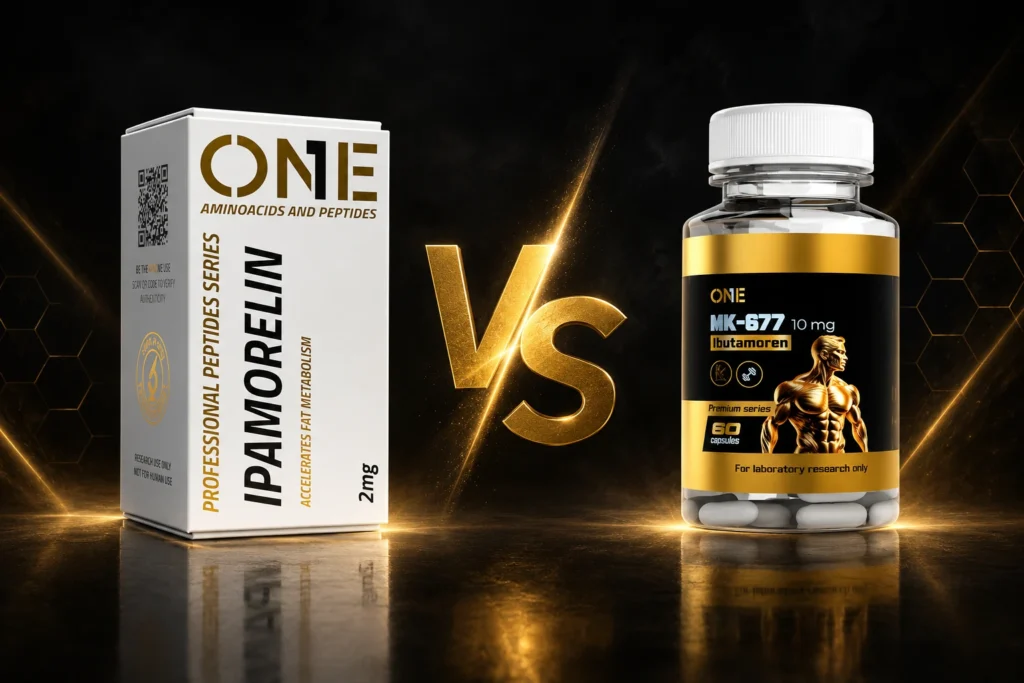
A research comparison of MK-677 and ipamorelin, focusing on GHS-R1a signaling, selectivity, administration route, human evidence and WADA status.
