 ES
ES  EN
EN  DE
DE 

A research-focused comparison of Melanotan II and PT-141, covering melanocortin receptor selectivity, evidence, safety signals and regulatory status.
A chemical reagent intended exclusively for laboratory research (Research Use Only). It is not a medicinal product, a dietary supplement, or a foodstuff. It is not intended for administration to humans or animals outside a controlled experimental environment.
RAD-140, known as Testolone, is one of the more frequently described compounds from the group of selective androgen receptor modulators (SARMs). Many market oversimplifications have grown up around it — from the label of the “strongest SARM” to physique-related promises. This article organizes what has actually been reported in the scientific literature, and does so within the framework of a research reagent, without transferring preclinical results into promises regarding humans.
This material is educational in nature and concerns a research compound. It does not constitute health advice, instructions for handling the substance outside the laboratory, or encouragement to administer it. We describe exclusively scientific data and regulatory status.
RAD-140 is a non-steroidal compound developed as part of the research program of the company Radius Health and first characterized in detail by Miller et al. (2011). It was created as a research tool in the search for compounds with an anabolic action on muscle and bone tissue, with limited influence on other androgen-sensitive tissues.
In laboratory practice, RAD-140 functions as a reagent for preclinical research. The market term “strongest SARM” is a commercial narrative, not a clinical finding — the actual evidence base rests on animal models and cellular systems, not on clinical trials with hard endpoints in humans.
The basis of RAD-140’s action is binding to the androgen receptor (AR). As a selective modulator, the compound does not stimulate the receptor uniformly across all tissues. In the preclinical characterization (Miller et al. 2011), a profile was reported in which the anabolic activity toward muscle and bone was high, while the influence on prostate tissue was relatively limited compared with classic steroidal androgens.
The essence of this difference lies in the way the non-steroidal structure of RAD-140 interacts with the androgen receptor compared with testosterone itself. Testosterone stimulates AR in all androgen-sensitive tissues — including the prostate and skin — which in models is associated with a range of androgenic effects. SARM-class compounds were designed to shift the tissue balance: in preclinical models RAD-140 was reported as a substance with a strong influence on muscle and bone tissue while acting relatively more weakly on glandular tissues. It is precisely this divergence that is described as a “high anabolic-to-androgenic activity ratio” (Miller et al. 2011) — a parameter reported in experimental systems, describing the predominance of the muscle-tissue effect over the androgenic one.
This phenomenon of tissue separation constitutes the essence of the concept of “selectivity.” A few caveats are worth emphasizing, however. First, the anabolic-to-androgenic ratio is a quantity dependent on the model, the measurement method, and the tissue studied — not a physical constant of the compound. Second, it was described in animal models and cellular systems, not in humans under the conditions of controlled registration trials. Selectivity in a test tube and in a rodent does not translate directly into a guaranteed, safe profile in humans — it is a research hypothesis requiring further verification, not an established clinical characteristic.
The scientific literature concerning RAD-140 focuses on several directions. We describe each of them as “what was reported in a given model.”
Androgen receptor characterization (Miller et al. 2011). The foundational work described the synthesis of the compound and its preclinical profile, including a high anabolic-to-androgenic activity ratio and activity toward AR. The authors characterized the affinity of RAD-140 for the androgen receptor and its behavior in muscle-tissue models, indicating an anabolic direction of action with a limited androgenic profile. This is the foundation on which further research interest rests — a point of reference for all subsequent work on the compound.
Neuroprotection (Jayaraman et al. 2014). In neuronal cultures and in male rats with kainate-induced brain injury, it was reported that RAD-140 acted neuroprotectively. The mechanism the authors proposed runs through the androgen receptor present in nervous tissue: stimulation of AR in neurons was linked to the activation of pathways supporting the survival of nerve cells under injury conditions. The kainate model in the rat is a standard system for studying neurodegeneration — kainate causes excitatory neuronal injury (excitotoxicity), and the studied compound is assessed for tissue protection. In this system, RAD-140 was reported as a factor limiting neuron loss. The authors compared its action with testosterone, pointing to the potential of a non-steroidal compound as a research tool in neuroprotection. The entire result, however, concerns in vitro and animal models — it does not constitute proof of a neuroprotective effect in humans.
Experimental oncology (Yu et al. 2017). In a preclinical model of breast cancer with androgen and estrogen receptor expression (AR+/ER+), it was reported that RAD-140 inhibited the growth of cancer cells. The proposed mechanism is particularly interesting here: in some breast cancers the androgen and estrogen receptors act in opposition, and stimulation of AR may suppress signaling driven by the estrogen receptor (ER). In this view, RAD-140 was studied as an activator of the AR pathway constituting an alternative route for inhibiting the growth of an ER-dependent tumor. The effect was reported in cell cultures and in xenograft-type animal models (human cancer cells implanted into an experimental animal). The study belongs to experimental oncology and concerns model systems, not the treatment of patients.
The common denominator of these works is the same: they show potential research directions, not proven applications in humans. It is also worth noting their internal consistency — all three run through the androgen receptor, only in different tissues: muscle, nervous, and cancerous. This makes RAD-140 a convenient tool for studying AR signaling itself in various systems. At the same time, none of these observations justifies formulating health promises. That is why an accurate description of RAD-140 stays with the phrasing “reported in a model,” not “works in humans.”
The hepatotoxicity signal requires separate, explicit discussion. Barbara, Dhingra, and Mindikoglu (2020) described a case of drug-induced liver injury (DILI) associated with products containing RAD-140. It was a clinical report of a real event reported in the peer-reviewed medical literature.
We do not pass over this information in silence. Just as we speak openly about other risks of research compounds, here too we state it: in the context of the use of products containing RAD-140, a case of liver injury has been documented. The framing remains cautious — “what was reported in a clinical report” — without exaggeration and without encouragement, but also without concealment. For those conducting research on this reagent, hepatotoxicity is a real, documented point of attention, not a theoretical speculation.
The critical review by Bond et al. (2025) organizes the limitations of the entire SARM class, including RAD-140. The authors draw attention to the shortage of complete phase III clinical trials, to the discrepancy between market promises and the actual evidence base, and to the risks arising from the uncontrolled trade of these compounds as “supplements.”
It is worth elaborating on what this evidentiary gap consists of. Knowledge about RAD-140 rests on three unequal pillars. The first is preclinical research — cell cultures and animal models (Miller et al. 2011; Jayaraman et al. 2014; Yu et al. 2017), which describe the mechanism well but do not predict the safety and efficacy profile in humans. The second is reports of individual clinical cases, such as the documented hepatotoxicity (Barbara et al. 2020) — valuable as a warning signal, but methodologically weak for estimating the frequency of adverse effects. The third pillar — large, controlled phase III clinical trials with hard endpoints and a long observation period — is simply lacking.
Practical conclusions from this review for the description of RAD-140:
In other words, market enthusiasm significantly outpaces the state of scientific knowledge. For those conducting research, this means that every conclusion concerning RAD-140 must be formulated cautiously and embedded in a specific experimental model. This is at the same time the main argument for keeping the description within the framework of a research reagent.
RAD-140 appears on the WADA Prohibited List of Substances and Methods in the category S1 (anabolic agents). It is a substance prohibited in sport both in competition and out of competition; its presence in an athlete’s sample constitutes a violation of anti-doping rules.
In regulatory terms, RAD-140 does not have registration as a medicinal product and has not been authorized by the EMA. In circulation, it functions as a research reagent (Research Use Only), not intended for consumption or for administration to living organisms outside a controlled experiment.
The two most frequently compared compounds from the SARM group are RAD-140 and ostarine (MK-2866). The fundamental difference lies in the evidence base: ostarine has been the subject of clinical trials, including phase III in the context of cachexia, whereas RAD-140 remains mainly at the stage of preclinical research and early observations. We discuss the scientific comparison of the two compounds — without physique-related comparisons — in a separate material: “RAD-140 vs ostarine (MK-2866) — what the research says.” You will find more about ostarine itself in the article and on the reagent card in the One-Peptides catalog.
Is RAD-140 really the “strongest SARM”?
It is a market term, not a clinical finding. In preclinical models a high anabolic-to-androgenic ratio was reported (Miller et al. 2011), but there are no phase III clinical data confirming such comparisons in humans.
What was studied in the context of neuroprotection?
In neurons in vitro and in rats with kainate injury, a neuroprotective effect of RAD-140 was reported (Jayaraman et al. 2014). This is a preclinical result, not proof of an effect in humans.
Can RAD-140 harm the liver?
The literature describes a case of drug-induced liver injury associated with products containing RAD-140 (Barbara et al. 2020). The hepatotoxicity signal is documented.
Is RAD-140 prohibited in sport?
Yes. WADA classifies it in category S1 (anabolic agents) as a prohibited substance.
Do phase III clinical data exist?
No. The evidence base rests on preclinical models; complete phase III trials are lacking (Bond et al. 2025).
Related reagents: RAD-140 — reagent card and RAD-140 category.

A research-focused comparison of Melanotan II and PT-141, covering melanocortin receptor selectivity, evidence, safety signals and regulatory status.
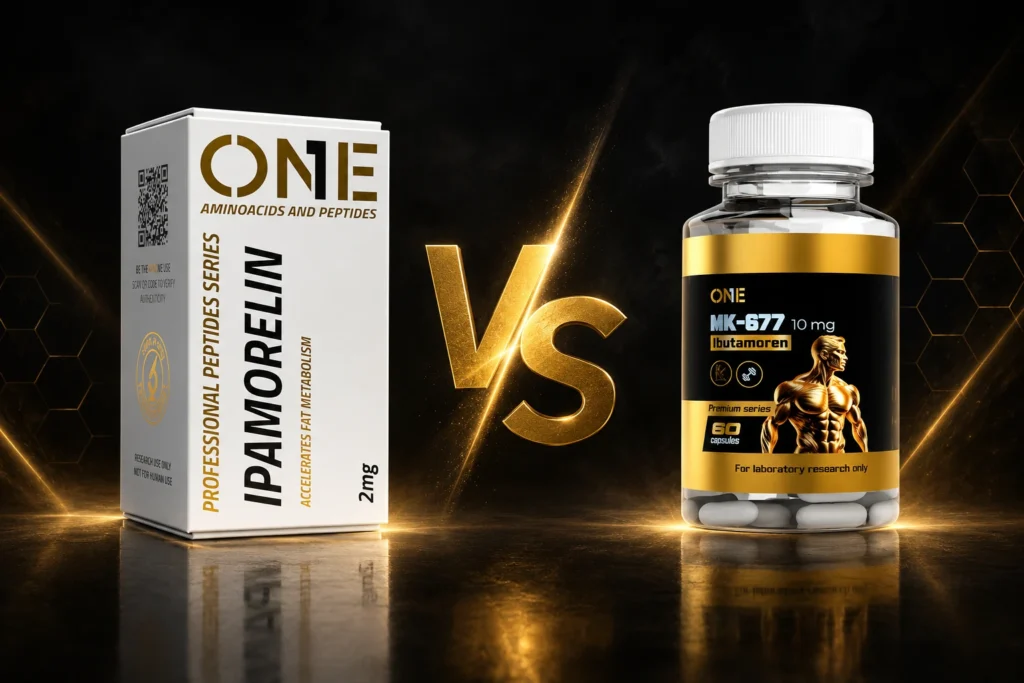
A research comparison of MK-677 and ipamorelin, focusing on GHS-R1a signaling, selectivity, administration route, human evidence and WADA status.
