One Peptides Medsomatrope 100 IU. Research Use Only (RUO). A chemical reagent for laboratory research only. Medsomatrope is recombinant somatropin (human growth hormone) in lyophilisate form, together with bacteriostatic water for reconstitution, the subject of research into the GH–IGF1 axis.
€299.00El precio original era: €299.00.€249.00El precio actual es: €249.00.
Medsomatrope 100 IU is a chemical reagent intended exclusively for laboratory research (Research Use Only) supplied as a lyophilizate. The active substance — somatropin (recombinant human growth hormone, rhGH) — is also present on the market as a registered medicinal product. These two instances represent two distinct regulatory frameworks — the RUO reagent is not a medicine, is not intended for human use, and is not subject to pharmaceutical regulation. Somatropin appears on the WADA Prohibited List (category S2 — peptide hormones and growth factors) — athletes subject to anti-doping control may not use it at any time of the year.
Growth hormone is one of the best-characterized signaling proteins in endocrinology. Medsomatrope is a recombinant somatropin with a sequence identical to human growth hormone, supplied as a research kit: ten vials of lyophilizate at 10 IU each (100 IU total) together with two vials of bacteriostatic water at 5 ml each (10 ml total) for reconstitution. The vial format gives full control over the concentration of the working solution — important in laboratory protocols investigating the GH-IGF1 axis, growth hormone receptor signaling, and metabolism. The product belongs to the 191 amino acid sequence category — authentic, full-length somatropin.
This description is educational in nature and discusses the scientific literature on somatropin in a research context. Medsomatrope functions exclusively as a chemical reagent for laboratory research (Research Use Only). It is not a medicinal product, dietary supplement, or food product.
What is somatropin — structure and class
Somatropin is recombinant human growth hormone (rhGH) — a polypeptide of 191 amino acids with a molecular weight of approximately 22,124 Da (22 kDa) and two intramolecular disulfide bridges. The sequence of somatropin is identical to the endogenous growth hormone produced by the somatotropic cells of the anterior pituitary lobe.
Recombinant production of somatropin — in bacterial cells (Escherichia coli) or mammalian cells carrying an introduced human GH gene — replaced the historical method of obtaining the hormone from human cadaveric pituitaries. Modern somatropin is a product of genetic engineering with high purity and reproducibility.
Chemical characteristics and kit composition
Name
Somatropin (recombinant human growth hormone, rhGH)
Number of amino acids
191
Molecular weight
~22,124 Da (22 kDa)
Class
Peptide hormone / growth factor
Sequence
Identical to endogenous human GH
Vial content
10 vials of lyophilizate × 10 IU = 100 IU total (~33 mg, per WHO conversion 1 mg = 3 IU)
Solvent
2 vials of bacteriostatic water × 5 ml = 10 ml total
Physical form
Lyophilizate (dry powder) for reconstitution
HPLC purity
≥98%
Identity confirmation
Mass spectrometry (MS)
Mechanism of action in research
Somatropin binds to the growth hormone receptor (GHR) — a membrane receptor from the cytokine receptor family. Binding of one hormone molecule to two receptor subunits leads to dimerization and activation of the intracellular signaling cascade:
JAK2/STAT5 pathway — receptor-associated JAK2 kinase phosphorylates STAT5 transcription factors, modulating the expression of GH-response genes
GH-IGF1 axis — activation of the GHR in the liver stimulates production of insulin-like growth factor 1 (IGF-1), which mediates many of the peripheral effects of growth hormone
Metabolic pathways — modulation of lipid metabolism, carbohydrate handling, and protein turnover in research models
The GHR receptor mechanism and JAK2/STAT5 signaling are among the well-documented pathways of molecular endocrinology — a subject of research ranging from growth physiology to energy metabolism and tissue regeneration in preclinical models.
Applications in scientific research
As a research reagent, somatropin is used in laboratory studies on:
Pharmacology of the growth hormone receptor (GHR) and JAK2/STAT5 signaling
The GH-IGF1 axis in cellular and animal models
Lipid metabolism, carbohydrate handling, and protein turnover
Tissue regeneration processes in preclinical models
Comparative analyses with peptides of the GH axis — GH secretagogues (MK-677 / ibutamoren) and growth hormone fragments (HGH Fragment 176-191); cf. MK-677 vs HGH Fragment 176-191
The vial format with a separate solvent is particularly useful in protocols that require control of the working concentration — the researcher selects the volume of bacteriostatic water to achieve the desired solution concentration.
One Peptides quality specification
Each batch of Medsomatrope undergoes a five-stage analytical control procedure:
HPLC ≥98% — chromatographic purity confirmed by high-performance liquid chromatography
MS confirmation — structural identity confirmed by mass spectrometry (~22 kDa)
Cold chain 2–8°C — cold chain from synthesis to delivery
Batch traceability — batch number recorded on the packaging, invoice, and COA
Lyophilizate reconstitution protocol
The somatropin lyophilizate requires reconstitution in bacteriostatic water before use in a laboratory protocol. The kit contains two vials of bacteriostatic water (5 ml each, 10 ml total) as solvent.
Reconstitution guidelines:
Add the solvent slowly down the wall of the vial, not as a direct stream onto the lyophilizate — somatropin is a protein sensitive to shear forces
Leave the vial upright, then gently rotate it between your hands until the lyophilizate is fully dissolved. Do not shake — shaking causes foaming and protein denaturation
After reconstitution the solution should be clear, free of particulates and streaks
Select the volume of bacteriostatic water according to the desired working solution concentration; for a 10 IU vial a typical range is 1–2 ml per vial
Lyophilizate (unopened vials): in the cold chain at 2–8°C, away from light
Reconstituted solution: at 2–8°C; somatropin is sensitive to heat, light, and shaking
The solution must not be frozen
The stability of the reconstituted solution depends on storage conditions — bacteriostatic water (with added benzyl alcohol) extends the stability window relative to water for injection
Regulatory status and WADA
Medsomatrope (this product): RUO research reagent in the EU, labeled “For research use only. Not for human use”
Somatropin as a medicine: registered by the EMA and FDA as a medicinal product for specific endocrinological indications, available by prescription only. This is a regulatory framework separate from the RUO reagent.
WADA: somatropin appears on the Prohibited List in category S2 — the prohibition applies year-round.
Frequently asked questions
What does the Medsomatrope 100 IU kit contain?
The kit includes ten vials of somatropin lyophilizate at 10 IU each (100 IU total, ~33 mg) and two vials of bacteriostatic water at 5 ml each (10 ml total) as solvent. The lyophilizate requires reconstitution in bacteriostatic water before use in a laboratory protocol.
Why is somatropin supplied as a lyophilizate?
A lyophilizate (dry powder after freeze-drying) gives somatropin higher stability than a solution — the protein in dry form retains its structure for a longer period under refrigerated conditions. Reconstituting it just before use minimizes the time the hormone spends in its less stable solution form. The vial format also gives the researcher full control over the concentration of the working solution.
How do you reconstitute somatropin lyophilizate?
Bacteriostatic water is added slowly down the wall of the vial, after which the vial is gently rotated until dissolved. Somatropin must not be shaken — shaking causes foaming and protein denaturation. After reconstitution the solution should be clear. The volume of solvent is selected according to the desired concentration; the peptide calculator assists with the calculations.
What does 100 IU correspond to in milligrams?
According to the World Health Organization conversion, 1 mg of somatropin corresponds to approximately 3 international units (IU). The 100 IU kit therefore contains about 33 mg of recombinant somatropin, distributed across ten vials of 10 IU each (~3.3 mg each).
Is somatropin on the WADA list?
Yes. Somatropin appears on the WADA Prohibited List in category S2 (peptide hormones and growth factors). The prohibition applies year-round.
How does the vial kit differ from a somatropin pen?
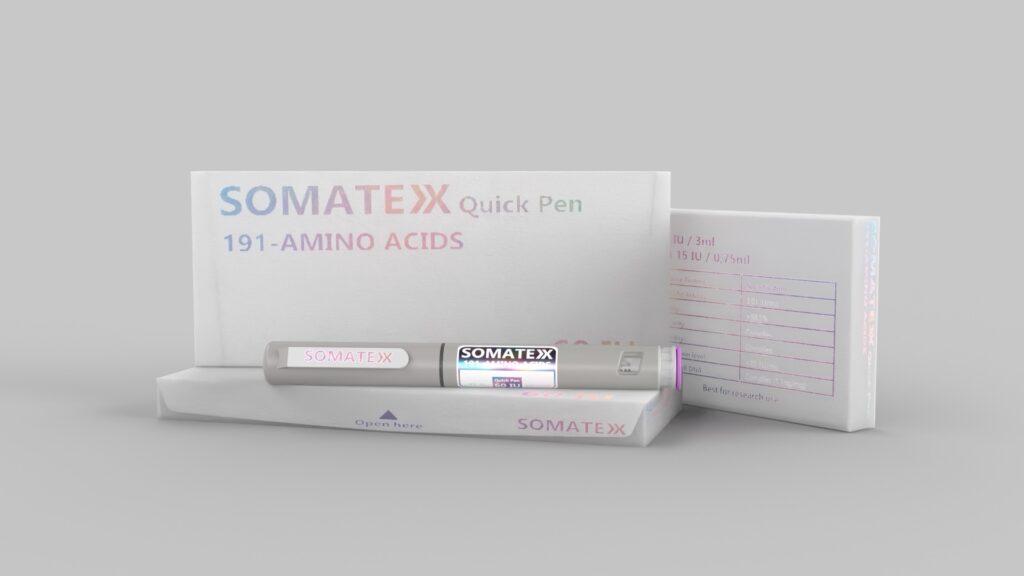
The vial kit contains a lyophilizate requiring reconstitution in bacteriostatic water, which gives full control over the concentration of the working solution. A pen — such as the Somatex GH Pen — contains pre-reconstituted somatropin, ready to draw without a reconstitution step. The choice of format depends on the research protocol: the vial for precise concentration control, the pen for the convenience of working with a ready-made solution.
Chemical reagent intended exclusively for laboratory research (Research Use Only). Medsomatrope in the One Peptides catalog is not a medicinal product, dietary supplement, or food product. It is not intended for administration to humans or animals outside a controlled experimental setting. Somatropin appears on the WADA Prohibited List (S2). The information in this description is educational and scientific in nature and concerns results reported in the literature — it does not constitute medical advice or a suggestion for use in humans.
Pharmacological review:MPharm Aneta Kropicka Pharmaceutical reviewer and sports supplementation expert.
Master of Pharmacy with 12 years of professional experience, graduate of the Medical University of Łódź (2014). Verifies One Peptides product content for pharmacology, clinical dosing, and regulatory compliance across RUO / dietary supplement / drug frameworks.
Operator: Joscur Limited · Room 511, Building 5/F, MING SANG IND BLDG, 19-21 Hing Yip Street, Kwun Tong, Hong Kong · Reg. no 77335383 · [email protected]
 ES
ES  EN
EN  DE
DE 






Valoraciones
No hay valoraciones aún.