 ES
ES  EN
EN  DE
DE 

A research-focused comparison of Melanotan II and PT-141, covering melanocortin receptor selectivity, evidence, safety signals and regulatory status.
A chemical reagent intended exclusively for laboratory research (Research Use Only). It is not a medicinal product, dietary supplement, or foodstuff. It is not intended for administration to humans or animals outside a controlled experimental setting.
The development of selective androgen receptor modulators (SARMs) over more than two decades led from the first molecules characterized in vitro to compounds that reached the clinical trial stage. After ostarine (MK-2866), which progressed furthest in research on cachexia and sarcopenia, LGD-4033 became one of the better-documented representatives of this class — with a published phase I study in healthy volunteers. This article organizes what has actually been reported in the literature about Ligandrol, as part of a reliable description of a research reagent.
The text below is educational in nature and concerns a compound treated as a research reagent. It is not health advice, instructions for use, or an encouragement to administer the substance to any organism. All described effects refer to specific research models and are presented as “what has been reported in studies”.
LGD-4033, commonly known as Ligandrol, is a nonsteroidal selective androgen receptor modulator. In development documentation it also appears under the code VK5211. The compound was developed by Ligand Pharmaceuticals, and the rights to its further development were acquired by Viking Therapeutics, which pursued work on the molecule as a potential tool in the context of musculoskeletal disorders.
The nomenclature can be confusing, so it is worth clarifying: “LGD-4033” is the technical code of the compound, used most often in the scientific literature and in the reagent trade, whereas “ligandrol” is the colloquial name, common in the media and in sports reports. Both terms refer to the same compound with CAS number 1165910-22-4.
In chemical classification, LGD-4033 belongs to the nonsteroidal SARMs — a group of compounds that interact with the androgen receptor without a steroidal structural core. Solomon (2019), in a review of the class, places Ligandrol among the best-characterized molecules of this group.
The basis of LGD-4033’s action described in studies is binding to the androgen receptor (AR). A characteristic feature of the SARM class, observed in preclinical models, is tissue selectivity — differing action on various tissues despite interacting with the same receptor.
In animal models it was reported that LGD-4033 exhibits anabolic action on muscle and bone tissue with a relatively weaker effect on androgenic tissues such as the prostate. Mechanistically, this is explained by different conformational changes of the receptor and varying recruitment of cofactor proteins depending on the tissue. Solomon (2019) describes this model of selectivity as a central theme of research on the entire SARM class.
Interpretive caution is warranted. Bond (2025), in a critical review, points out that the data confirming selectivity come largely from preclinical studies, and that translating this profile into fully predictable and safe action in humans remains insufficiently documented. In other words — the model of selectivity is well described under laboratory conditions, but the evidence base for the class has significant limitations.
The most important single source of clinical data for Ligandrol remains the phase I study described by Basaria (2013). It was conducted with healthy young men and focused on the safety and pharmacokinetics of the compound rather than on physique-related effects.
In the phase I study it was reported that LGD-4033 is characterized by bioavailability after oral administration and a predictable pharmacokinetic profile within the studied range. Good tolerability of the compound over a short observation horizon was also reported, together with the occurrence of hormonal changes — discussed in more detail in the section devoted to safety. It should be emphasized that these were observations from a controlled clinical trial conducted by a research team, and not effects achieved outside such a setting.
Preclinical data — from rodent models and in vitro systems — provided earlier indications regarding binding to the androgen receptor and tissue-selective anabolic action. It is precisely these models that constitute the most common context for the use of LGD-4033 as a reagent in laboratory work.
A reliable description of the compound requires presenting the reported safety signals without exaggerating them and without omitting them.
Reversible suppression of endogenous testosterone. In the phase I study (Basaria 2013), a reduction in the level of endogenous testosterone and related hormonal markers was reported during administration of the compound, with the reversibility of these changes described after the end of exposure within the observed time window. This was one of the main safety signals noted in that study.
Case report of drug-induced liver injury (DILI). Labban (2024) described a case of drug-induced liver injury associated with LGD-4033. This is a single clinical case report that documents a real hepatotoxicity signal linked to exposure to the compound. A report of this kind should be treated seriously as an element of the safety profile — while remembering that a case report does not allow inferences about the frequency of the phenomenon.
Limitations of the evidence base and lack of long-term data. Bond (2025) emphasizes that for LGD-4033 and the entire SARM class there is a lack of data from large, long-term clinical studies. This means that the full safety profile — including the effects of chronic exposure — remains uncharacterized. This evidentiary gap is an important element of an honest description of the compound.
In the regulatory domain, LGD-4033 does not hold the status of a medicine or supplement in the European Union — it functions exclusively as a research reagent (Research Use Only) and has no registration with the European Medicines Agency.
In the context of sport, Ligandrol appears on the Prohibited List of Substances and Methods of the World Anti-Doping Agency (WADA) in category S1 (anabolic agents) — as a substance prohibited in sport at all times, both in-competition and out-of-competition. LGD-4033 has been the subject of recorded anti-doping cases in professional sport, which makes awareness of its status important for people operating in a sporting environment.
Ligandrol and ostarine (MK-2866) are the two best-documented SARMs, but their evidence bases differ in scope. Ostarine progressed further in clinical trials — to phase III in the context of cancer cachexia and muscle mass loss — whereas LGD-4033 has, above all, phase I data concerning safety and pharmacokinetics. This difference matters when comparing what has actually been studied.
A detailed scientific comparison of the two compounds can be found in a separate article: LGD-4033 vs ostarine — what the research says. It is also worth reviewing the profile of ostarine itself in the article on ostarine (MK-2866), as well as the range of One-Peptides SARM research reagents.
Are LGD-4033 and Ligandrol the same thing?
Yes. LGD-4033 is the laboratory code, Ligandrol is the common name of the same compound. In development documentation the code VK5211 is also used.
What research phase did LGD-4033 reach?
Phase I in healthy volunteers (Basaria 2013), where safety and pharmacokinetics were studied. The remaining data come from preclinical models.
Is LGD-4033 safe?
The full safety profile remains uncharacterized. The literature has reported reversible testosterone suppression (phase I) and a case report of liver injury (Labban 2024), and Bond (2025) points to a lack of long-term data.
Is LGD-4033 prohibited by WADA?
Yes, in category S1 (anabolic agents) as a substance prohibited in sport at all times.
Can I buy LGD-4033 as a supplement?
No. LGD-4033 is a laboratory research reagent (RUO), not a supplement or medicine. It is not intended for consumption.
Related reagents: LGD-4033 — reagent datasheet and LGD-4033 category.

A research-focused comparison of Melanotan II and PT-141, covering melanocortin receptor selectivity, evidence, safety signals and regulatory status.
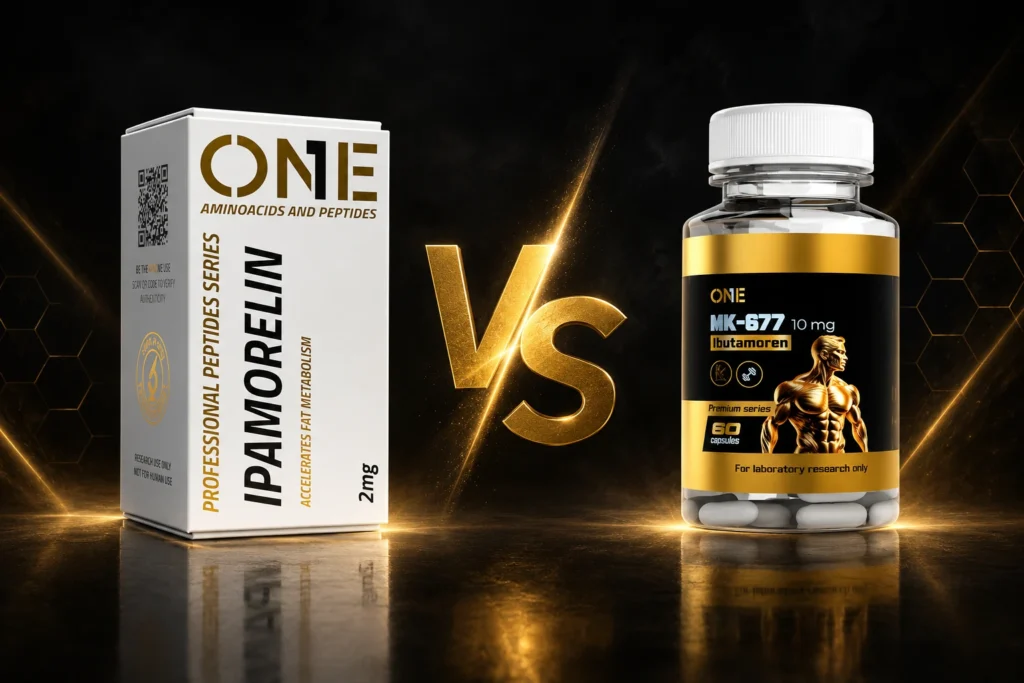
A research comparison of MK-677 and ipamorelin, focusing on GHS-R1a signaling, selectivity, administration route, human evidence and WADA status.
