 ES
ES  EN
EN  DE
DE 

A research-focused comparison of Melanotan II and PT-141, covering melanocortin receptor selectivity, evidence, safety signals and regulatory status.
A chemical reagent intended exclusively for laboratory research (Research Use Only). It is not a medicinal product, a dietary supplement, or a foodstuff. It is not intended for administration to humans or animals outside a controlled experimental environment.
Andarine (S4) is among the earliest described nonsteroidal selective androgen receptor modulators. For researchers following the development of the SARM class, it is a compound of almost historical value — a tool on which the very concept of tissue selectivity was tested. This article organizes what has actually been reported in the literature, where the limits of the evidence lie, and why the S4 profile differs from the newer compounds of this family.
The material below is educational in nature and concerns a research reagent. It does not constitute health advice, instructions for use, or encouragement of any use outside the laboratory. All described effects refer to experimental models.
Andarine appears in the literature and in reagent catalogs under several designations: the common name Andarine and the laboratory codes GTx-007 and S-4. The compound was developed in the research team of James T. Dalton at GTx, during a period of intensive work on nonsteroidal androgen receptor ligands.
Chemically, Andarine (S4) is an arylpropionamide — a structure far removed from classical steroids, designed to bind the androgen receptor in a manner different from endogenous hormones. It was precisely this difference in structure that became the starting point for research into selectivity of action in various tissues.
As a research material, Andarine (S4) remains an RUO reagent. It has not undergone the registration pathway as a medicinal product, and the available data have for the most part not gone beyond the preclinical stage.
Historical context matters here. Work on nonsteroidal SARMs began with a view to conditions accompanied by loss of muscle and bone mass — situations in which classical steroidal androgens carried an activity profile that was difficult to accept. Andarine (S4) was one of the first tools on which it was tested whether it is possible to separate activity in muscle and bone tissue from activity in reproductive tissues. For this reason, the compound appears in many early publications as a reference point for the entire class, even if later work shifted researchers’ attention toward newer molecules with richer clinical documentation.
The basis of interest in the entire SARM class, including Andarine (S4), is the concept of tissue selectivity. In the review by Solomon et al. (2019), androgen receptor modulators were described as compounds intended to stimulate the receptor in a differentiated manner depending on the type of tissue — one way in muscle and bone, another way in reproductive tissues.
In animal models, Andarine (S4) bound the androgen receptor (AR) and exhibited an activity profile that researchers interpreted as partially selective toward muscle and bone tissue. Mechanistically, this means that in these models the compound behaved like a ligand with a profile different from that of a full steroidal agonist.
It is worth noting the interpretive boundary: “selectivity in models” is not the same as a confirmed, predictable profile of action in humans. It is a laboratory observation that the literature treats as a starting point, not as an established clinical characteristic.
The core of the Andarine (S4) evidence base is formed by two frequently cited rodent studies.
Gao et al. (2005) worked on a model of orchidectomized rats (following removal of the testes). They reported an improvement in muscle strength and body composition as well as prevention of bone tissue loss in this model. This was one of the signals that steered further work on the compound as a tool for studying tissue anabolism without a full steroidal profile.
Kearbey et al. (2007) used a model of ovariectomized rats (following removal of the ovaries), often employed in bone research. In this model, observations were reported concerning prevention of bone mass loss and reduction of adipose tissue.
Two important caveats put these data into perspective:
Additionally, a relatively short half-life of the compound was noted in the models — a parameter important for those planning pharmacokinetic experiments. A short retention time of the compound in the model organism means faster elimination, which translates directly into the design of the measurement schedule and the interpretation of data collected over time.
It is also worth honestly noting what these studies do not settle. The orchidectomy and ovariectomy models create conditions of low sex-hormone levels — a deliberately chosen context in which it is easier to capture the action of an androgen receptor ligand. Transferring such observations to an organism with a normal hormonal profile, and all the more so to a human, requires separate studies, which for Andarine (S4) simply have not been carried out to an extent comparable with the newer compounds of the class. That is why a reliable description of S4 stops at the formula “what was reported in the model” rather than promising a reproducible result.
The element that most strongly distinguishes Andarine (S4) from the other compounds of this class in common perception concerns vision. In the literature and in reports, xanthopsia — a yellowish tint to the field of vision — as well as impaired night vision and difficulty adapting to darkness have been reported.
The phenomenon was linked to the compound’s affinity for receptors present in the retina of the eye. Available reports describe this effect as reversible. We present it honestly: this is information about what has been reported, not a scare tactic and not an inducement. For those conducting research on the SARM class, visual disturbances constitute a recognizable, honest element of the S4 characterization and a natural point of comparison when analyzing the safety profile of the various compounds of this family.
A broader look at the safety of the SARM class is provided by the work of Leciejewska et al. (2024), which compiled reported adverse events associated with the use of these compounds. Analyses of this type point to safety signals reported in the context of the entire SARM family, while clearly noting the limitations of the evidence.
Important limitations to bear in mind when interpreting them:
In this context, the S4-specific reports of visual disturbances remain the most recognizable and characteristic signal described in the literature concerning this compound.
A reliable assessment of the safety profile also requires taking into account how the data arise. Some of the signals described for the SARM class come from accounts and reports gathered outside the conditions of a controlled study, which makes it difficult to separate the effect of the substance itself from accompanying factors — such as the unknown identity and purity of material used outside the laboratory. This is one of the reasons why batch traceability and confirmation of analytical identity (HPLC, MS) have for the researcher a value that is not only qualitative but also interpretive: without certainty as to what exactly was studied, it is difficult to attribute an observed signal to a specific molecule. For Andarine (S4) this rule is particularly evident, because its clinical record is modest and most of the picture is built up by the preclinical literature and reports of an observational nature.
Andarine (S4) is a substance prohibited in sport. The World Anti-Doping Agency (WADA) classifies it in category S1 (anabolic agents) — the ban applies both in competition and out of competition.
In regulatory terms, the compound holds no registration as a medicinal product with the EMA or other agencies. It functions as a research reagent (RUO), intended exclusively for laboratory applications by those conducting research. The regulations concerning the trade and possession of compounds of this class differ from country to country.
The most common comparison that arises with Andarine (S4) concerns ostarine (MK-2866). The difference comes down above all to the maturity of the data: ostarine has been the subject of clinical trials, including phase III, whereas the Andarine (S4) base remains predominantly preclinical and based on rodent models. Added to this is the signal concerning vision that is characteristic of S4, which the ostarine profile does not include at such intensity.
A full, scientific comparison of both compounds can be found in a separate article: Andarine (S4) vs ostarine (MK-2866). It is also worth turning to the profile of ostarine and to the overview article on the SARM class within our guide. Capsule-form variants of Andarine (S4) can be found in the Andarine (S4) category.
Are Andarine and S4 the same compound?
Yes — Andarine is the common name, and S4 (as well as GTx-007 / S-4) are the laboratory codes of the same arylpropionamide SARM.
Why is there talk of “yellow vision” with S4?
In the literature, xanthopsia and impaired night vision have been reported, linked to affinity for receptors in the retina. The effect was described as reversible.
Does Andarine (S4) have phase III clinical trials?
No. The evidence base rests predominantly on preclinical data from rodent models.
Is Andarine (S4) prohibited in sport?
Yes. WADA classifies it in category S1 as a prohibited substance.
Is it a medicine or a supplement?
No. Andarine (S4) is a research reagent (RUO), not a medicinal product and not a foodstuff.

A research-focused comparison of Melanotan II and PT-141, covering melanocortin receptor selectivity, evidence, safety signals and regulatory status.
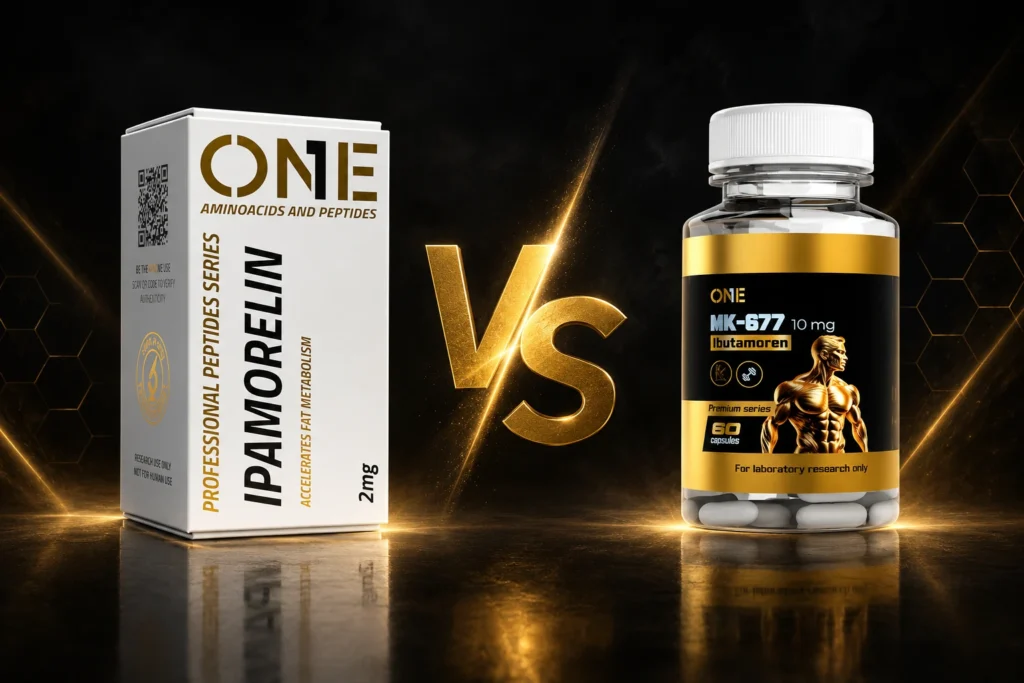
A research comparison of MK-677 and ipamorelin, focusing on GHS-R1a signaling, selectivity, administration route, human evidence and WADA status.
