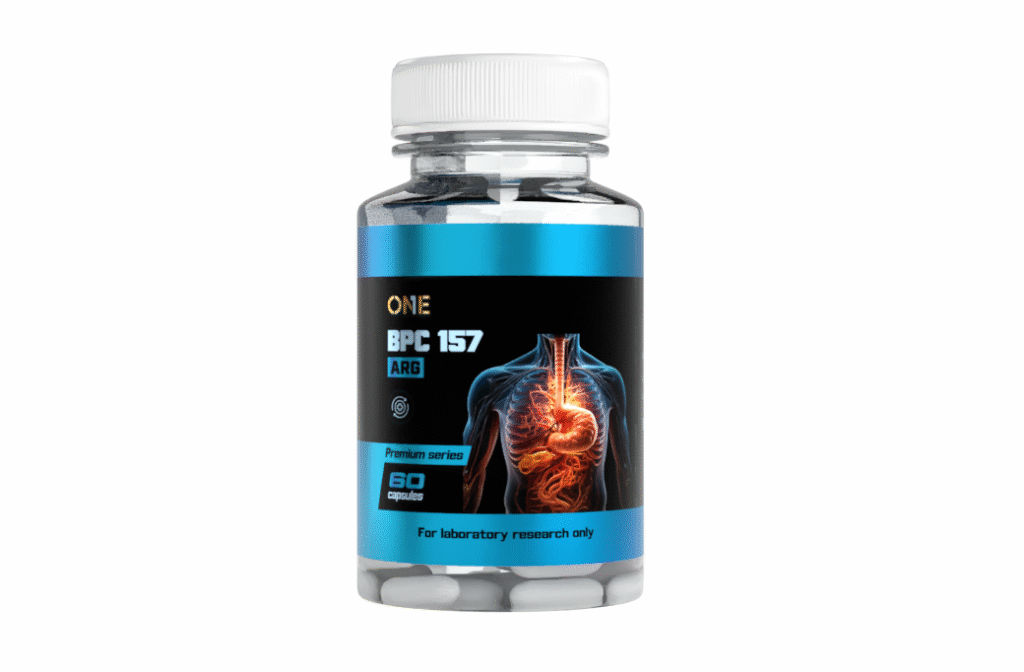
ARG BPC-157 – Variants of the modified BPC-157 peptide
The category includes two distinct variants of the research peptide, collectively designated “ARG BPC-157” – arginine salt of the classic BPC-157 (sequence 15 aa, mass 1419 Da) and variant with an added arginine residue in the sequence (16 aa, ~1575 Da). These are two different reagents – the amino acid sequence and the molecular mass determine which variant goes into your protocol. All items in the catalog meet the HPLC ≥98% standard and are tested by HPLC at an independent laboratory. Browse available vials below and check the specifications on the product page before purchasing.
What is ARG BPC-157 and why does it have two meanings
In the trade of Research Use Only reagents, the term “ARG BPC-157” has two meanings. Both circulate in suppliers’ catalogs under the same name – which is a source of real mistakes for a researcher assessing the repeatability of an experimental protocol.
First meaning: arginine salt of the classic BPC-157
The peptide has an identical sequence to the classic one BPC-157 (Gly-Glu-Pro-Pro-Pro-Gly-Lys-Pro-Ala-Asp-Asp-Ala-Gly-Leu-Val, 15 amino acids, mass 1419.53 Da). It only changes form of salt — counterion with which the peptide is paired during synthesis and crystallization. The classic form is the acetate or trifluoroacetate salt (TFA salt after HPLC purification). In the arginine variant, the counterion is arginine.
Second meaning: variant with an added arginine residue in the sequence
The peptide has modified sequence — with an arginine residue attached to the N-terminus or C-terminus of the classic BPC-157 (e.g. Arg-Gly-Glu-Pro-Pro-Pro-Gly-Lys-Pro-Ala-Asp-Asp-Ala-Gly-Leu-Val, 16 amino acids). The mass increases by ~156 Da. This a different peptide structurally, with a different charge profile at physiological pH.
Comparison table – two variants under one name
| Characteristic |
Arginine salt of the classic BPC-157 |
Variant with Arg added in the sequence |
| Sequence |
15 aa (GEPPPGKPADDAGLV) |
16 aa (Arg-GEPPPGKPADDAGLV or variant C-Arg) |
| Molecular mass of the peptide |
1419.53 Da |
~1575.71 Da |
| Salt form (counterion) |
Arginine |
Acetate / TFA / arginate (variable) |
| Identity in MS – Master Mass |
~1419 Da |
~1575 Da |
| Charge at physiological pH |
Close to neutral |
Slightly positive (Arg) |
| Mechanism of action |
Identical to the classic BPC-157 |
Potentially modified – no head-to-head peer-reviewed |
| Literary achievements |
The entire body of work of BPC-157 applies |
No separate works in the peer-reviewed literature |
A full comparison of both variants along with an analysis of stability, pharmacokinetics and WADA status can be found in the article BPC-157 vs ARG BPC-157 – comparison of research peptides.
Arginine salt BPC-157 – classic sequence, different counterion
If the COA indicates a 15-amino acid sequence and a measured mass of ~1419 Da, you have classic BPC-157 in the form of arginine salt. The sequence is identical to the classic, the peptide acts according to its pleiotropic mechanistic profile (modulation of the nitric oxide axis, stimulation of angiogenesis by VEGF and FGF, effect on growth factors) – full review in flagship article about BPC-157.
The marketing arguments pointing to arginine salt as the preferred variant mainly concern solution stability after reconstitution. Arginine acts as a pH buffer (stabilizes 6.5–7.5, optimal for most short peptides), and the lack of residual TFA ions is important in protocols sensitive to these ions. These arguments are mechanistically coherent, but lack of peer-reviewed head-to-head research comparing arginine salt with the classic acetate salt under identical experimental conditions. Inferring advantage remains a hypothesis.
Variant with added Arg in the sequence – a structurally new peptide
If the COA indicates a measured mass of ~1575 Da and a 16-amino acid sequence, you have structurally modified variant — peptide with an added arginine residue. This is a different chemical compound than the classic BPC-157, although related.
Mechanistic implications:
- Positively charged Arg can enhance interaction with the anionic domains of receptors and proteins
- Can change the recognition profile of proteases (both protect and introduce new cleavage sites)
- May affect transport across membranes and biodistribution
No published head-to-head studies comparing the biological activity of the Arg-BPC-157 variant with the classic one in identical experimental models. For a researcher planning to replicate the results from the BPC-157 literature, the use of the Arg-BPC-157 variant introduces an uncontrolled variable – the protocol is no longer a repetition of the literature, it becomes an exploration.
How to Know Which Variant You’re Buying – Reading the COA
A certificate of analysis that identifies the variant should include:
- Amino acid sequence — unambiguous identification of the peptide. 15 aa = classic BPC-157 salt; 16 aa = variant with added Arg.
- Theoretical molecular mass — 1419.53 Da (classic) or ~1575.71 Da (Arg-BPC-157).
- Molecular mass measured by MS — the difference between 1419 and 1575 Da is immediately visible in the spectrogram.
- Salt form (counterion) — acetate / TFA / arginate / chloride.
- HPLC result — main peak area ≥98% of the sum of areas in the chromatogram.
If the COA does not include any of these fields, require completion from the supplier. The trade name itself does not uniquely identify the peptide. A full description of the quality control procedure can be found in the section quality tests and certificates, and practical tips in the guide how to recognize high-quality research peptides. Peptide calculator will help you calculate the amount of bacteriostatic water to prepare the solution regardless of the variant.
What all variants in the catalog have in common – quality
Regardless of which ARG BPC-157 variant you choose, each product in this category is tested in the same way:
- HPLC ≥98% — chromatographic purity confirmed by high-performance liquid chromatography
- HPLC report from an independent laboratory (content and purity)
- Batch number on the vial label and on the invoice
This is the operational minimum. Other BPC-157 variants can be found in the parent page category BPC-157, and the full offer of research peptides in peptide categories.
Frequently asked questions
How does ARG BPC-157 differ from the classic BPC-157?
Depends on the variant. If ARG is an arginine salt, the peptide sequence (15 aa, 1419 Da) is identical – only the counterion to which the peptide is paired is different. If ARG denotes a variant with an added Arg residue in the sequence (16 aa, ~1575 Da), it is a structurally different peptide. Clear identification in COA.
How do I know which version of the ARG BPC-157 I am purchasing?
Check two parameters: amino acid sequence (15 aa vs 16 aa) and molecular weight measured by MS (~1419 Da vs ~1575 Da). The difference is immediately visible.
Does ARG BPC-157 have the same mechanism of action as classic BPC-157?
In the case of arginine salt – yes. The peptide sequence is identical, so the mechanistic profile (modulation of the NO/cGMP axis, stimulation of angiogenesis by VEGF, modulation of growth factors) remains the same as the classic one. In the case of the variant with added Arg in the sequence – there is no peer-reviewed work verifying the full preservation of the mechanistic profile; sequence modification can affect the way it interacts with receptors and proteases.
Is ARG BPC-157 more stable in solution than classic BPC-157?
Marketing arguments point to better stability of the arginine salt thanks to the buffering properties of arginine (maintaining the pH of the solution around 6.5–7.5). Mechanistically consistent, but no peer-reviewed head-to-head studies verifying the longer shelf life of the solution relative to the acetate salt. Stability data have not been published for the variant with added Arg in the sequence.
Is ARG BPC-157 on the WADA list?
Classic BPC-157 is on the WADA Prohibited List, category S0. Arginine variants are not listed separately in the guidelines, but due to sequence identity (in the case of salt) or close relatedness (in the case of Arg in sequence), doping-controlled athletes should treat them similarly and verify current guidelines before use.
Which variant should you choose to replicate the results from the BPC-157 literature?
Classic BPC-157 in the form of an acetate salt or TFA – the variant on which the original evidence base is based (works by Sikirica, Chang, Cerovecki). The arginine salt retains the classic sequence and should give comparable results, but the difference in counterion may affect the kinetics of peptide release. The variant with Arg added in the sequence introduces an uncontrolled variable.
Product status. All items in this category – regardless of variant – are chemical reagents intended only for laboratory tests (Research Use Only). They are not medicinal products, dietary supplements or foodstuffs. BPC-157 (including its arginine variants) is on the WADA Prohibited List, category S0 – athletes subject to doping control should verify current guidelines before use. Variant BPC-157 in the form of oral capsules (separate product card) falls under the EFSA framework as a dietary supplement and does not fall under this RUO category.
 DE
 EN
 ES