 EN
EN  DE
DE  ES
ES  PL
PL 


In 1982, Ivan Ashmarin’s team at the Institute of Molecular Genetics of the Russian Academy of Sciences undertook a rational modification of the ACTH(4-10) fragment – the aim was to maintain nootropic activity, eliminate residual hormonal activity and extend proteolytic stability from minutes to hours. The result was a heptapeptide sequence Met-Glu-His-Phe-Pro-Gly-Pro, in which the C-terminal tripeptide Pro-Gly-Pro replaced the degradable residues of the original.
Semax is one of the most documented nootropic peptides in the experimental literature today – with a bibliography that includes hundreds of studies from cerebral ischemia, cognitive, anxiolytic, and in vitro models of neurotrophin expression. What makes it interesting for neurotropic peptide pharmacology is pleiotropic modulation of several signaling axes in parallel — BDNF, NGF, dopamine, enkephalin system, MC4R. A profile rare in the class of nootropics. The full literature review can be found in the article Semax – nootropic peptide in scientific research.
Chemical reagent intended exclusively for laboratory tests (Research Use Only). It is not a medicinal product, dietary supplement or food. It is not intended for administration to humans or animals outside a controlled experimental environment.
Semax is a synthetic heptapeptide sequence Met-Glu-His-Phe-Pro-Gly-Pro (single letter: MEHFPGP). The four N-terminal amino acids correspond to the fragment ACTH(4–7) natural adrenocorticotropic hormone. C-terminal tripeptide Pro-Gly-Pro is a synthetic extension introduced intentionally by Ashmarin’s team as a protection against proteolysis – proline residues adjacent to glycine create a structural anchor that makes it difficult for aminopeptidases and carboxypeptidases to cleave in serum and brain tissue. The construction is repeated in the related one Selanku (Thr-Lys-Pro-Arg-Pro-Gly-Pro) – this is the hallmark of the Russian school of regulatory peptidology.
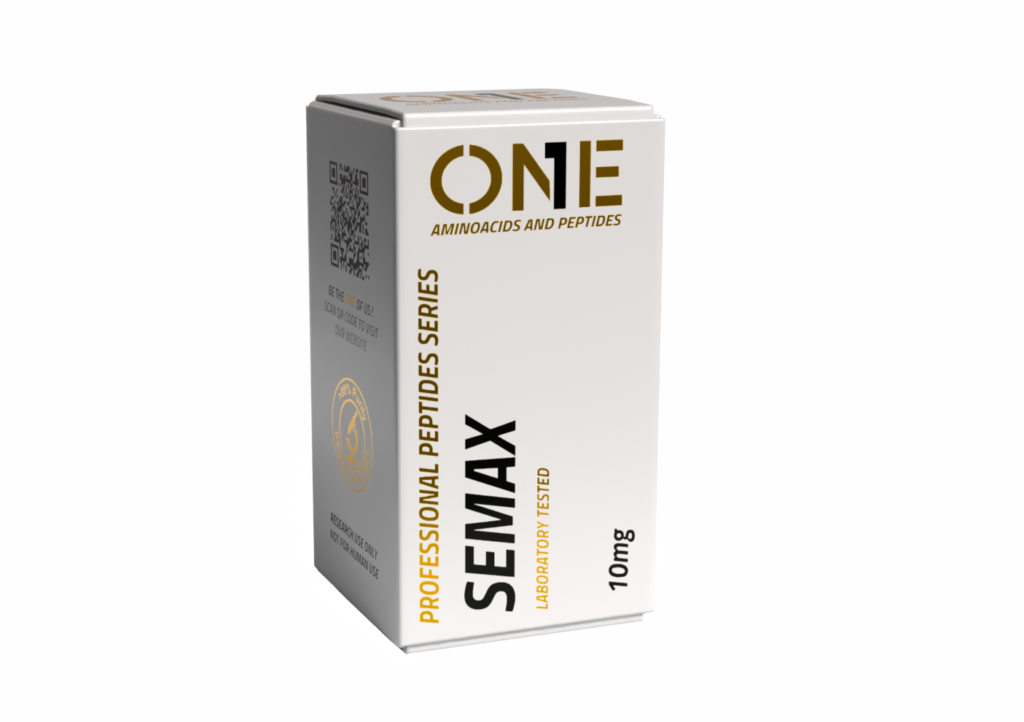
| Parameter | Value |
|---|---|
| Sequence | Met-Glu-His-Phe-Pro-Gly-Pro |
| Number of amino acids | 7 (heptapeptide) |
| Molecular mass | 813.93 Da |
| Summary formula | C₃₇H₅₁N₉O₁₀S |
| Class | Neurotrophic peptide, ACTH(4–7) derivative |
| Salt form | Acetate |
| CAS# | 80714-61-0 |
| Physical form | White or creamy-white lyophilisate |
| HPLC purity | ≥98% |
| Isoelectric pH (pI) | ~5.0 |
Semax does not act through one isolated receptor – modulation of several parallel signaling pathways in the central nervous system has been reported in the literature. The mechanistic profile observed in preclinical experiments is as follows.
BDNF and NGF modulation. The best documented mechanism. Studies in animal models suggest that a single administration of Semax to rats increases mRNA and protein levels brain neurotrophic factor (BDNF) and nerve growth factor (NGF) in the hippocampus and prefrontal cortex within 3–24 hours (Dolotov et al., 2006). The cascade includes CREB activation, BDNF translation, and subsequent TrkB receptor activation. A parallel increase in TrkB expression has been reported, which enhances the neurotrophic signal.
Impact on the dopamine and serotonergic systems. In animal models, Semax affects dopamine neurotransmission in the prefrontal cortex and striatum. The mechanism involves increasing tyrosine hydroxylase activity and modulating dopamine release in response to cognitive stimuli (Sokolov et al., 2018). Some studies also indicate serotonergic modulation, mediated indirectly by inhibition of enkephalinases.
Antioxidant and neuroprotective effects. In models of cerebral ischemia (MCAO) in rats, Semax showed clear neuroprotective effects. In vivo studies reported a reduction in microglia activation, modulation of the cytokine profile (decrease in TNF-α and IL-1β, increase in IL-10), inhibition of NF-κB activity and stabilization of the blood-brain barrier in the infarct border area. In vitro studies on cell cultures showed antioxidant activity at the level of oxidative stress enzymes (Levitskaya et al., 2002).
Semax’s bibliography includes several hundred experimental works from the last four decades. Four main lines of evidence have been reported in the literature.
Ischemic stroke models. The richest area of research. MCAO models in rats reported a 25–40% reduction in infarct area when the peptide was administered in a 6–24-hour window after ischemia, improved recovery of motor function, and modulation of the cytokine profile in the penumbral region. Synaptic regeneration and neurogenesis in the infarct border area are an active field of work.
Models of stress and cognition. Semax was tested in classic paradigms – Morris water maze (spatial memory), novel object recognition test, active and passive avoidance. Improved memory trace consolidation has been reported in rodent models of learning and memory.
Research on anxiolytic potential. In some protocols, Semax has a weaker anxiolytic effect than the related Selank – the emphasis is on the activating-nootropic profile. Comparative work on both peptides constitutes a tool for examining mechanistic selectivity within ACTH/tuftsin peptides. A full list of both peptides can be found in the article nootropic peptides – Semax vs Selank in scientific studies.
The classic route of administration in experimental work includes spraying the solution in cell cultures (in vitro) and intraperitoneal injections and intranasal administration in rodent models (in vivo). In the context of the RUO reagent in the EU, intranasal form does not suggest human application — is an experimental procedure in animal models.
Each batch of Semax in the One Peptides catalog undergoes a five-stage analytical control process. This is an operational minimum – a batch that does not meet any of these rules does not leave the warehouse.
Details of the QA process, sample COAs, and descriptions of each of the five audit stages – v quality tests and certificates.
The following laboratory guide describes the general procedure for preparing a working solution from lyophilized food in the context of a laboratory research reagent. It does not constitute a dosage for humans or animals – it is only a technical guide for reconstituting the reagent for further experimental work.
Solvent. Standard bacteriostatic water (sterile water with 0.9% benzyl alcohol) or sterile water for injection. For cell cultures, PBS buffer with pH 7.4 may be considered.
Solvent volume. Typically 1–2 mL per 10 mg vial. 1 mL gives a concentration of 10 mg/mL, 2 mL – 5 mg/mL.
Working concentrations in cell cultures. A range of 10⁻⁶ to 10⁻⁹ M has been used in the literature, depending on the cell line and endpoint. Working solutions are prepared by serial dilution from the starting solution in an appropriate medium.
Reconstitution procedure. For a full step-by-step guide, see the article how to dissolve peptides. Pour the solvent slowly along the side of the vial – not in a stream directly onto the lyophilisate. Leave in an upright position for 1-2 minutes, then gently roll in your hands (do not shake – heptapeptides are sensitive to foam). The solution should be clear and free from particles.
Stability. The unopened lyophilisate is stable for at least 24 months at -20°C, protected from light. After reconstitution in bacteriostatic water, the solution is stored at 2-8°C for up to 28 days.
Peptide calculator will help you calculate the exact amount of solvent for the planned concentration of the starting solution.
Semax in the One Peptides catalog is chemical reagent intended exclusively for laboratory tests (Research Use Only). Under European Union pharmaceutical law, it is not a medicinal product, dietary supplement or food. It does not have a marketing authorization from the EMA or any national registration authority in the EU.
Two distinct regulatory frameworks – RUO reagent ≠ national drug. In the Russian Federation, Semax is clinically registered as a nasal drop drug with indications including acute ischemic stroke and selected cognitive disorders. Russian registration is separate regulatory framework, not applicable in the EU. The RUO reagent sold in the EU – including by One Peptides – is not a medicinal form of Semax and has no use in humans. The international name and sequence are identical, but the regulatory framework and intended uses are disjoint.
Semax is not on the WADA list – the peptide is neither classified as an anabolic agent nor as a peptide hormone subject to categories S2/S4. This distinction is only of regulatory importance – the reagent remains RUO regardless of anti-doping status.
Both peptides come from the Russian school of peptidology and have a Pro-Gly-Pro motif at the C-terminus that protects against proteolysis. Semax (Met-Glu-His-Phe-Pro-Gly-Pro) is derived from a fragment of ACTH(4–7), reported as an activating-nootropic peptide with strong modulation of BDNF and the dopamine system. Selank (Thr-Lys-Pro-Arg-Pro-Gly-Pro) is derived from a fragment of tuftsin, reported with a dominant anxiolytic profile (GABA and serotonin modulation). Direct head-to-head comparison in identical protocols remains limited.
The unopened lyophilisate is stable for at least 24 months at -20°C. After reconstitution in bacteriostatic water, the solution is stored at 2-8°C for up to 28 days. Semax is more stable than most short regulatory peptides due to its C-terminal Pro-Gly-Pro – serum half-life at 37°C is several hours.
NO. In the European Union, Semax does not have a marketing authorization as a medicinal product. The reagent in the One Peptides catalog is a Research Use Only product – a laboratory chemical reagent, not a medicinal form. The registration of Semax as a drug in the Russian Federation (nasal drops) is a separate, geographically limited regulatory framework.
The dominant animal models are rats (Wistar, Sprague-Dawley) and mice (C57BL/6, BALB/c). The most recognizable model of ischemia is MCAO. Cognitive models include the Morris water maze, novel object recognition test, and active avoidance. In vitro work is carried out on primary hippocampal neuron cultures and on the PC12 and SH-SY5Y lines. Some clinical work comes from the Russian-language literature – validation in independent Western groups remains limited.
NO. Semax is not on the current list of banned substances of the World Anti-Doping Agency. WADA status may change in subsequent editions of the list – it is the investigator’s responsibility to verify the current status.
The C-terminal tripeptide Pro-Gly-Pro is an intentional structural extension introduced by Ashmarin’s team. Proline residues adjacent to glycine form a structural anchor that makes cleavage difficult for aminopeptidases and carboxypeptidases in serum and brain tissue. The motif increases resistance to enzymatic degradation and extends the half-life of the peptide from minutes to several hours. The solution became the hallmark of the Russian school of peptidology.
Chemical reagent intended exclusively for laboratory tests (Research Use Only). Semax in the One Peptides catalog is not a medicinal product, dietary supplement or food. It is not intended for administration to humans or animals outside a controlled experimental environment. All information in the product description is educational and scientific in nature and concerns results reported in experimental literature – it does not constitute medical advice or a suggestion for clinical use.



Reviews
There are no reviews yet.