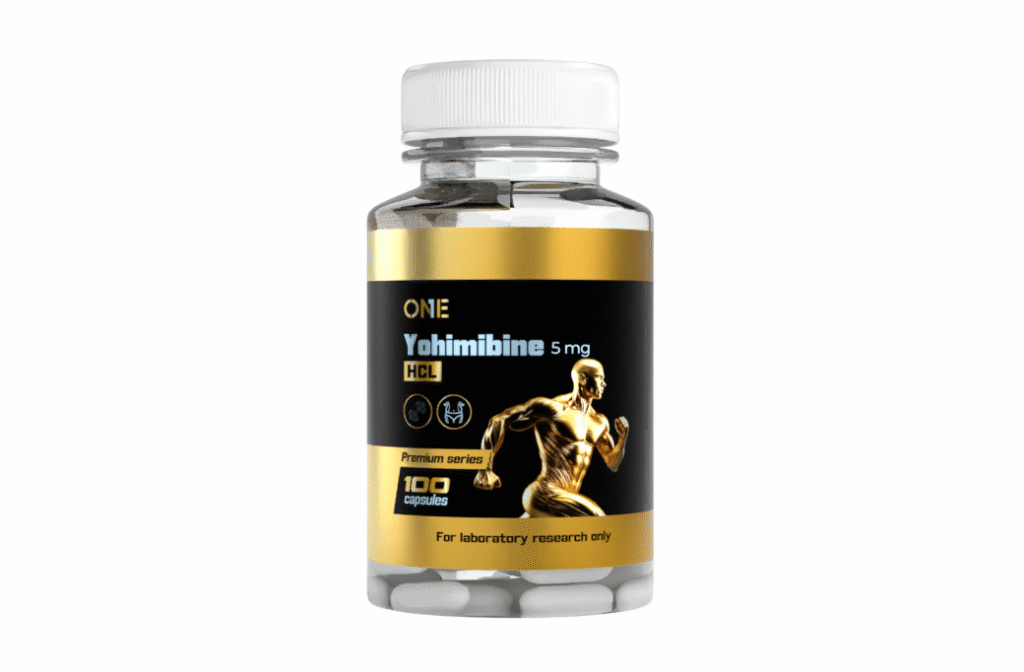
Yohimbine — a research reagent (α2-adrenergic receptor antagonist)
Yohimbine is a chemical reagent intended solely for laboratory research (Research Use Only) — an indole alkaloid and a selective antagonist of the α2-adrenergic receptors. In scientific research it serves as a tool for studying adrenergic regulation and lipid metabolism. It is not a dietary supplement, a medicine or a product intended for use in humans.
Research Use Only. The products in this category are chemical substances for laboratory and scientific applications. They are not dietary supplements, medicines or foodstuffs. They are not intended for consumption or for administration to humans or animals, and they do not serve for weight reduction. The descriptions refer to pharmacology and to results reported in the literature — they do not constitute advice or instructions for use.
What yohimbine is in a research context
Yohimbine is an alkaloid isolated from the bark of the Pausinystalia yohimbe tree. In modern pharmacology it is of interest to researchers primarily as a selective antagonist of the α2-adrenergic receptors — membrane proteins that, under physiological conditions, inhibit the release of noradrenaline and lipolysis in adipose tissue. The blockade of these receptors is the subject of research into the adrenergic regulation of metabolism.
In the research-reagent trade, yohimbine appears as a pure, analytically defined substance (yohimbine HCl) — unlike the plant raw material (yohimbe bark extract), which contains variable amounts of many alkaloids. In scientific research, pure yohimbine of a confirmed concentration is used, because standardisation is a condition for the reproducibility of results.
What is studied in the context of yohimbine
The directions below describe what is the subject of research, not effects promised in humans.
- α2 receptor pharmacology — profiling yohimbine as an antagonist, receptor-activity assays, interactions with the noradrenergic system.
- Adrenergic regulation of lipolysis — in cell and animal models, the effect of α2 blockade on lipid mobilisation in adipocytes is studied, particularly in depots rich in these receptors. This is a biochemical mechanism, not a claim of a physique effect.
- Metabolic context — the dependence of lipolytic effects on the insulin state is one of the variables studied in the design of experiments.
A full description of the mechanism and the state of the research is expanded in a dedicated article on yohimbine as an α2 receptor antagonist in the One-Peptides knowledge base.
Yohimbine HCl and yohimbe: why they are not the same
In popular descriptions, these two names are sometimes used interchangeably. However, they refer to two different categories of material, and the distinction is fundamental for researchers.
Yohimbine hydrochloride (yohimbine HCl) is a single, defined chemical compound with one molecular formula, one molar mass and measurable purity. The substance content and purity must be confirmed for the specific batch. Chromatographic purity alone does not guarantee identical substance content in every batch. Confirmed parameters allow the response to be related to concentration.
Yohimbe is a botanical raw material: the bark of Pausinystalia johimbe. Yohimbine accounts for only part of its pool of indole alkaloids. Other constituents include rauwolscine and corynanthine, in proportions that depend on the tree, region, harvest season and extraction method. The yohimbine content can be low and variable, and independent analyses of commercial preparations have found substantial discrepancies between label declarations and laboratory measurements.
This has three consequences. Two portions of extract with the same mass may contain different amounts of yohimbine. The accompanying alkaloids are not pharmacologically inert: rauwolscine is itself an α2 antagonist with different receptor-subtype selectivity, while corynanthine shifts the profile towards the α1 receptor, making the extract a mixture of ligands with partially opposing effects. The botanical material also introduces batch-to-batch variability, which itself becomes a confounding variable.
For this reason, research on α2-receptor pharmacology uses a pure, characterised compound rather than an extract. A full discussion of the distinction, together with references, is available in the article on yohimbine’s mechanism of action at the alpha-2 receptor.
Reagent quality
- HPLC purity ≥98% — confirmed by liquid chromatography.
- Identity confirmation — mass spectrometry / analytical documentation.
- COA per batch — a certificate of analysis for each batch.
- Batch traceability — the batch number linked to the documentation.
The item available in this category is yohimbine hydrochloride in capsules, containing 5 mg of the substance per capsule and 100 capsules per pack. The identification parameters given on the product page are CAS number 65-19-0, molar mass 390.9 g/mol and molecular formula C21H26N2O3 · HCl. The substance is a crystalline powder. Information on batch-level quality documentation is available on the reagent product page.
Pharmacological profile — a note of caution
Yohimbine is a pharmacologically active substance with a distinct cardiovascular and central profile (an effect on blood pressure, heart rate and noradrenergic activity). In a research context it requires careful monitoring of parameters and consideration in the design of the experiment — it is not a “mild” substance. This description concerns the pharmacological properties studied in the literature, not recommendations for use.
Frequently asked questions about yohimbine
What is yohimbine?
Yohimbine is an indole alkaloid isolated from the bark of Pausinystalia yohimbe, described in pharmacology as a selective antagonist of α2-adrenergic receptors. In the reagent trade, it is supplied as the hydrochloride, a pure, analytically defined substance. In this category it is a chemical reagent for laboratory applications, not a foodstuff or medicinal product.
How does yohimbine HCl differ from yohimbe?
Yohimbine HCl is a single compound with a known molar mass and measurable purity. Yohimbe is a botanical raw material containing yohimbine alongside dozens of other alkaloids in variable proportions. This distinction directly affects reproducibility: a pure compound allows an observation to be related to a known quantity of substance, whereas an extract relates it to a mixture of undetermined composition. See the section above for further details.
Do johimbina and yohimbine mean the same thing?
Yes. “Yohimbine” is the English name and “johimbina” is the Polish spelling. Both names refer to yohimbine. CAS number 65-19-0 identifies its hydrochloride (yohimbine HCl), whereas the free base has CAS number 146-48-5. The spellings “yohimbina” and “johimbina HCl” are also encountered; the latter specifically identifies the hydrochloride form. The naming does not change the material’s status: in this category it is a research reagent.
Regulatory frame
Yohimbine in this category is a chemical reagent with Research Use Only status. It is not a dietary supplement, a medicine, a cosmetic or a foodstuff; it is not intended for weight reduction or for any use in humans. In some jurisdictions, yohimbine as an active substance is registered for narrow medical indications — this is a separate regulatory frame, which should not be confused with a research reagent.
 EN
EN  DE
DE  ES
ES  PL
PL