 EN
EN  DE
DE  ES
ES  PL
PL 


In 2015, Pinchas Cohen’s team from the University of Southern California published in Cell Metabolism work that changes the conceptual framework in mitochondrial biology. Lee et al. showed that a small open reading frame within the mitochondrial 12S rRNA encodes a functional, sixteen-amino-acid peptide with metabolic activity. They named him MOTS-c — Mitochondrial open reading frame of the 12S rRNA-c.
Mitochondria, previously treated as energy organelles subordinated to nuclear transcriptional control, turned out to have their own “signaling language” – peptides encoded by mtDNA that are able to leave the organelle, circulate in the blood and modulate the cell’s transcriptional program. MOTS-c became the first member of the class described mitochondrial-derived peptides (MDPs) and remains the best characterized representative of the family.
Chemical reagent intended exclusively for laboratory tests (Research Use Only). It is not a medicinal product, dietary supplement or food. It is not intended for administration to humans or animals outside a controlled experimental environment.
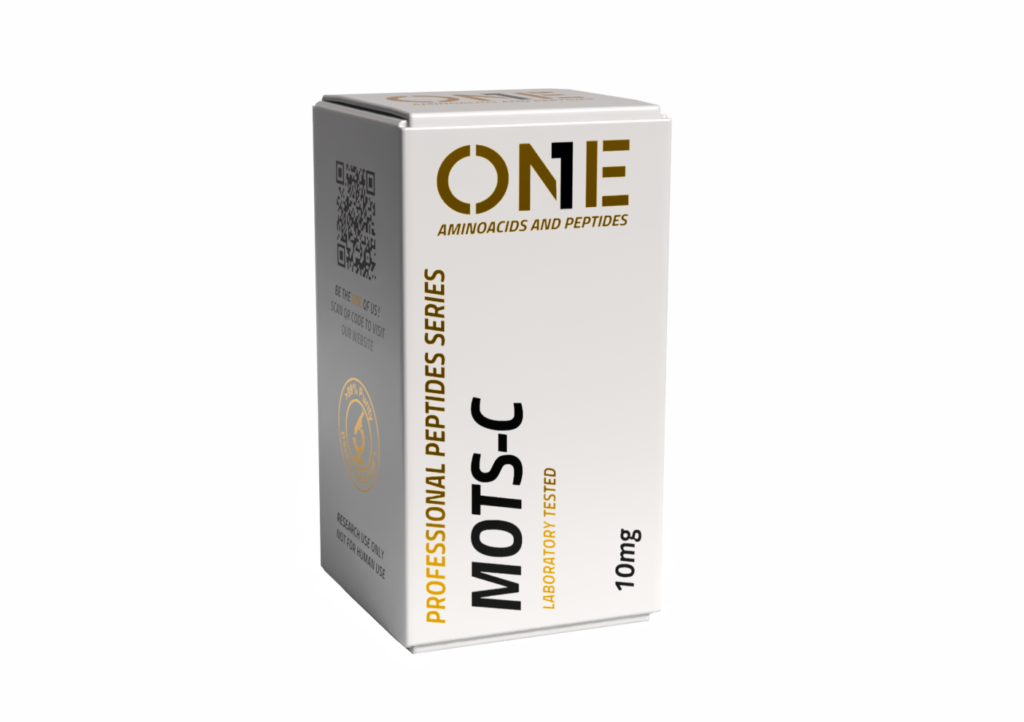
MOTS-c is an endogenous peptide sequence MRWQEMGYIFYPRKLR — sixteen amino acids, molecular weight approx 2174 Da. Its distinguishing feature is the coding site: the open reading frame is not located in the cell nucleus, but within the gene. mitochondrial 12S rRNA, which was traditionally classified as structural, non-coding rRNA. The discovery of a functional ORF within it forced mitochondrial geneticists to re-invent the coding potential of the mitochondrial genome – additional peptides from this class were described in related works (Humanin from 16S rRNA, family SHLP1–6). MOTS-c remains the best characterized MDP with a metabolic profile – Humanin is described mainly for cytoprotective purposes, SHLPs are at an earlier stage of functional characterization.
| Parameter | Value |
|---|---|
| Sequence | Met-Arg-Trp-Gln-Glu-Met-Gly-Tyr-Ile-Phe-Tyr-Pro-Arg-Lys-Leu-Arg (MRWQEMGYIFYPRKLR) |
| Number of amino acids | 16 |
| Molecular mass | ~2174 Da |
| Class | Mitochondrial-derived peptide (MDP) |
| Coding | Mitochondrial 12S rRNA (mt-RNR1) |
| Natural occurrence | YES, endogenous peptide in humans |
| Physical form | White or creamy-white lyophilisate |
| HPLC purity | ≥98% |
| Salt form | Acetate |
MOTS-c appears in the experimental literature as a pleiotropic peptide that acts in parallel at several cellular levels. Three mechanistic pillars stand out for their strength of evidence.
AMPK activation. Best documented pathway (Lee 2015 and subsequent replications). MOTS-c inhibits the folate cycle and de novo purine synthesis reactions, which leads to the accumulation of AICAR and an increase in the AMP/ATP ratio – an activating signal AMPK by LKB1. This is a common trail junction with metformin. AMPK activation triggers ACC phosphorylation, mTORC1 inhibition and the catabolic program – fatty acid oxidation, mitophagy, mitochondrial biogenesis.
Retrograde mitochondrial signaling. Mechanism distinguishing MOTS-c from metformin. Reynolds 2021 and Kim 2017 reported that MOTS-c, after leaving the mitochondrion in response to metabolic stress, can enter cell nucleus and modulate the expression of antioxidant response genes (program NRF2). Metformin activates cytoplasmic AMPK and indirectly modifies the metabolic program – MOTS-c modifies it directly by physically entering the nucleus. The class of MDPs has thus become a canonical example reverse signaling from organelles to the nucleus.
Exercise-mimetic in mouse models. Reynolds 2021 – MOTS-c administered to mice partially replicated the endurance training phenotype: it increased exercise capacity in the treadmill running test, increased mitochondrial biogenesis in skeletal muscle, and delayed age-related decline in performance in aged animals. Profile observed in animal models – without extrapolation to humans. The broader context of peptides that modulate aging processes is described in the guide peptides in aging research.
Endogenous levels decline with age. D’Souza 2020 reported that the level of MOTS-c in serum and skeletal muscle decreases with age, and a single physical exercise in healthy volunteers causes a transient increase in the concentration of the peptide in the circulation. These are correlative observations, not causal evidence regarding the function of the peptide in humans.
Six dominant lines of research on MOTS-c have been reported in the literature.
Models of insulin resistance and dyslipidemia. The richest area. In high-fat diet (HFD)-fed mouse models, MOTS-c was reported to be associated with improvements in glucose tolerance, insulin sensitivity, and lipid profile—an effect consistent with AMPK activation. Genetic obesity models (ob/ob, db/db) are a related area.
Models of age-related sarcopenia. Aged mice with loss of muscle mass and performance decline as a platform to assess whether exogenous administration of MOTS-c corrects deficits in mitochondrial biogenesis in skeletal muscle (Reynolds 2021). For a complete mechanistic background on tissue regeneration and mitochondrial biogenesis in research peptides, see how regenerative peptides work.
Studies on mitochondrial biogenesis. C2C12 myoblasts and primary muscle cultures – examining how MOTS-c modulates PGC-1α, NRF1/2 expression.
Research on exercise capacity. Endurance models in rodents – running on a treadmill, swimming until exhaustion. Acute and chronic effects were reported.
MASH/MASLD models. In models of fatty liver disease, MOTS-c has been reported to improve the lipid profile in hepatocytes and reduce triglyceride accumulation – indirectly through AMPK.
Experiments on retrograde mitochondrial signaling. Cultures with NRF2 transcriptional reporters and analysis of MOTS-c nuclear translocation by immunofluorescence.
Each batch of MOTS-c in the One Peptides catalog undergoes an analytical inspection process. This is an operational minimum – a batch that does not meet any of these rules does not leave the warehouse.
Details of the QA process, sample COAs, and descriptions of each of the five audit stages – v quality tests and certificates.
The following laboratory guide describes the general procedure for preparing a working solution from lyophilized food in the context of a laboratory research reagent. It does not constitute a dosage for humans or animals – it is only a technical guide for reconstituting the reagent for further experimental work.
Solvent. Standard bacteriostatic water or sterile water for injection; for cell cultures – PBS with pH 7.4. MOTS-c, due to the presence of hydrophobic residues (Trp, Tyr, Phe, Ile, Leu), requires the addition of <1% v/v DMSO for full clarity in some protocols.
Solvent volume. Typically 2 mL per 10 mg vial – this gives the starting concentration 5 mg/mL, convenient for further serial dilutions.
Working concentrations in cell cultures. The range used in the literature is wide – from submicromolar to tens of micromoles per liter – depending on the cell line and model. In Lee 2015, concentrations were kept mainly in the micromolar range.
Reconstitution procedure. For a full step-by-step guide, see the article how to dissolve peptides. Pour the solvent slowly along the side of the vial – not in a stream directly onto the lyophilisate. Leave in an upright position for 1-2 minutes, then gently roll in your hands (do not shake). The solution should be clear. Slight turbidity may indicate aggregation of hydrophobic residues – consider adding DMSO or warming to 25-30°C with gentle stirring.
Stability. The unopened lyophilisate is stable for at least 24 months at -20°C, protected from light. After reconstitution in bacteriostatic water, the solution is stored at 2-8°C for up to 28 days. The in vivo plasma half-life for peptides of this size is estimated to range from minutes to several dozen minutes.
Peptide calculator will help you calculate the exact amount of solvent for the planned concentration of the starting solution.
MOTS-c in the One Peptides to catalog chemical reagent intended exclusively for laboratory tests (Research Use Only). It is not a medicinal product, dietary supplement or food. It does not have a marketing authorization issued by the EMA, FDA or any national registration authority.
Class mitochondrial-derived peptides is at a very early stage of clinical development. CohBar Inc. — a company co-founded by Pinchas Cohen — conducted early research on MOTS-c analogues (CB4211 program). However, published peer-reviewed data comes mainly from animal models and cell cultures.
MOTS-c is named on the WADA Prohibited List for 2026 — section S4.4.1 (metabolic modulators, AMPK activators). It is prohibited at all times, in and out of competition. The List is updated every year — responsibility for verifying the current status rests with the researcher.
Both compounds activate AMPK. Metformin acts at the level of complex I of the respiratory chain, increases the AMP/ATP ratio in the cytoplasm and activates AMPK through LKB1 in the cytoplasmic compartment. MOTS-c, after leaving the organelle, can enter the cell nucleus and directly modulate the expression of metabolic and antioxidant response genes (NRF2). Metformin is a small molecule used clinically as a drug, MOTS-c is an experimental research peptide.
In mouse models (Reynolds 2021), MOTS-c partially replicated the endurance training phenotype – it increased exercise capacity, increased mitochondrial biogenesis, and delayed the decline in performance in old animals. The term “exercise-mimetic” refers to this profile in animal models. Extrapolation to humans requires independent validation – there is very little clinical data for MOTS-c in training protocols in the peer-reviewed literature.
NO. MOTS-c does not have marketing authorization as a medicinal product in the European Union, the United States or any other major jurisdiction. A class of MDPs is in the very early stages of clinical development – CohBar Inc. conducted early research on analogues. The reagent in the One Peptides catalog is a Research Use Only product.
The unopened lyophilisate is stable for at least 24 months at -20°C, protected from light. After reconstitution in bacteriostatic water, the solution is stored at 2-8°C for up to 28 days. The presence of hydrophobic residues in the sequence may require the addition of DMSO (<1% v/v) for full solution clarity.
MDPs are peptides encoded by open reading frames within mitochondrial DNA – traditionally thought of as encoding only thirteen respiratory chain proteins. The first described MDP was Humanin (encoded in 16S rRNA, cytoprotective and neuronal profile). MOTS-c (Lee 2015) is the first MDP with a dominant metabolic profile. Family SHLP1–6 are other, less characterized MDPs. The class is a model example retrograde mitochondrial signaling.
Yes. MOTS-c is named on the World Anti-Doping Agency (WADA) Prohibited List for 2026 — section S4.4.1 (metabolic modulators, AMPK activators). It is prohibited at all times, in and out of competition. The List is updated every year — it is the researcher’s responsibility to verify the current status.
Chemical reagent intended exclusively for laboratory tests (Research Use Only). MOTS-c in the One Peptides catalog is not a medicinal product, dietary supplement or food. It is not intended for administration to humans or animals outside a controlled experimental environment. All information in the product description is educational and scientific in nature and concerns results reported in experimental literature – it does not constitute medical advice or a suggestion for clinical use.







Reviews
There are no reviews yet.