 EN
EN  DE
DE  ES
ES  PL
PL 
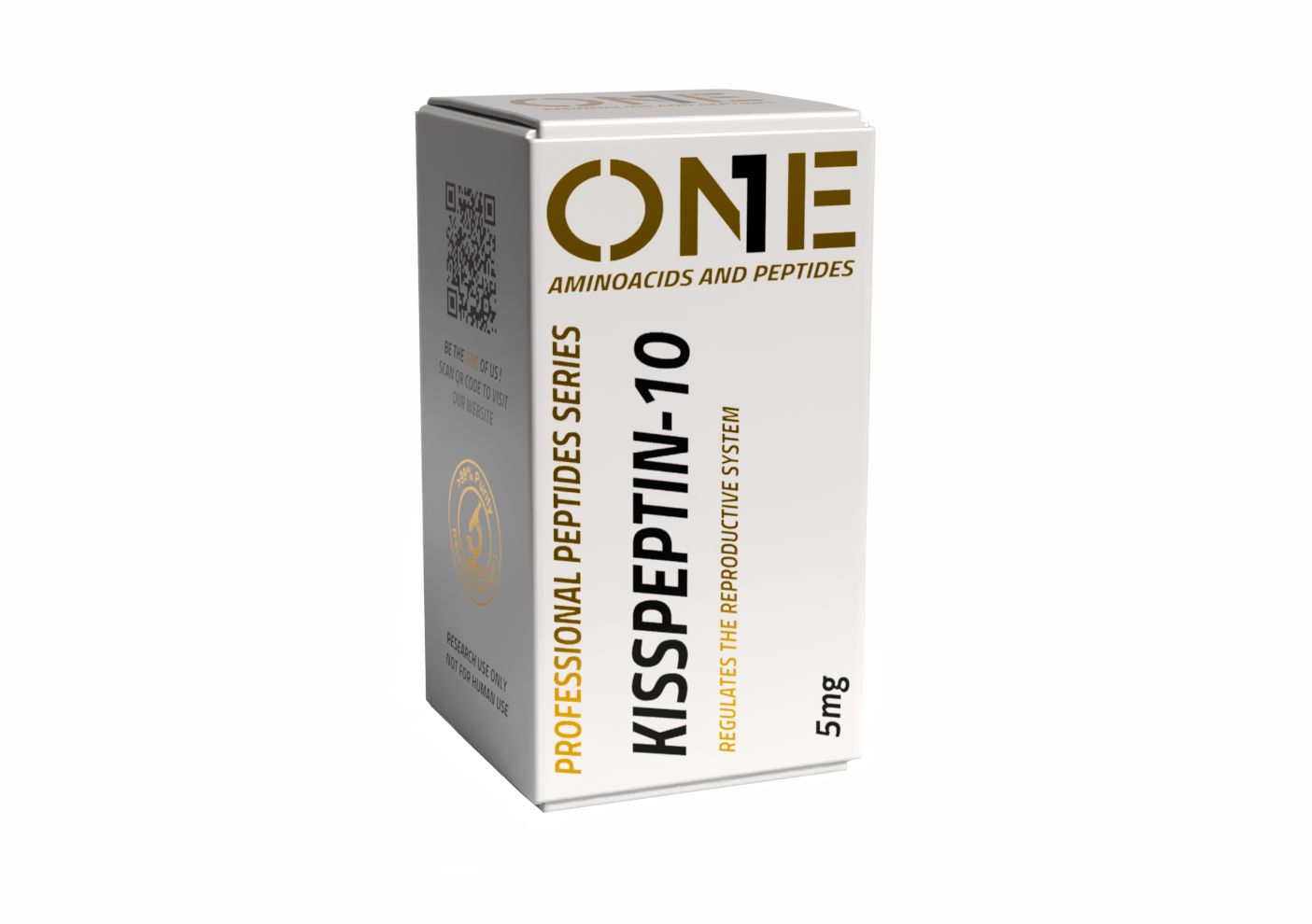

Kisspeptin – Research Use Only (RUO). Chemical reagent intended only for laboratory tests. It is not intended for human consumption or diagnostic purposes.
Related categories and reagents: In the context of this area of research, it is also worth comparing Oxytocin 10 mg.
Kisspeptin-10 vs oxytocin. Both are short peptides described in the context of neuroendocrinology, but they enter two different receptor systems. Kisspeptin-10 (1,302.45 g/mol) is a decapeptide and a ligand of the KISS1R receptor (formerly GPR54), described in the literature in the context of regulating the hypothalamic-pituitary-gonadal axis. Oxytocin (1,007.19 g/mol) is a cyclic nonapeptide and a ligand of OXTR, which belongs to a completely different receptor family. The research area is shared, not the mechanism; these are not interchangeable reagents.
Kisspeptin-10 (Kp-10), also known as metastin 45-54, is a synthetic decapeptide that is the C-terminal fragment of full-molecule kisspeptin-54. This peptide is a biologically active fragment of the KISS1 gene product, which plays a central role in the regulation of the hypothalamic-pituitary-gonadal (HPG) axis by activating the KISS1R receptor (GPR54).
The discovery of kisspeptin in 2003 was a breakthrough in understanding the mechanisms of reproductive function control at the neuroendocrine level. Kisspeptin-10 retains the full biological activity of full-molecule kisspeptin, which makes it a valuable tool in research on the regulation of gonadotropin secretion.
Kisspeptin-10 is a decapeptide with the sequence Tyr-Asn-Trp-Asn-Ser-Phe-Gly-Leu-Arg-Phe-NH2, corresponding to positions 112-121 (or 45-54 counting from the C-terminus) of the kisspeptin precursor. This is the minimal sequence that retains full affinity for the KISS1R receptor and biological activity.
In scientific research, Kisspeptin-10 serves as:

Kisspeptin-10 is a C-terminal decapeptide that is the active fragment of kisspeptin-54 (metastin). The KISS1 gene encodes a 145 amino acid precursor that is proteolytically processed into active forms: kisspeptin-54, -14, -13 and -10.
| Year | Event |
|---|---|
| 1996 | Discovery of the KISS1 gene as a metastasis suppressor |
| 2001 | Identification of the GPR54 receptor (KISS1R) |
| 2003 | Discovery of the role of kisspeptin in GnRH regulation |
| 2003 | Association of KISS1R mutations with hypogonadism |
| 2005+ | Intensive research on reproductive functions |
The name “kisspeptin” comes from the place where the KISS1 gene was discovered – Hershey in Pennsylvania (USA), known for the production of Hershey’s Kisses chocolates. The alternative name “metastin” refers to initial research into its role in suppressing cancer metastases.
| Form | Length | Positions | Activity |
|---|---|---|---|
| Kisspeptin-54 | 54 A.A | 68-121 | Full |
| Kisspeptin-14 | 14 A.A | 108-121 | Full |
| Kisspeptin-13 | 13 A.A | 109-121 | Full |
| Kisspeptin-10 | 10 A.A | 112-121 | Full |
Kisspeptin-10 consists of 10 amino acids:
H-Tyr-Asn-Trp-Asn-Ser-Phe-Gly-Leu-Arg-Phe-NH2
One letter code: YNWNSFGLRF-NH2
| Parameter | Value |
|---|---|
| Summary formula | C63H83N17O14 |
| Molar mass | 1302.45 g/mol |
| CAS number | 374675-21-5 |
| Number of amino acids | 10 |
| C-end | Amidated (-NH2) |
| Isoelectric point (pI) | ~10.0 (basic) |
| Solubility | Soluble in water |
| Form | Freeze-dried powder (white) |
| Aromatic amino acids | 4 (Tyr, Trp, 2×Phe) |
Kisspeptin-10 belongs to the RF-amide peptide family, characterized by the C-terminal sequence Arg-Phe-NH2:
Quality parameters:
| Test | Method | Specification |
|---|---|---|
| Cleanliness | HPLC | ≥98% |
| Identification | MS | 1302.45 ± 0.5 Da |
| Water content | Karl Fischer | ≤8% |
| Acetate content | Titration | ≤12% |
| Appearance | Visual | White lyophilisate |
| Solubility | Test | Clear in water |
Freeze-dried form:
– Temperature: -20°C (optimal)
– Permissible: 2-8°C (up to 1 month)
– Protect from light (tryptophan!)
– Protect against moisture
– Shelf life: 24 months at -20°C
After reconstitution:
– Solvent: sterile water or PBS
– Storage: 2-8°C in the dark
– Use within 7-14 days
– Freezing aliquots recommended
– Avoid repeated freezing/thawing
Kisspeptin-10 is an agonist of the KISS1R receptor, a Gq/11 protein-coupled GPCR. In vitro tests analyze:
Binding characteristics:
– High affinity for KISS1R
– EC50 in the nanomolar range
– Comparison with longer forms of kisspeptin
Intracellular signaling:
– Activation of phospholipase C
– IP3 and DAG production
– Release of Ca2+ from the ER
– Activation of PKC and MAPK
In vitro studies have established:
Kisspeptin-10 has been tested for:
In vitro studies show potential interactions with:
IMPORTANT: The product is intended for in vitro testing only. Not intended for:
– Use in humans or animals
– Diagnostic or therapeutic purposes
– Any clinical use
Kisspeptin-10 is a synthetic decapeptide that is the minimal active fragment of kisspeptin, retaining full affinity for the KISS1R receptor. Its central role in regulating the HPG axis makes it an indispensable tool in neuroendocrine research and reproductive biology.
Material One Peptides Kisspeptin-10 5 mg offers:
Kisspeptin-10 (Kp-10) is a synthetic decapeptide with the sequence Tyr-Asn-Trp-Asn-Ser-Phe-Gly-Leu-Arg-Phe-NH2 (YNWNSFGLRF-NH2) and a molar mass of 1302.45 g/mol. This is the C-terminal fragment of kisspeptin-54, retaining full activity towards the KISS1R receptor. The CAS number is 374675-21-5.
Kisspeptin is a key regulator of the hypothalamic-pituitary-gonadal (HPG) axis. Kisspeptin neurons in the hypothalamus control the secretion of GnRH, which in turn regulates the secretion of gonadotropins (LH, FSH) from the pituitary. Mutations in the KISS1 or KISS1R gene lead to puberty disorders.
In lyophilized form, the peptide is stored at -20°C, protected from light (due to tryptophan) and moisture. After reconstitution in sterile water, the solution is stored at 2-8°C for up to 7-14 days in the dark. It is recommended to freeze small portions for longer storage.
The RF-amide motif is the C-terminal Arg-Phe-NH2 (RF-NH2) sequence, characteristic of the RF-amide peptide family to which kisspeptin belongs. This motif is necessary for binding to the KISS1R receptor – its modification leads to the loss of the biological activity of the peptide.
Kisspeptin-10 is used in in vitro studies in the field of: neuroendocrinology (regulation of the HPG axis), reproductive biology, KISS1R receptor studies, GnRH control mechanisms and integration of metabolic and reproductive signals. It is not intended for use on humans or animals.
The most important features of the ONE Kisspeptin-10 5 mg product:
 DHL Express


Reviews
There are no reviews yet.