 EN
 DE
 ES



HGH Fragment – Research Use Only (RUO). Chemical reagent intended only for laboratory tests. It is not intended for human consumption or diagnostic purposes.
Related categories and reagents: In the context of this area of research, it is also worth comparing reagents affecting GH and GLP-1+GIP.
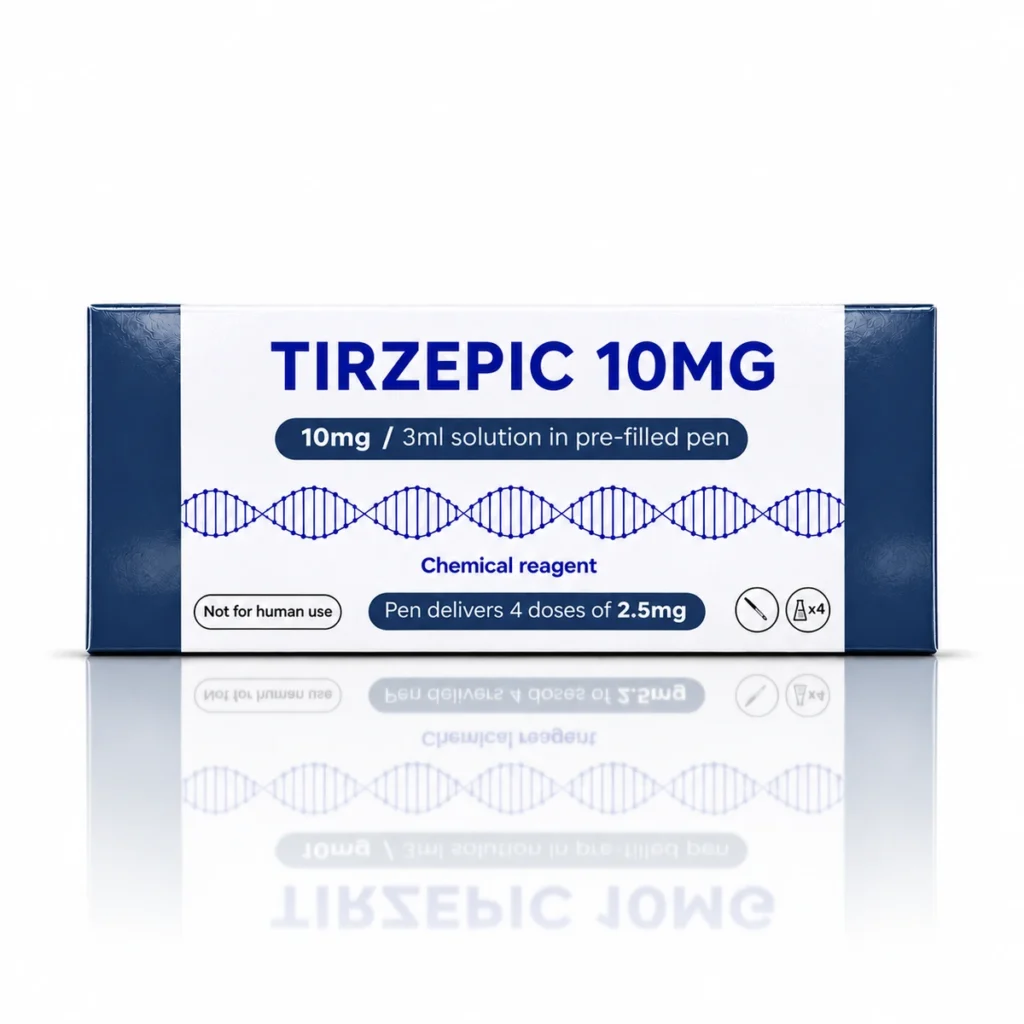
HGH Fragment 176-191 vs tirzepatide (GLP-1+GIP). Both appear in metabolic research, but they originate from two different hormonal systems. HGH Fragment 176-191 (1,815.08 g/mol) is the C-terminal section of human growth hormone—16 amino-acid residues from the complete 191-residue hGH sequence; the fragment alone does not reproduce the full hormone profile and is described separately in the literature. Tirzepatide is a much larger incretin analogue described as an agonist of two receptors—GLP-1 and GIP; its point of action lies in the incretin system, not the growth hormone axis.
How does it differ from GH secretagogues? Fragment 176-191 is a section of the hormone molecule itself, whereas MK-677 (528.7 g/mol), GHRP-2 (817.97 g/mol), GHRP-6 (873.01 g/mol) and ipamorelin (711.85 g/mol) are compounds described as stimulating its release. These are two different locations within the same axis.
HGH Fragment 176-191, also known as AOD-9604 in modified form, is a synthetic peptide consisting of 16 amino acids that represents the C-terminal fragment of human growth hormone (hGH). This sequence corresponds to amino acids 176-191 of the full hGH chain and was isolated as a separate research peptide in the 1990s.
Fragment 176-191 is the subject of scientific research due to its specific structure, which retains only part of the properties of the full growth hormone. This selectivity makes it an interesting tool in structure-activity studies and in the analysis of molecular mechanisms related to the C-terminal region of hGH.
HGH Fragment 176-191 is a linear peptide corresponding to the amino acid sequence 176-191 of human growth hormone. Full hGH consists of 191 amino acids, while fragment 176-191 represents the final 16 amino acids of the C-terminal chain.
In a research context, this peptide is used for:
The One Peptides HGH Fragment 176-191 5 mg material is supplied in the form of a high-purity lyophilized powder intended for use in biochemical and molecular biology research.

HGH Fragment 176-191 is a synthetic peptide that is a fragment of full-length human growth hormone. Growth hormone (GH, somatotropin) is a protein produced by the pituitary gland, consisting of 191 amino acids.
| Aspect | Description |
|---|---|
| Sequence source | Human growth hormone (hGH) |
| Position in hGH | Amino acids 176-191 |
| Region | C-terminal (last 16 AA) |
| Type | Peptide fragment |
| Characteristic | hGH (full) | Fragment 176-191 |
|---|---|---|
| Number of amino acids | 191 | 16 |
| Molar mass | ~22 kDa | ~1.8 kDa |
| Structure | Globular protein | Linear peptide |
| S-S bonds | 2 bridges | 0 bridges |
| Year | Event |
|---|---|
| 1970s | hGH sequencing |
| 1990s | Synthesis of fragment 176-191 |
| 2000s | Research on AOD-9604 (derivative) |
| 2010s+ | Applications in structure-activity research |
Fragment 176-191 consists of 16 amino acids:
H-Tyr-Leu-Arg-Ile-Val-Gln-Cys-Arg-Ser-Val-Glu-Gly-Ser-Cys-Gly-Phe-OH
One letter code: YLRIVQCRSVEGSCGF
| Parameter | Value |
|---|---|
| Molecular formula | C78H123N23O23S2 |
| Molar mass | 1815.08 g/mol |
| CAS number | 221231-10-3 |
| Number of amino acids | 16 |
| Cysteine | 2 (positions 182 and 189) |
| Isoelectric point (pI) | ~8.5 |
| Solubility | Soluble in water |
| Form | Freeze-dried powder (white) |
Quality parameters:
| Test | Method | Specification |
|---|---|---|
| Purity | HPLC | ≥98% |
| Appearance | Visual | White lyophilisate |
| Solubility | Test | Clear in water |
Freeze-dried form:
– Temperature: -20°C (optimal)
– Permissible: 2-8°C (up to 1 month)
– Protect from light and moisture
– Inert atmosphere (nitrogen/argon) recommended
– Shelf life: 24 months at -20°C
After reconstitution:
– Solvent: sterile water or 0.1% acetic acid
– Storage: 2-8°C
– Use within 7 days
– Freezing aliquots recommended
– Avoid oxidizing conditions
Due to the presence of two cysteine residues:
HGH Fragment 176-191 represents the C-terminal domain of growth hormone. In full-length hGH, this region is part of the helix-4 structure and participates in interactions with the GH receptor (GHR).
Structure in the context of hGH:
– Helical conformation in full hGH
– Region involved in receptor dimerization
– Part of the Site 2 binding site
Fragment 176-191 is compared with:
Analyzed parameters:
– Binding to the GHR receptor
– Activation of signaling pathways
– Stability in various conditions
The literature describes research on the fragment on:
| Characteristic | Fragment 176-191 | AOD-9604 |
|---|---|---|
| Sequence | Native | +Tyr at the C-terminus |
| Length | 16 A.A | 17 A.A |
| Modification | None | N-terminal acetylation |
IMPORTANT: The product is intended for in vitro testing only. Not intended for:
– Use in humans or animals
– Diagnostic or therapeutic purposes
– Any clinical use
HGH Fragment 176-191 is a synthetic peptide corresponding to the C-terminal 16 amino acids of human growth hormone. Its well-defined structure, the presence of two cysteines and its association with full-length hGH make it a valuable tool in biochemical and molecular biology research.
The One Peptides HGH Fragment 176-191 5 mg material offers:
HGH Fragment 176-191 is a synthetic peptide consisting of 16 amino acids (sequence YLRIVQCRSVEGSCGF), corresponding to positions 176-191 of human growth hormone. The molar mass is 1815.08 g/mol. The peptide contains two cysteines at positions 182 and 189. The CAS number is 221231-10-3.
Full human growth hormone (hGH) is a protein consisting of 191 amino acids of ~22 kDa with two disulfide bridges. Fragment 176-191 is only the C-terminal 16 amino acids (~1.8 kDa) without internal S-S bridges. The fragment represents only part of the structure and function of the full hormone.
In lyophilized form, the peptide is stored at -20°C, protected from light and moisture. Due to the two cysteines, it is recommended to store it in an inert atmosphere (nitrogen/argon). After reconstitution in sterile water, the solution is stored at 2-8°C for up to 7 days or frozen in small portions.
Cysteines at positions 182 and 189 can be oxidized, forming disulfide bridges (intra- or intermolecular). Oxidation may lead to aggregation or changes in properties. Therefore, it is recommended to store it in reducing conditions or in an inert atmosphere.
The fragment is used in in vitro studies in the field of: structure-activity of growth hormone, interaction with the GHR receptor, comparisons with full hGH, and biochemical and biophysical studies. It is used to map the function of the C-terminal region of hGH. It is not intended for use on humans or animals.
The most important features of the ONE HGH Fragment 176-191 5 mg product:
 DHL Express
Have a question about this product? Ask it below. We publish questions together with our answer after review.
No questions yet. Be the first to ask.




Reviews
There are no reviews yet.