 DE
 EN
 ES



L-carnitine 200 mg – Research Use Only (RUO). Chemical reagent intended only for laboratory tests. It is not intended for human consumption or diagnostic purposes.
Related categories and reagents: In the context of this area of research, it is also worth comparing with SR-9009 and GW-501516.
L-carnitine vs SR-9009 and GW-501516. All three appear in studies of fatty-acid metabolism, but at two completely different levels. L-carnitine (161.20 g/mol) is an endogenous quaternary ammonium compound involved in transporting fatty acids into mitochondria; it is an element of the pathway itself. SR-9009 (437.94 g/mol) and GW-501516 (453.50 g/mol) are synthetic nuclear-receptor ligands, REV-ERB and PPARβ/δ respectively, described in the literature in the context of regulating expression of genes in that pathway. The difference is categorical, not quantitative: a metabolic substrate compared with signaling molecules, hence the nearly threefold difference in molar mass.
L-Carnitine (levocarnitine) is a naturally occurring organic compound, an amino acid derivative that plays a key role in the energy metabolism of cells. It is necessary for the transport of long-chain fatty acids across the inner mitochondrial membrane, where they undergo β-oxidation.
Carnitine was discovered at the beginning of the 20th century in muscle tissue (Latin: carnis – meat) and has since become the subject of intensive biochemical research. Its central role in lipid metabolism and ATP production makes it an important tool in cellular bioenergetics research.
L-Carnitine is β-hydroxy-γ-trimethylaminobutyrate, a quaternary amino acid synthesized in the body from lysine and methionine. Its main biological function is the transport of acyl CoA residues to the mitochondrial matrix in a process called the carnitine cycle.
In scientific research, L-carnitine is used as:
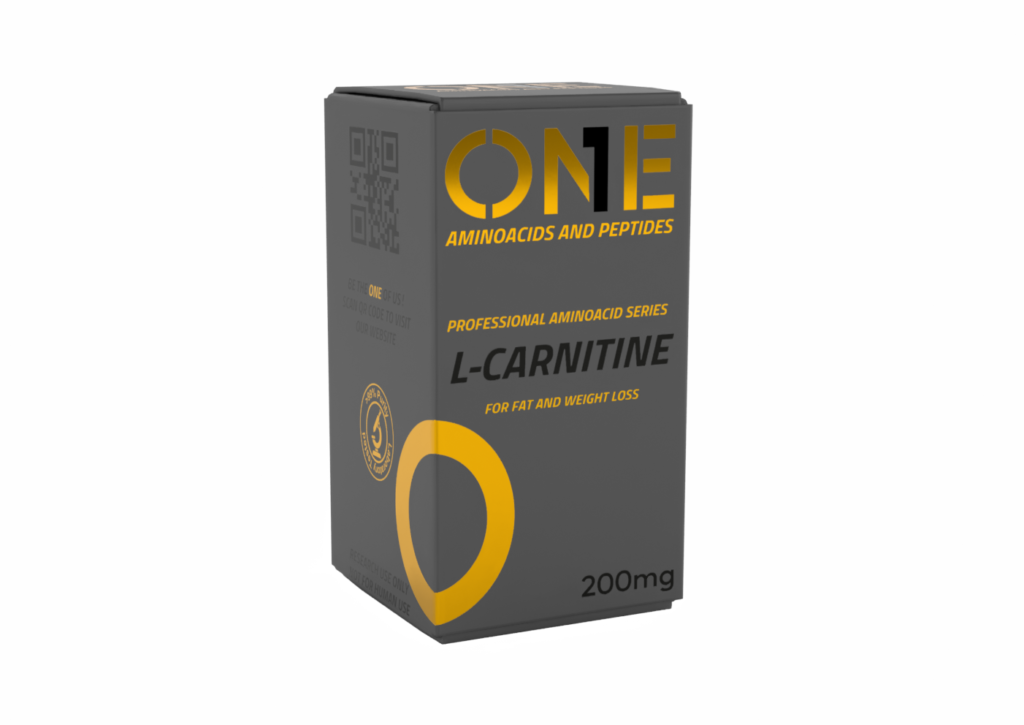
The One Peptides L-Carnitine 200 mg material is supplied in a form intended for use in biochemical and metabolic research.
L-Carnitine is an endogenous compound present in all mammalian tissues, with particularly high concentrations in skeletal muscles and the heart. The body synthesizes carnitine in the liver and kidneys, but a significant part also comes from the diet (mainly red meat).
| Stage | Enzyme | Substrate | Product |
|---|---|---|---|
| 1 | Methyltransferase | Lysine | ε-N-trimethyllysine |
| 2 | Hydroxylase | ε-N-TML | β-hydroxy-ε-N-TML |
| 3 | Aldolase | β-OH-ε-N-TML | γ-butyrobetainaldehyde |
| 4 | Dehydrogenase | Aldehyde | γ-butyrobetaine |
| 5 | γ-BB hydroxylase | γ-BB | L-Carnitine |
| Tissue | Concentration | % of Pool |
|---|---|---|
| Skeletal muscles | High | ~95% |
| Heart | High | ~2% |
| Liver | Average | ~1% |
| Kidneys | Average | <1% |
| Plasma | Low | <1% |
| Year | Event |
|---|---|
| 1905 | Muscle isolation (Gulewitsch, Krimberg) |
| 1927 | Determining the structure |
| 1955 | Discovery of a function in β-oxidation |
| 1973 | Characteristics of CPT (palmitoyltransferase) |
L-Carnitine is β-hydroxy-γ-trimethylaminobutyrate with one chiral center.
Scientific name (IUPAC):
(3R)-3-hydroxy-4-(trimethylazaniumyl)butanoate
| Parameter | Value |
|---|---|
| Summary formula | C7H15NO3 |
| Molar mass | 161.20 g/mol |
| CAS number | 541-15-1 |
| Appearance | White crystalline powder |
| Melting point | 197-212°C (decomposition) |
| pi | ~3.8 (zwitterjon) |
| Solubility in water | >2500 g/L (very good) |
| Configuration | (R) or L |
| Form | Zwitterjon |
| Isomer | Biological activity |
|---|---|
| L-Carnitine (R) | Biologically active |
| D-Carnitine (S) | Inactive, may inhibit L-form |
| Form | Anwendung |
|---|---|
| L-Carnitine (free) | Standard |
| L-Carnitine L-tartrate | Better stability |
| Acetyl-L-carnitine | Acetyl ester |
| Propionyl-L-carnitine | Propionyl ester |
HPLC:
– Detection at 210 nm or derivatization
– HILIC or C18 column with ion pair
– No strong UV absorption (requires derivatization for high sensitivity)
Solubility:
– Water: >2500 mg/ml (excellent)
– Water buffers: excellent
– Ethanol: moderate
– DMSO: okay
Recommendations:
1. Prepare fresh solutions
L-Carnitine is a key element of the carnitine cycle, enabling the transport of acyl-CoA across the mitochondrial membrane.
Cycle stages:
| Enzyme | Location | Function | Ki carnitine |
|---|---|---|---|
| CPT-1A | OMM (liver) | Synthesis of acylcarnitines | Regulated by malonyl-CoA |
| CPT-1B | OMM (muscles) | Synthesis of acylcarnitines | Less sensitive to malonyl-CoA |
| CACT | IMM | Transport | – |
| CPT-2 | IMM | Acyl-CoA regeneration | – |
L-carnitine tested for:
| Function | Mechanism |
|---|---|
| Acyl-CoA buffering | Binding of excess acyl groups |
| Detoxification | Removal of xenobiotics (as acylcarnitine) |
| CoA/acyl-CoA modulation | Regulation of intercourse |
| Antioxidant | Indirect (via metabolism) |
IMPORTANT: The product is intended for in vitro testing only. Not intended for:
– Use in humans or animals
– Therapeutic purposes
– Supplementation
L-Carnitine is an endogenous compound that plays a key role in the transport of long-chain fatty acids to the mitochondria. Its central role in energy metabolism makes it an indispensable tool in the study of cellular bioenergetics and lipid metabolism.
Material One Peptides L-Carnitine 200 mg offers:
L-Carnitine is an endogenous compound (C7H15NO3, mass 161.20 g/mol, CAS 541-15-1) necessary for the transport of long-chain fatty acids to the mitochondrial matrix. Enables β-oxidation of fatty acids and ATP production. It is synthesized from lysine and methionine mainly in the liver and kidneys.
The carnitine cycle is a mechanism for transporting acyl-CoA across mitochondrial membranes. It includes: (1) acyl group transfer to carnitine by CPT-1, (2) acylcarnitine transport by CACT translocase, (3) acyl-CoA regeneration by CPT-2. Free carnitine returns to the cytosol in the antiport.
Aqueous solutions can be stored at -20°C. Thanks to its excellent solubility in water (>2500 mg/ml), it is easy to prepare solutions with high concentrations.
L-carnitine (R configuration) is a biologically active form, recognized by enzymes and transporters. D-carnitine (S configuration) is inactive and can competitively inhibit the transport of the L-form. Therefore, only pure L-carnitine is used in research.
L-carnitine is used in in vitro studies on: mitochondrial bioenergetics, β-oxidation of fatty acids, kinetics of CPT enzymes, and as a tool for studying lipid metabolism in various types of cells. It is not intended for use on humans or animals.
The most important features of the ONE L-Carnitine 200 mg product:
 DHL Express
Have a question about this product? Ask it below. We publish questions together with our answer after review.
No questions yet. Be the first to ask.



Bewertungen
Es gibt noch keine Bewertungen.