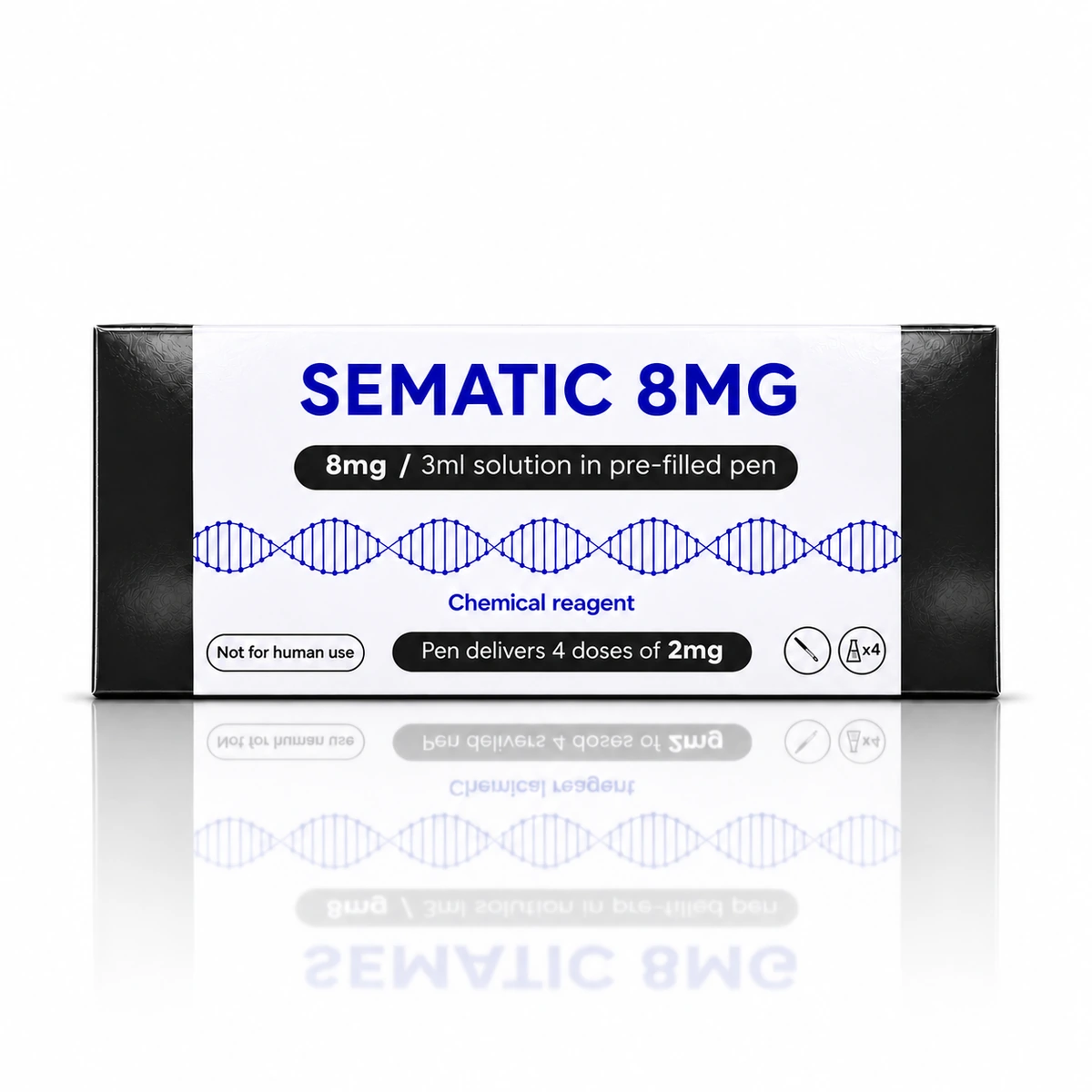
SEMATIC 8 mg PEN — semaglutide, a GLP-1 receptor monoagonist, in a pre-dissolved pen for laboratory testing. RUO reagent, HPLC ≥98%, independent laboratory. Higher peptide content (8 mg) for teams planning multiple replicates and dilution series. The pen format simplifies the workflow—no need to reconstitute a lyophilized powder.
One-Peptides SEMATIC 8 mg PEN — semaglutide in a pre-dissolved pen for laboratory research
SEMATIC 8 mg PEN (previously Sema G 8 mg PEN) is a research reagent (Research Use Only) in the form of a pre-dissolved pen. The active substance — semaglutide — is also on the market as a medicine authorised by the EMA and the FDA under the trade names Ozempic (type 2 diabetes) and Wegovy (obesity), likewise in a pen format. These two occurrences of the same peptide are two separate regulatory frames — the RUO pen in the One Peptides catalogue is not a medicine, is not intended for use in humans and is not subject to pharmaceutical regulation. The Novo Nordisk pen comes from EMA/FDA authorisation; the RUO pen comes from the chemical-reagent trade. The identity of the active substance does not remove this boundary.
Semaglutide is one of the most thoroughly clinically documented peptides of the past decade — a GLP-1 receptor monoagonist on which the entire modern landscape of incretin pharmacology is built. The reference literature includes the SUSTAIN programme (type 2 diabetes) and the STEP programme (obesity), with endpoints reported in the NEJM and the Lancet. The molecule was developed by Novo Nordisk, and it is that company which holds the authorisations for Ozempic, Wegovy and Rybelsus.
In the One Peptides catalogue, the same peptide appears within a separate regulatory frame — as a research reagent (RUO) in a pre-dissolved pen format with a content of 8 mg. The higher peptide content in the pen provides greater flexibility when planning dilution series and longer experimental protocols — a configuration for teams working with semaglutide across many replicates. The pen format simplifies laboratory work: it does not require lyophilisate reconstitution and allows precise drawing of the peptide under controlled conditions. A technical solution for researchers working with semaglutide in in vitro and in vivo models — not a medicinal form, not a therapeutic analogue for administration to humans.
What semaglutide is — sequence and class
Semaglutide is a GLP-1 receptor (GLP-1R) monoagonist — a stabilised analogue of the endogenous glucagon-like peptide 1. The molecule comprises 31 amino acids, with a molecular weight of around 4113 Da. Relative to human GLP-1, structural modifications were introduced that stabilise the peptide against enzymatic degradation and extend its half-life.
C18 fatty-acid acylation — the attached chain enables reversible binding to serum albumin. Albumin acts as a reservoir: the molecule circulates partly bound, and is gradually released and degraded. The result: a serum half-life of around 7 days (the once-weekly regimen in the Ozempic and Wegovy protocols).
The substance was developed by Novo Nordisk. FDA authorisations: Ozempic 2017 (T2 diabetes), Rybelsus 2019 (oral form), Wegovy 2021 (obesity). The EMA approved analogous indications in the EU.
Chemical characteristics
Parameter
Value
Pharmacological class
GLP-1 receptor (GLP-1R) monoagonist
Number of amino acids
31
Molecular weight
~4113 Da
Structural modifications
C18 fatty-acid acylation, reversible albumin binding
Serum half-life
~7 days (once-weekly regimen in the Ozempic/Wegovy clinical protocols)
Physical form
Pre-dissolved solution in a pen
Content in the pen
8 mg semaglutide
HPLC purity
≥98%
Mechanism of action in research
Activation of the GLP-1 receptor sets off a cascade of four complementary effects reported in the clinical and preclinical literature.
Glucose-dependent insulin secretion. In pancreatic β cells, activation of the G-protein-coupled GLP-1R increases cAMP, which potentiates insulin release in response to a glucose load. The mechanism is glucose-dependent — at normoglycaemia, insulin secretion is not significantly stimulated.
Suppression of glucagon secretion postprandially in pancreatic α cells — combined with insulin stimulation, this provides two-point control of postprandial glycaemia.
Central action — appetite modulation. GLP-1R in the arcuate nucleus of the hypothalamus mediates satiety signalling. Slowed gastric emptying additionally prolongs post-meal satiety.
The reference data come from Novo Nordisk research programmes: SUSTAIN (Marso et al. 2016, SUSTAIN-6 — cardiovascular endpoints in type 2 diabetes) and STEP (Wilding et al. 2021, STEP-1 — obesity; Davies et al. 2021, STEP-2 — obesity with type 2 diabetes). STEP-1 reported a mean body weight reduction of around 14.9% over 68 weeks of intervention with semaglutide 2.4 mg weekly vs placebo.
SEMATIC 8 mg PEN RUO vs pharmaceutical pen (Ozempic, Wegovy) — the fundamental difference
Feature
SEMATIC 8 mg PEN (RUO)
Ozempic Pen / Wegovy Pen (medicine)
Regulatory status
Research reagent (Research Use Only)
Authorised medicine (EMA, FDA)
Active substance
Semaglutide (the same peptide)
Semaglutide (the same peptide)
Manufacturer
One-Peptides (Joscur Limited)
Novo Nordisk
Documentation
HPLC report from an independent laboratory
Full EMA/FDA marketing-authorisation dossier
Indication
Laboratory research
Type 2 diabetes (Ozempic), obesity (Wegovy)
Sale
Chemical-reagent trade
Prescription only
Oversight
No medical oversight
Treating physician, pharmacovigilance
Label
“For research use only. Not for human use”
Full patient information leaflet
The active substance is the same (semaglutide), but the products come from two separate regulatory lines with different documentation and intended use. The Novo Nordisk pen is a medicinal product with a patient information leaflet, a Summary of Product Characteristics (SmPC) and EMA pharmacovigilance oversight. The RUO pen in the One Peptides catalogue is a chemical reagent with an HPLC report from an independent laboratory. The identity of the peptide does not remove the distinction between regulatory frames.
Applications in scientific research
SEMATIC 8 mg PEN as an RUO reagent finds use in several directions.
Pharmacology of the GLP-1 axis. Receptor-activity assays, GLP-1R selectivity profiling, EC50 measurements in cell cultures with cAMP and β-arrestin reporters. The 8 mg content in the pen makes it possible to prepare large pools of stock solutions for serial dilutions without reaching for another pen.
Animal models of insulin resistance and obesity. DIO mice, ob/ob and db/db models, Zucker rats. Endpoints: body weight, composition (DEXA, NMR), OGTT/ITT, HOMA-IR, lipid profile. Semaglutide serves as a reference GLP-1R monoagonist for comparisons with newer analogues.
Pharmacokinetics and central action on appetite. The PK profile of acylated GLP-1 analogues, albumin-binding kinetics, behavioural satiety models, activation of POMC neurons in the arcuate nucleus.
Comparative analyses with other GLP-1 analogues — liraglutide, dulaglutide, exenatide, tirzepatide (dual GLP-1R/GIPR), retatrutide (tri-agonist). Semaglutide as a reference monoagonist for SAR work.
One Peptides SEMATIC quality specification
The SEMATIC pen is tested by HPLC at an independent laboratory.
HPLC ≥98% — the main peak area is ≥98% of the total area (liquid chromatography with UV detection).
HPLC report from an independent laboratory (content and purity)
Working with the pre-dissolved pen in a laboratory protocol
The guidance below describes the technical handling of the pen in the context of a reagent for laboratory research. It does not constitute instructions for administration to humans or animals — the pen in the RUO trade is not a pharmaceutical form for injection in humans. The pen format is technical in nature: it provides a stable, pre-dissolved source of the peptide for further experimental work.
Pen content. The SEMATIC 8 mg PEN contains 8 mg of semaglutide pre-dissolved in 3 mL of solution (nominal concentration ~2.7 mg/mL).
Working with the pen. The solution is drawn with a laboratory syringe or a dispensing applicator with microlitre precision. The solution should be clear — turbidity, sediment or a colour change is a sign that the batch is not suitable for further work.
Working solutions. For in vitro receptor assays, the picomolar-to-nanomolar scale is standard. Working solutions are prepared by serial dilution in PBS at pH 7.4 or in buffers compatible with the specific experimental system.
Stability. Unopened pen: typically up to 24 months at 2–8°C, protected from light. After first opening: typically up to 28 days at 2–8°C. Avoid freeze–thaw cycles — acylated peptides are sensitive to thermal denaturation.
A peptide calculator makes it easier to convert the stock concentration from the pen into the desired working concentration when planning serial dilutions.
This is not an instruction for administration to humans. The clinical semaglutide regimens (Ozempic, Wegovy) described in the SmPC apply solely to the medicines authorised by Novo Nordisk — not to research reagents.
Regulatory status — SEMATIC 8 mg PEN, Ozempic, Wegovy
SEMATIC 8 mg PEN (this product) — a Research Use Only research reagent in the EU chemical-reagent trade. Label: “For research use only. Not for human use”. It is not a medicinal product, a dietary supplement or a foodstuff. It holds no EMA or FDA authorisation as a medicine.
Semaglutide as a medicine (Novo Nordisk):Ozempic — injection pen, type 2 diabetes (FDA 2017, EMA 2018); Wegovy — injection pen, obesity (FDA 2021, EMA 2022); Rybelsus — oral form, type 2 diabetes (FDA 2019).
Only the medicines authorised by Novo Nordisk have the status of a medicinal product. The SEMATIC 8 mg PEN RUO does not. The identity of the active substance (semaglutide) does not remove this distinction.
WADA. Semaglutide is not on the WADA Prohibited List (2026 and 2027 editions), but it is named in the WADA Monitoring Program, in and out of competition. The status may change in future editions — verifying the current guidance rests with the researcher.
Frequently asked questions
How does the SEMATIC 8 mg PEN RUO differ from Ozempic / Wegovy?
The active substance is the same — semaglutide. The differences concern the regulatory frame. The SEMATIC 8 mg PEN is a Research Use Only reagent with an HPLC report from an independent laboratory. Ozempic and Wegovy are Novo Nordisk medicines with a full EMA/FDA marketing-authorisation dossier, available on prescription only under medical supervision. The RUO pen is not a medicinal form.
Is the SEMATIC 8 mg PEN a weight-loss medicine?
No. It is an RUO reagent for laboratory research. The medicine authorised in the EU for the obesity indication is Wegovy (Novo Nordisk) — and only that product is subject to pharmaceutical regulation as a therapy.
Can I use the SEMATIC 8 mg PEN like Ozempic?
No. The RUO pen is not subject to pharmaceutical regulation and does not have a pharmaceutical-grade quality profile (GMP, injectable sterility, endotoxin control at the level required for medicines) — this is the analytical documentation of a reagent, not of a medicinal product. The clinical semaglutide regimens from the Ozempic and Wegovy SmPC apply only to the Novo Nordisk medicines.
How long does the pen retain activity after first opening?
Typically up to 28 days at 2–8°C from first draw. Avoid freeze–thaw cycles.
Does the SEMATIC 8 mg PEN require reconstitution?
No. The pen format is a pre-dissolved semaglutide solution — ready to draw with a syringe or applicator, without adding a solvent. This is a fundamental difference from lyophilisates in vials.
Is semaglutide on the WADA list?
No. Semaglutide is not on the WADA Prohibited List for 2026 or 2027, but it is named in the WADA Monitoring Program (in and out of competition). The status may change — verifying the guidance rests with the researcher.
Research Use Only chemical reagent. The SEMATIC 8 mg PEN in the One Peptides catalogue is not a medicinal product, a dietary supplement or a foodstuff. It is not intended for administration to humans or animals outside a controlled experimental environment. The SEMATIC 8 mg PEN RUO must not be confused with the semaglutide medicines authorised by Novo Nordisk — Ozempic, Wegovy, Rybelsus. The active substance is the same (semaglutide), but the RUO pen and the pharmaceutical pen come from two separate regulatory frames with different documentation and intended use. The information in this description is educational and scientific in character and refers to results reported in the literature — it does not constitute medical advice or instructions for administration.
Pharmacological review:MPharm Aneta Kropicka Pharmaceutical reviewer and sports supplementation expert.
Master of Pharmacy with 12 years of professional experience, graduate of the Medical University of Łódź (2014). Verifies One Peptides product content for pharmacology, clinical dosing, and regulatory compliance across RUO / dietary supplement / drug frameworks.
Operator: Joscur Limited · Room 511, Building 5/F, MING SANG IND BLDG, 19-21 Hing Yip Street, Kwun Tong, Hong Kong · Reg. no 77335383 · [email protected]
 EN
 DE
 ES






Jessica O. –
i love this on in pen!