 EN
EN  DE
DE  ES
ES  PL
PL 

A research-focused comparison of Melanotan II and PT-141, covering melanocortin receptor selectivity, evidence, safety signals and regulatory status.
At 25 your body produces growth hormone in amounts that maintain muscle, repair tissue, and deliver deep, restorative sleep. At 40 that production has halved. At 60 — it has dropped to a quarter. This is not a disease. It is physiology: each decade the pituitary releases less GH, and the consequences ripple through body composition, sleep quality, bone density, and repair capacity. For decades the only way to “top it up” was recombinant growth hormone — injections that cost a fortune and carried a load of side-effect risk. Then MK677 arrived: an oral molecule that does not deliver growth hormone from outside, but “asks” the pituitary to make it itself.
This article is educational and reviews the published scientific literature. The studies described were conducted in animal models or in vitro unless stated otherwise. This is not medical advice.
MK-677, also known as Ibutamoren, is an oral ghrelin mimetic — ghrelin being the “hunger hormone” produced mainly in the stomach. It was developed by Merck & Co. in the 1990s as a potential treatment for growth hormone deficiency, sarcopenia, and osteoporosis.
An important distinction: MK-677 is not a SARM. It does not bind the androgen receptor and does not modulate androgenic signaling. It is sometimes grouped with SARMs in research-reagent catalogs for classification convenience, but its mechanism is entirely different. MK-677 is a growth hormone secretagogue — a substance that stimulates endogenous (the body’s own) GH production.
Ghrelin — the “hunger hormone” — beyond appetite regulation also stimulates growth hormone release. When ghrelin binds the GHS-R1a receptor in the pituitary, the pituitary releases GH into the bloodstream. MK-677 mimics that signal — it binds the same receptor and triggers GH release, without delivering exogenous hormone.
More on the SARM and modulator context is available in the overview article: What SARMs are: mechanism, generations, and the state of the research.
The somatotropic axis (GH/IGF-1) is the hormonal system responsible for growth, repair, and metabolism. It works like a chain of command:
MK-677 plugs into this chain at the pituitary level, mimicking ghrelin. The effect? The pituitary releases GH in pulses — in a pattern close to the natural rhythm of secretion. That is a meaningful difference from exogenous GH (injections), which delivers a steady level of hormone, bypassing the physiological pulse.
The best analogy: exogenous GH is power from a backup generator — it works, but not in the way the wiring is designed for. MK677 is fixing the switch in the breaker panel — power flows from the grid (the pituitary), through the normal circuit, in the normal cycles.
The effects of pulsatile GH rise and the secondary IGF-1 rise observed in studies include:
MK-677 stands out in its category with a relatively rich evidence base — including human clinical trials.
A randomized, placebo-controlled study published in Annals of Internal Medicine. 65 healthy adults aged 60–81 received MK-677 (25 mg/day) or placebo for 12 months. Results: MK-677 increased GH and IGF-1 levels to values seen in healthy young adults. An increase in fat-free mass (FFM) was recorded, without a significant change in fat mass. Increases in fasting glucose and insulin were also noted — indicating a potential impact on insulin sensitivity.
This is a human clinical study — one of the strongest entries in the MK-677 literature.
A short-term study in healthy volunteers showed that MK-677 at 25 mg/day for 7 days reversed the negative nitrogen balance induced by caloric restriction. This effect suggests anti-catabolic properties — the capacity to protect muscle from breakdown under energy deficit. GH secretion increased by about 40% versus placebo.
One of the most intriguing MK-677 studies concerns its effect on sleep. Copinschi and colleagues showed that MK-677 lengthens REM sleep and slow-wave sleep (SWS) duration in healthy young men. The effect is consistent with physiology: GH is released mainly during deep sleep, and MK-677’s stimulation of the GH axis amplifies that natural mechanism.
For researchers in chronobiology and neuroendocrinology, this aspect of MK-677 — its effect on sleep architecture — is a distinct, fascinating line of exploration.
Interested in research reagents for studies on the GH/IGF-1 axis? Check MK-677 in the One-Peptides catalog — every batch with an HPLC certificate of analysis.
The Copinschi data deserve their own section, because they represent a unique point in the MK-677 research profile.
Slow-wave sleep (SWS) is the phase during which most repair processes happen: from muscle recovery, through memory consolidation, to “metabolite cleanup” in the brain (the glymphatic system). With age the proportion of slow-wave sleep declines — a 50-year-old spends about 60% less time in SWS than a 25-year-old.
MK-677, by stimulating pulsatile GH release, reinforces the natural nocturnal peak of growth hormone secretion. Studies have shown:
This is not a sleep-inducing effect in the classical sense — MK-677 does not act as a hypnotic. In polysomnographic studies it was associated with changes in sleep architecture: longer REM sleep and, in younger participants, longer deep (stage IV) sleep.
No substance is free of potential adverse effects. For MK-677, clinical trials observed the following:
The MK-677 safety profile in studies up to 12 months appears moderately favorable compared with exogenous GH. There are, however, no multi-year data.
| Feature | MK-677 (Ibutamoren) | Exogenous GH (rHGH) | GHRP-6 / GHRP-2 |
|---|---|---|---|
| Mechanism | Ghrelin mimetic (GHS-R1a) | Direct GH delivery | GHS-R1a stimulation (peptides) |
| Route of administration | Oral | Subcutaneous injection | Subcutaneous injection |
| GH pulsatility | Preserved (physiological) | None (constant level) | Preserved |
| Appetite effect | Significant (ghrelin) | Minimal | Moderate to significant |
| Cortisol effect | No significant rise | None | Moderate rise (GHRP-6) |
| Cost | Low (research reagent) | High (drug) | Medium (research reagent) |
| Convenience | Tablet/capsule | Daily injections | Multiple injections daily |
A detailed comparison of MK677 with HGH Fragment 176-191 — a lipolytic peptide that is a fragment of growth hormone — is covered in the article: MK-677 vs HGH Fragment — comparing the mechanisms.
Running research on growth hormone secretagogues? One-Peptides offers MK-677 and peptides from the GHRP family (including GHRP-2 and GHRP-6) — all with an HPLC certificate confirming purity ≥98%.
No. MK-677 (Ibutamoren) is an oral ghrelin mimetic — a growth hormone secretagogue. It does not bind the androgen receptor and does not affect androgenic signaling. It is sometimes grouped with SARMs for classification reasons, but its mechanism is entirely different.
Trial data indicate a GH rise within several hours of the first dose. IGF-1 builds up more slowly — it stabilizes after roughly 2-4 weeks of consistent dosing. Effects on body composition and sleep quality develop gradually over weeks to months.
Copinschi et al. (1997) showed that MK-677 lengthens slow-wave sleep (SWS) and REM sleep duration in healthy men. The effect is consistent with the physiology of GH secretion, whose peak occurs during deep sleep.
Yes — this is one of the most commonly reported effects in clinical trials. MK-677 mimics ghrelin (the hunger hormone), so appetite increase is a predictable consequence of the mechanism. The effect is often strongest in the first weeks.
MK677 stimulates endogenous (the body’s own) GH production by the pituitary — preserving the physiological pulse of secretion. Exogenous GH (injections) delivers hormone from outside in a continuous fashion, bypassing the natural pulsatile rhythm. Also, MK-677 is administered orally, while rHGH requires injection.
More articles from this cluster: SARMs & modulators category.
MK-677 is not a SARM, but it is often discussed alongside SARMs — see how SARMs work.

A research-focused comparison of Melanotan II and PT-141, covering melanocortin receptor selectivity, evidence, safety signals and regulatory status.
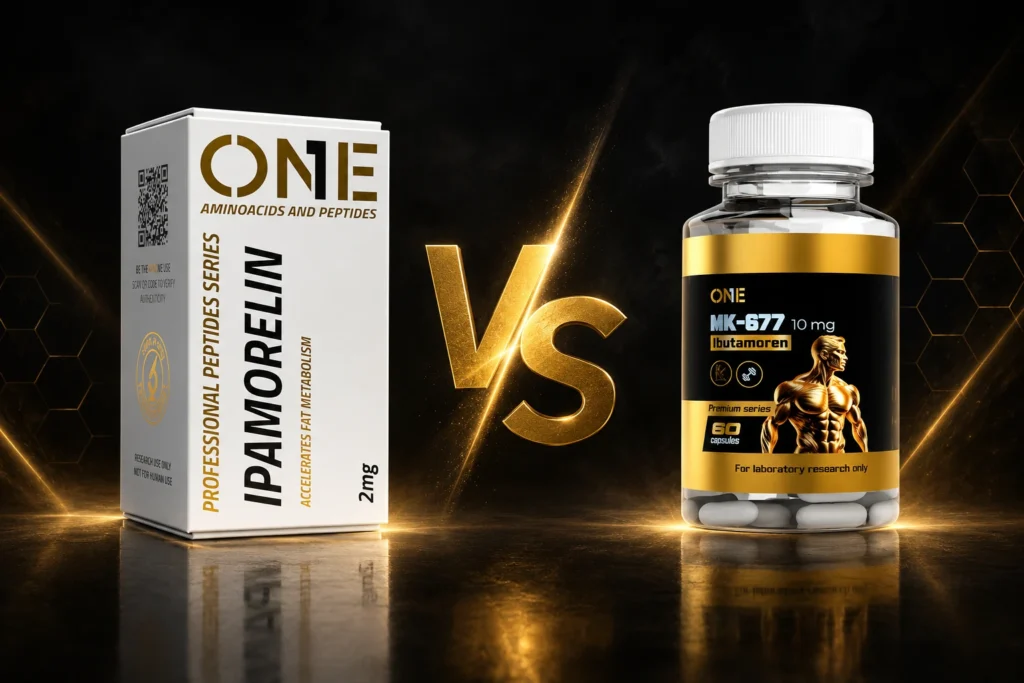
A research comparison of MK-677 and ipamorelin, focusing on GHS-R1a signaling, selectivity, administration route, human evidence and WADA status.
