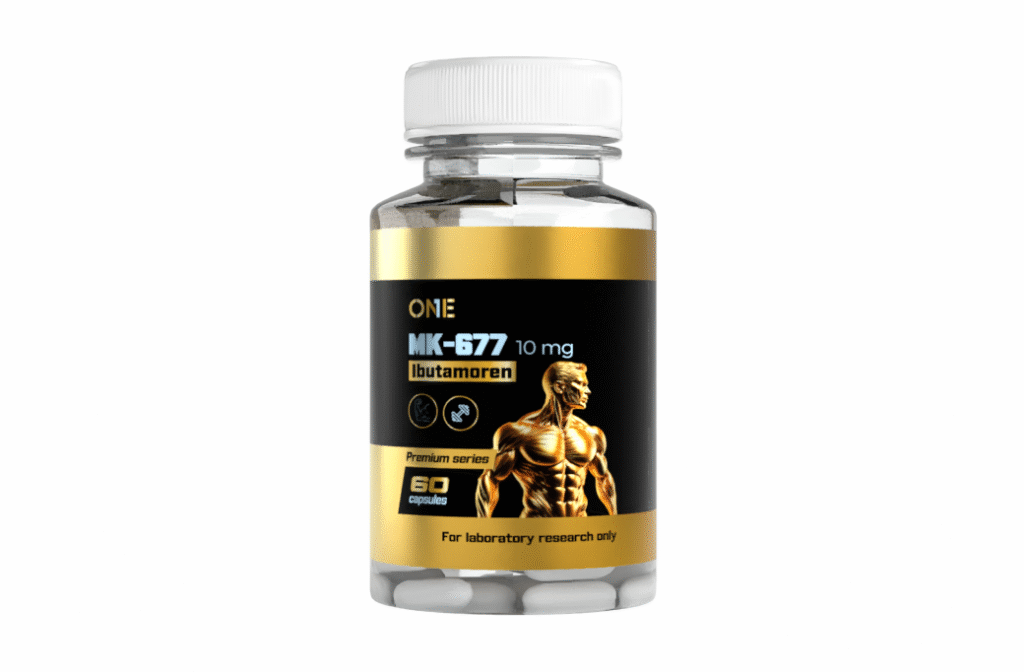
SARMs and Modulators — Research Reagents (Research Use Only)
The compounds in this category are chemical reagents intended solely for laboratory research (Research Use Only). They span two families: SARMs proper, which act through the androgen receptor, and modulators with other molecular targets (PPARδ, the ghrelin receptor, Rev-Erbα). They are not dietary supplements, medicinal products or products intended for human use.
Research Use Only. Products in this category are chemical substances for laboratory and scientific applications. They are not dietary supplements, medicinal products or foodstuffs. They are not intended for consumption or administration to humans or animals, and they do not serve to support training, physique or physical condition. The descriptions refer to pharmacology and to findings reported in the literature — they do not constitute advice or instructions for use.
What SARMs Are — the Androgen Receptor Mechanism
A SARM (selective androgen receptor modulator) belongs to a class of compounds that bind to the androgen receptor (AR) — the same protein activated by testosterone. The difference concerns what happens after binding.
Once bound to the receptor, testosterone triggers a broad transcriptional programme — in muscle and bone, but also in the prostate, the skin and the hair follicles. SARMs induce a different conformational change in the receptor, and in preclinical models this leads to the recruitment of a different set of cofactors. The effect reported in studies is tissue selectivity: activity in muscle and bone tissue alongside relatively weaker action on androgenic tissues.
The values describing this selectivity (the anabolic-to-androgenic ratio) are parameters dependent on the model and the method, not physical constants of the compound. Critical reviews of the class point out that translating the selectivity observed in models into fully predictable effects remains a subject of research, and that the evidence base for SARMs has substantial limitations.
Two Families in One Category — Named Correctly
Commercially these compounds sit side by side; mechanistically they belong to different classes. The distinction matters when selecting a reagent for a study — hence they are named here as the literature names them, not as it would be convenient to sell them.
Family I — SARMs proper (target: the androgen receptor, AR). In the catalogue: ostarine. The class also includes LGD-4033, Andarine, RAD-140 and YK-11, which we do not currently offer.
Family II — modulators with other molecular targets. They are sometimes grouped with SARMs, yet they are not SARMs and do not bind to the androgen receptor:
- Cardarine (GW-501516) — a PPARδ agonist, studied in the context of fatty acid metabolism and aerobic capacity in animal models.
- MK-677 (Ibutamoren) — a ghrelin mimetic and growth hormone secretagogue acting through the GHS-R1a receptor in the pituitary; studies have reported increases in GH and IGF-1 levels.
- SR-9009 (Stenabolic) — a Rev-Erbα agonist, linked to the regulation of circadian rhythm and metabolism.
A shared marketing denominator is not a shared pharmacological one.
Compounds in This Category
SARMs (Androgen Receptor)
- Ostarine (MK-2866, enobosarm) — the best-studied SARM in the literature and the only one with data from phase III clinical trials (the POWER programme, cancer cachexia). Its research value rests not on claimed potency but on the quality and reproducibility of the data.
The other SARMs are not currently in the catalogue. Their mechanism, state of research and safety profile are described in the articles: LGD-4033 (Ligandrol), Andarine (S4), RAD-140 (Testolone) and YK-11.
Modulators (Other Molecular Targets)
- Cardarine (GW-501516) — a PPARδ agonist. Its safety profile includes a carcinogenicity signal in long-term rodent studies, and on that basis clinical development of the compound was halted. Stated here openly. Details in the GW-501516 (Cardarine) category.
- MK-677 (Ibutamoren) — a growth hormone secretagogue with a relatively rich base of human studies. Its mechanism and the state of the research are developed in the dedicated MK-677 product page and in a separate knowledge-base article.
- SR-9009 (Stenabolic) — a Rev-Erbα agonist. The literature draws attention to its low oral bioavailability in animal models, which limits the interpretation of some reports.
The context of the class as a whole — the androgen receptor mechanism, the history of SARM development and the state of the evidence — is set out in the overview guide SARMs — what they are, how they work and what the science says.
What Is Studied in This Category
The lines of enquiry below describe what is under investigation — not effects promised to a buyer.
- Models of muscle mass loss — cancer cachexia and sarcopenia: endpoints relating to lean body mass and physical function.
- Bone tissue — mineral density and strength parameters in animal models.
- Tissue selectivity — characterisation of AR binding and cofactor recruitment in in vitro systems.
- Metabolic pathways — PPARδ, Rev-Erbα and the GH–IGF-1 axis in animal and cell models.
Safety — What Has Been Reported in the Literature
A sound picture of this category also takes in the warning signals. Studies and clinical reports have described:
- Suppression of endogenous testosterone (SARMs) — described as reversible over the horizon of the studies, with severity depending on the compound.
- Changes in the lipid profile — a fall in the HDL fraction, described as an effect characteristic of the SARM class.
- Hepatotoxicity signals (DILI) — case reports of drug-induced liver injury for some of the compounds (RAD-140 and LGD-4033 among them).
- Visual disturbance — xanthopsia reported for Andarine, described as reversible.
- A carcinogenicity signal — for cardarine (GW-501516) in long-term rodent studies.
- No data on long-term safety — the longest clinical trials in this group ran for a dozen or so weeks. The long-term risk profile remains unknown.
No SARM or modulator in this category has obtained marketing authorisation as a medicinal product — neither from the EMA nor from the FDA.
Capsule Form — Working with the Reagent
Reagents in this category are supplied in capsule form. The capsule is no more than a packaging format for research material — portioning into repeatable units simplifies batch record-keeping and analytical work.
The capsule form does not change the status of the reagent. Packaging in capsules is a technical solution, not a suggestion of purpose. Compounds in this category remain chemical reagents for laboratory research use only (Research Use Only) and are not intended for consumption by humans or animals.
The capsule form requires no reconstitution and no preparation of a working solution. The amount of substance per unit and its purity are tested by HPLC at an independent laboratory.
Reagent Quality
- HPLC purity ≥98% — confirmed by liquid chromatography.
- HPLC report from an independent laboratory (content and purity)
- Batch number on the label and on the invoice.
- Storage — in the original packaging, in a dry and cool place, away from light and moisture.
Regulatory Status and WADA
Compounds in this category are chemical reagents with Research Use Only status. They are not dietary supplements, medicinal products or foodstuffs; they are not intended for human use, nor for any application outside a controlled research setting.
Anti-doping status — the World Anti-Doping Agency prohibits both families, under different categories of the list:
- SARMs (ostarine, LGD-4033, Andarine, RAD-140, YK-11) — category S1 (anabolic agents), prohibited at all times.
- MK-677 (Ibutamoren) — category S2 (peptide hormones, growth factors — growth hormone secretagogues).
- Cardarine (GW-501516) and SR-9009 — category S4 (hormone and metabolic modulators).
Sensitive methods for detecting these compounds and their metabolites have been developed. Athletes subject to anti-doping testing should check the current WADA guidance.
 EN
 DE
 ES